

Level 1 – Case 7
44
(CO) 5 Cr
Ph
OEt
EtOH
NaBH 4
EtOH
NaBD 4
NaBH 4
CD 3 OD
EtO
Ph
EtO
Ph
D D
EtO
Ph
D
D
3
9
10
11
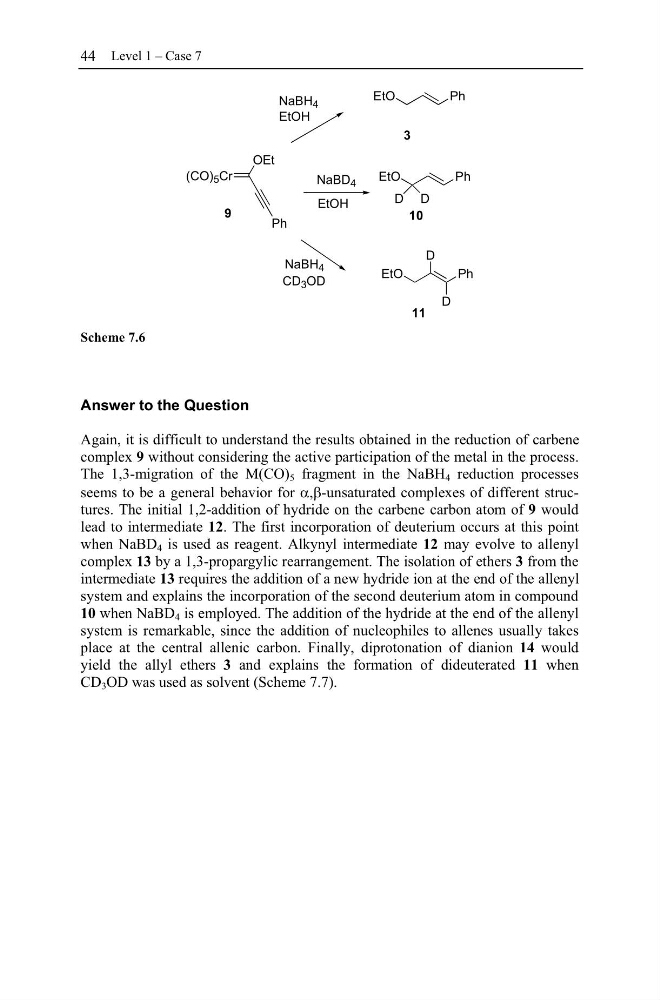
Scheme 7.6
Answer to the Question
Again, it is difficult to understand the results obtained in the reduction of carbene
complex 9 without considering the active participation of the metal in the process.
The 1,3-migration of the M(CO) 5 fragment in the NaBH 4 reduction processes
seems to be a general behavior for D,E-unsaturated complexes of different structures. The initial 1,2-addition of hydride on the carbene carbon atom of 9 would
lead to intermediate 12. The first incorporation of deuterium occurs at this point
when NaBD 4 is used as reagent. Alkynyl intermediate 12 may evolve to allenyl
complex 13 by a 1,3-propargylic rearrangement. The isolation of ethers 3 from the
intermediate 13 requires the addition of a new hydride ion at the end of the allenyl
system and explains the incorporation of the second deuterium atom in compound
10 when NaBD 4 is employed. The addition of the hydride at the end of the allenyl
system is remarkable, since the addition of nucleophiles to allenes usually takes
place at the central allenic carbon. Finally, diprotonation of dianion 14 would
yield the allyl ethers 3 and explains the formation of dideuterated 11 when
CD 3 OD was used as solvent (Scheme 7.7).
44
(CO) 5 Cr
Ph
OEt
EtOH
NaBH 4
EtOH
NaBD 4
NaBH 4
CD 3 OD
EtO
Ph
EtO
Ph
D D
EtO
Ph
D
D
3
9
10
11
Scheme 7.6
Answer to the Question
Again, it is difficult to understand the results obtained in the reduction of carbene
complex 9 without considering the active participation of the metal in the process.
The 1,3-migration of the M(CO) 5 fragment in the NaBH 4 reduction processes
seems to be a general behavior for D,E-unsaturated complexes of different structures. The initial 1,2-addition of hydride on the carbene carbon atom of 9 would
lead to intermediate 12. The first incorporation of deuterium occurs at this point
when NaBD 4 is used as reagent. Alkynyl intermediate 12 may evolve to allenyl
complex 13 by a 1,3-propargylic rearrangement. The isolation of ethers 3 from the
intermediate 13 requires the addition of a new hydride ion at the end of the allenyl
system and explains the incorporation of the second deuterium atom in compound
10 when NaBD 4 is employed. The addition of the hydride at the end of the allenyl
system is remarkable, since the addition of nucleophiles to allenes usually takes
place at the central allenic carbon. Finally, diprotonation of dianion 14 would
yield the allyl ethers 3 and explains the formation of dideuterated 11 when
CD 3 OD was used as solvent (Scheme 7.7).