

NaBH 4 Reduction of DE-Unsaturated Chromium Carbene Complexes 43
H
+
H
–
[Cr]
OEt
Ph
H
H
OEt
Ph
H
–
[Cr]
OEt
Ph
Ph
EtO
H H
H
+
H
H
Ph
[Cr]
EtO
H
H
H
Ph
H
EtO
H
H
H
Ph
[Cr]
EtO
H
1,3-migration
2
minor product
major product
1
3
H labeled position with NaBD 4
H labeled position with CD 3 OD
7
8
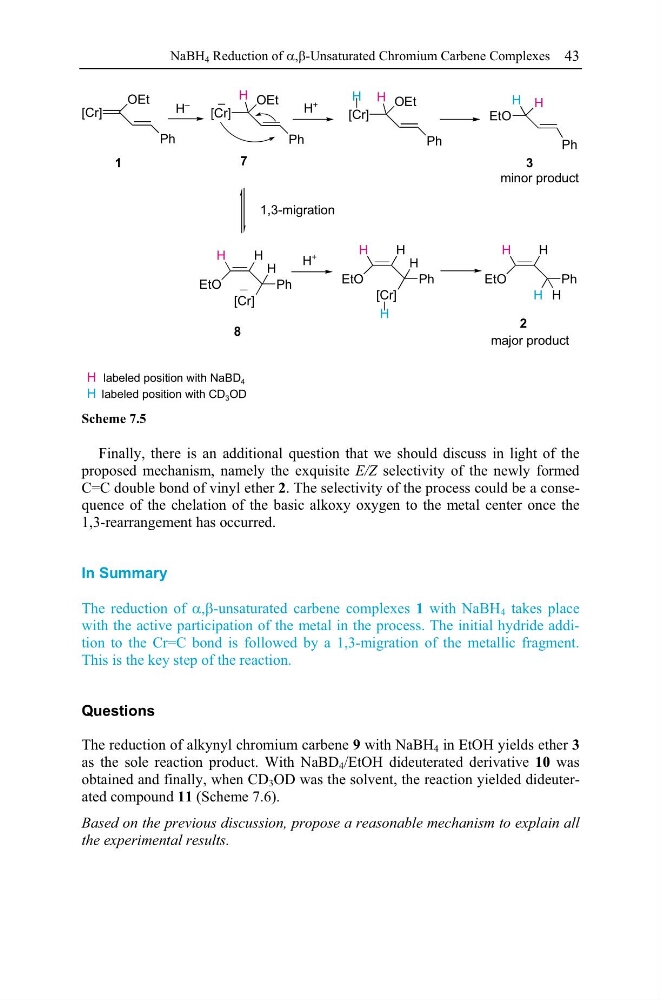
Scheme 7.5
Finally, there is an additional question that we should discuss in light of the
proposed mechanism, namely the exquisite E/Z selectivity of the newly formed
Z
C=C double bond of vinyl ether 2. The selectivity of the process could be a consequence of the chelation of the basic alkoxy oxygen to the metal center once the
1,3-rearrangement has occurred.
In Summary
The reduction of DE-unsaturated carbene complexes 1 with NaBH 4 takes place
with the active participation of the metal in the process. The initial hydride addition to the Cr=C bond is followed by a 1,3-migration of the metallic fragment.
This is the key step of the reaction.
Questions
The reduction of alkynyl chromium carbene 9 with NaBH 4 in EtOH yields ether 3
as the sole reaction product. With NaBD 4 /EtOH dideuterated derivative 10 was
obtained and finally, when CD 3 OD was the solvent, the reaction yielded dideuterated compound 11 (Scheme 7.6).
Based on the previous discussion, propose a reasonable mechanism to explain all
the experimental results.
H
+
H
–
[Cr]
OEt
Ph
H
H
OEt
Ph
H
–
[Cr]
OEt
Ph
Ph
EtO
H H
H
+
H
H
Ph
[Cr]
EtO
H
H
H
Ph
H
EtO
H
H
H
Ph
[Cr]
EtO
H
1,3-migration
2
minor product
major product
1
3
H labeled position with NaBD 4
H labeled position with CD 3 OD
7
8
Scheme 7.5
Finally, there is an additional question that we should discuss in light of the
proposed mechanism, namely the exquisite E/Z selectivity of the newly formed
Z
C=C double bond of vinyl ether 2. The selectivity of the process could be a consequence of the chelation of the basic alkoxy oxygen to the metal center once the
1,3-rearrangement has occurred.
In Summary
The reduction of DE-unsaturated carbene complexes 1 with NaBH 4 takes place
with the active participation of the metal in the process. The initial hydride addition to the Cr=C bond is followed by a 1,3-migration of the metallic fragment.
This is the key step of the reaction.
Questions
The reduction of alkynyl chromium carbene 9 with NaBH 4 in EtOH yields ether 3
as the sole reaction product. With NaBD 4 /EtOH dideuterated derivative 10 was
obtained and finally, when CD 3 OD was the solvent, the reaction yielded dideuterated compound 11 (Scheme 7.6).
Based on the previous discussion, propose a reasonable mechanism to explain all
the experimental results.