

Level 1 – Case 6
36
Are these species formed in the reaction of epoxides 1 and 2 with Me 3 Al? We
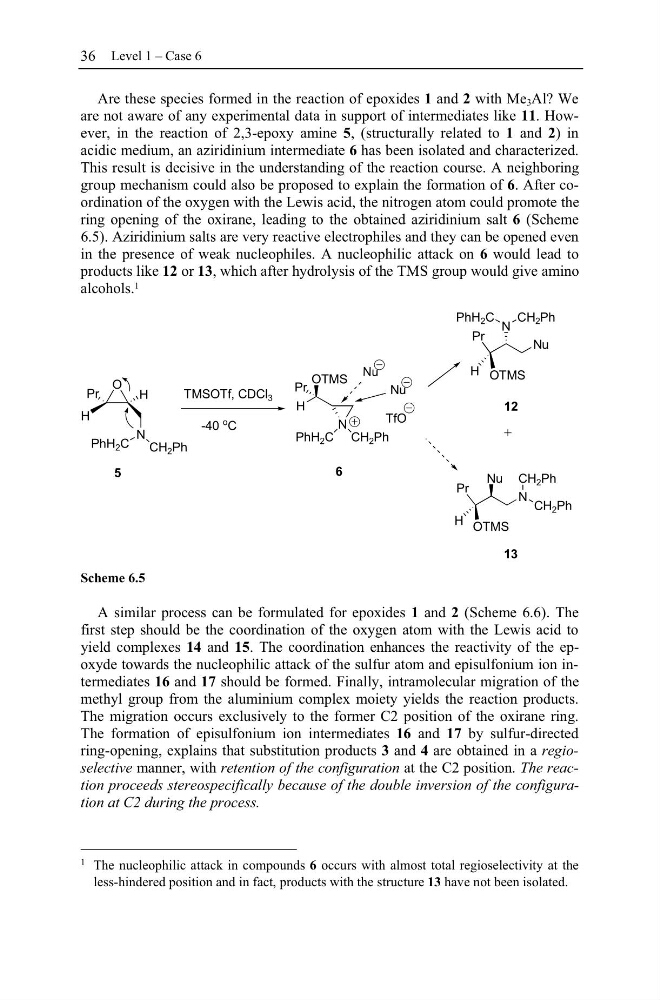
are not aware of any experimental data in support of intermediates like 11. However, in the reaction of 2,3-epoxy amine 5, (structurally related to 1 and 2) in
acidic medium, an aziridinium intermediate 6 has been isolated and characterized.
This result is decisive in the understanding of the reaction course. A neighboring
group mechanism could also be proposed to explain the formation of 6. After coordination of the oxygen with the Lewis acid, the nitrogen atom could promote the
ring opening of the oxirane, leading to the obtained aziridinium salt 6 (Scheme
6.5). Aziridinium salts are very reactive electrophiles and they can be opened even
in the presence of weak nucleophiles. A nucleophilic attack on 6 would lead to
products like 12 or 13, which after hydrolysis of the TMS group would give amino
alcohols.
1
O
H
H
Pr
N
CH 2 Ph
PhH 2 C
H
OTMS
Pr
N
CH 2 Ph
PhH 2 C
TfO
Pr
Nu
N
CH 2 Ph
PhH 2 C
OTMS
H
Pr
OTMS
H
Nu
N
CH 2 Ph
CH 2 Ph
5
TMSOTf, CDCl 3
-40
o C
6
Nu
12
Nu
13
A similar process can be formulated for epoxides 1 and 2 (Scheme 6.6). The
first step should be the coordination of the oxygen atom with the Lewis acid to
yield complexes 14 and 15. The coordination enhances the reactivity of the epoxyde towards the nucleophilic attack of the sulfur atom and episulfonium ion intermediates 16 and 17 should be formed. Finally, intramolecular migration of the
methyl group from the aluminium complex moiety yields the reaction products.
The migration occurs exclusively to the former C2 position of the oxirane ring.
The formation of episulfonium ion intermediates 16 and 17
d
by sulfur-directed
ring-opening, explains that substitution products 3 and 4 are obtained in a regioselective manner, with retention of the configuration at the C2 position. The reaction proceeds stereospecifically because of the double inversion of the configuration at C2 during the process.
1 The nucleophilic attack in compounds 6 occurs with almost total regioselectivity at the
less-hindered position and in fact, products with the structure 13 have not been isolated.
36
Are these species formed in the reaction of epoxides 1 and 2 with Me 3 Al? We
are not aware of any experimental data in support of intermediates like 11. However, in the reaction of 2,3-epoxy amine 5, (structurally related to 1 and 2) in
acidic medium, an aziridinium intermediate 6 has been isolated and characterized.
This result is decisive in the understanding of the reaction course. A neighboring
group mechanism could also be proposed to explain the formation of 6. After coordination of the oxygen with the Lewis acid, the nitrogen atom could promote the
ring opening of the oxirane, leading to the obtained aziridinium salt 6 (Scheme
6.5). Aziridinium salts are very reactive electrophiles and they can be opened even
in the presence of weak nucleophiles. A nucleophilic attack on 6 would lead to
products like 12 or 13, which after hydrolysis of the TMS group would give amino
alcohols.
1
O
H
H
Pr
N
CH 2 Ph
PhH 2 C
H
OTMS
Pr
N
CH 2 Ph
PhH 2 C
TfO
Pr
Nu
N
CH 2 Ph
PhH 2 C
OTMS
H
Pr
OTMS
H
Nu
N
CH 2 Ph
CH 2 Ph
5
TMSOTf, CDCl 3
-40
o C
6
Nu
12
Nu
13
A similar process can be formulated for epoxides 1 and 2 (Scheme 6.6). The
first step should be the coordination of the oxygen atom with the Lewis acid to
yield complexes 14 and 15. The coordination enhances the reactivity of the epoxyde towards the nucleophilic attack of the sulfur atom and episulfonium ion intermediates 16 and 17 should be formed. Finally, intramolecular migration of the
methyl group from the aluminium complex moiety yields the reaction products.
The migration occurs exclusively to the former C2 position of the oxirane ring.
The formation of episulfonium ion intermediates 16 and 17
d
by sulfur-directed
ring-opening, explains that substitution products 3 and 4 are obtained in a regioselective manner, with retention of the configuration at the C2 position. The reaction proceeds stereospecifically because of the double inversion of the configuration at C2 during the process.
1 The nucleophilic attack in compounds 6 occurs with almost total regioselectivity at the
less-hindered position and in fact, products with the structure 13 have not been isolated.