

Stereospecific Substitution Reactions of Epoxy Sulfides
35
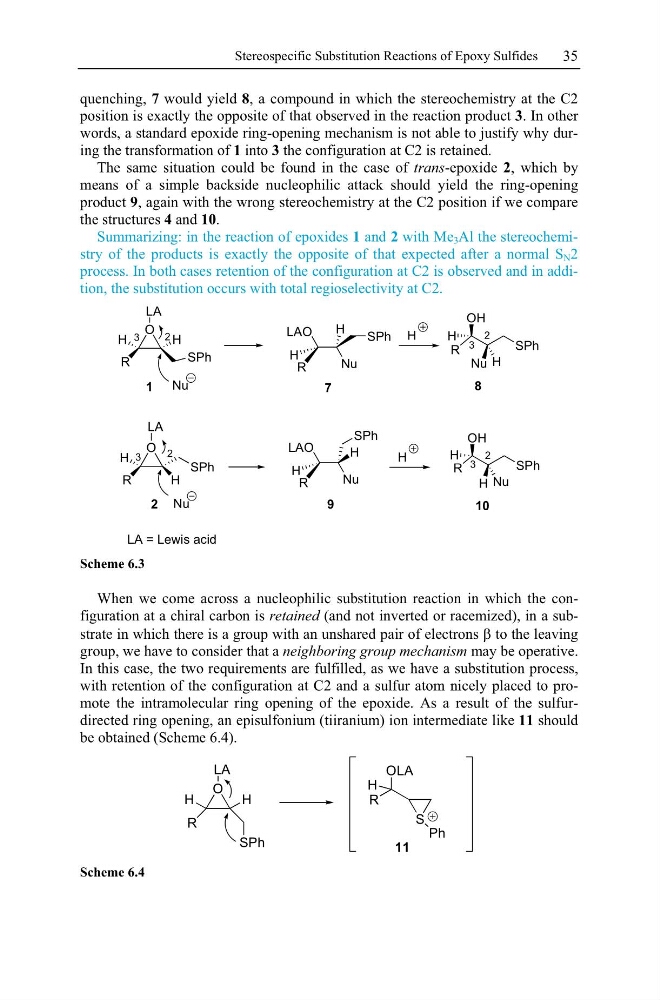
quenching, 7 would yield 8, a compo m und in which th t e stereochemistry at the C2
position is exactly the opposite of th t at observed in th t e reaction produ d ct 3. In other t
words, a standard epoxide ring-opening mechanism is not ab a le to justify why during the t transfo f f rm r ation of 1 into 3 the configuration at C2 is retained.
The same situation could be found in the case of trans-epoxide 2, which by
means of a simp m le backside nucleophilic attack should yield the ring-opening
product 9, again with the wrong stereochemistry at the C2 position if we comp m are
the structures 4 and 10.
Summarizing: in the reaction of epoxides 1 and 2 with Me 3 Al the stereochemistry of the products is exactly the opposite of that expected after a normal S N 2
process. In both cases retention of the configuration at C2 is observed and in addition, the substitution occurs with total regioselectivity at C2.
O
SPh
R
H
H
LA
O
R
SPh
H
H
LA
LAO
Nu
R
H
H
SPh
LAO
Nu
R
H
H
SPh
R
SPh
OH
Nu H
SPh
OH
H Nu
1
2
Nu
LA = Lewis acid
8
9
Nu
10
2
3
2
3
2
3
3
2
H
H
H
Scheme 6.3
When we come across a nucleophilic substitution reaction in which the configuration at a chiral carbon is retained (and not inverted or racemized), in a subd
strate in which there is a group with an unshared pair of electrons E to the leaving
group, we have to consider that a neighboring group mechanism may be operative.
In this case, the two requirements are fulfilled, as we have a substitution process,
f f
with retention of the configuration at C2 and a sulfur atom nicely placed to promote the intramolecular ring opening of the epoxide. As a result of the sulfurdirected ring opening, an episulfonium (tiiranium) ion intermediate like 11 should
be obtained (Scheme 6.4).
O
R
H
H
SPh
LA
R
OLA
H
S
Ph
11
Scheme 6.4
35
quenching, 7 would yield 8, a compo m und in which th t e stereochemistry at the C2
position is exactly the opposite of th t at observed in th t e reaction produ d ct 3. In other t
words, a standard epoxide ring-opening mechanism is not ab a le to justify why during the t transfo f f rm r ation of 1 into 3 the configuration at C2 is retained.
The same situation could be found in the case of trans-epoxide 2, which by
means of a simp m le backside nucleophilic attack should yield the ring-opening
product 9, again with the wrong stereochemistry at the C2 position if we comp m are
the structures 4 and 10.
Summarizing: in the reaction of epoxides 1 and 2 with Me 3 Al the stereochemistry of the products is exactly the opposite of that expected after a normal S N 2
process. In both cases retention of the configuration at C2 is observed and in addition, the substitution occurs with total regioselectivity at C2.
O
SPh
R
H
H
LA
O
R
SPh
H
H
LA
LAO
Nu
R
H
H
SPh
LAO
Nu
R
H
H
SPh
R
SPh
OH
Nu H
SPh
OH
H Nu
1
2
Nu
LA = Lewis acid
8
9
Nu
10
2
3
2
3
2
3
3
2
H
H
H
Scheme 6.3
When we come across a nucleophilic substitution reaction in which the configuration at a chiral carbon is retained (and not inverted or racemized), in a subd
strate in which there is a group with an unshared pair of electrons E to the leaving
group, we have to consider that a neighboring group mechanism may be operative.
In this case, the two requirements are fulfilled, as we have a substitution process,
f f
with retention of the configuration at C2 and a sulfur atom nicely placed to promote the intramolecular ring opening of the epoxide. As a result of the sulfurdirected ring opening, an episulfonium (tiiranium) ion intermediate like 11 should
be obtained (Scheme 6.4).
O
R
H
H
SPh
LA
R
OLA
H
S
Ph
11
Scheme 6.4