

Level 1 – Case 5
32
O
C 6 D 5
D D
Cl 3 SnO
3 SnO
H
O
C 6 D 5
Cl 3 SnO
H
6 D 5
Cl 3 SnO D
D
H
O
H
O
C 6 H 5
Cl 3 SnO
H
H
H
C 6 H 5
Cl 3 SnO D
D
H
O
O
C 6 H 5
H
H
SnCl 4
O
O
C 6 D 5
D D
H
H
O
SnCl 4
Cl
Cl
O
C 6 H 5
Cl
Cl
Cl
DCM
-30
o C
cis-13
18
DCM
-30
o
C
cis i i -11
21
17
19
20
22
23
24
Scheme 5.7
In Summary
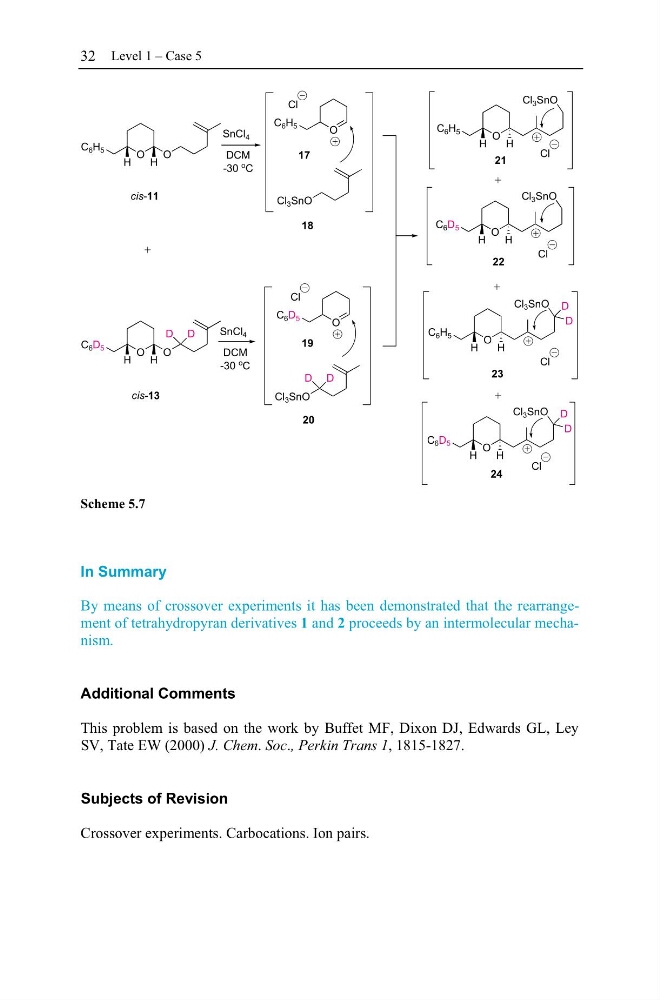
By means of crossover experiments it has been demonstrated that the rearrangement of tetrahydropyran derivatives 1 and 2 proceeds by an intermolecular mechanism.
Additional Comments
This problem is based on the work by Buffet MF, Dixon DJ, Edwards GL, Ley
SV, Tate EW (2000) J. Chem. Soc., Perkin Trans 1, 1815-1827.
Subjects of Revision
Crossover experiments. Carbocations. Ion pairs.
32
O
C 6 D 5
D D
Cl 3 SnO
3 SnO
H
O
C 6 D 5
Cl 3 SnO
H
6 D 5
Cl 3 SnO D
D
H
O
H
O
C 6 H 5
Cl 3 SnO
H
H
H
C 6 H 5
Cl 3 SnO D
D
H
O
O
C 6 H 5
H
H
SnCl 4
O
O
C 6 D 5
D D
H
H
O
SnCl 4
Cl
Cl
O
C 6 H 5
Cl
Cl
Cl
DCM
-30
o C
cis-13
18
DCM
-30
o
C
cis i i -11
21
17
19
20
22
23
24
Scheme 5.7
In Summary
By means of crossover experiments it has been demonstrated that the rearrangement of tetrahydropyran derivatives 1 and 2 proceeds by an intermolecular mechanism.
Additional Comments
This problem is based on the work by Buffet MF, Dixon DJ, Edwards GL, Ley
SV, Tate EW (2000) J. Chem. Soc., Perkin Trans 1, 1815-1827.
Subjects of Revision
Crossover experiments. Carbocations. Ion pairs.