

Rearrangements from Tetrahydropyran Derivatives
31
O
O
C 6 H 5
H
H
O
SnCl 4
O
O
C 6 D 5
D D
H
H
O
Cl 4
O
C 6 H 5
O
SnCl 4
O
C 6 D 5
O
D
D
Cl 4 Sn
C 6 H 5
H
H
O
O
SnCl 3
D
D
O
C 6 D 5
H
H
O
O
C 6 D 5
H
H
O
D
D
O
O
C 6 H 5
H
H
O
O
SnCl 3
Cl
Cl
cis-11
cis-13
14
DCM
-30
o
C
DCM
-30
o C
12
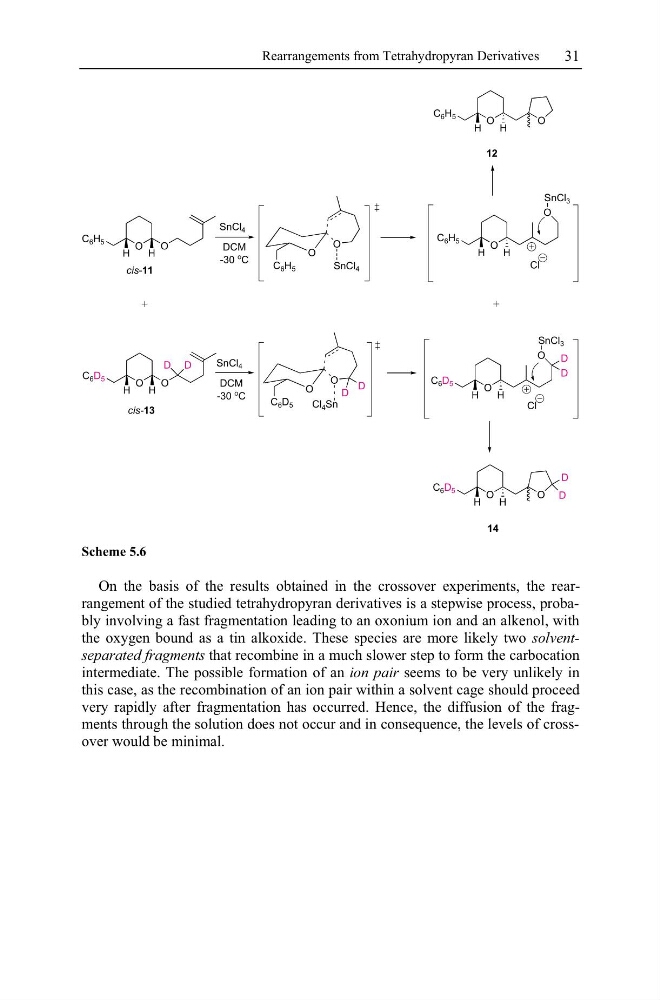
Scheme 5.6
On the basis of the results obtained in the crossover experiments, the rearrangement of the studied tetrahydropyran derivatives is a stepwise process, probably involving a fast fragmentation leading to an oxonium ion and an alkenol, with
the oxygen bound as a tin alkoxide. These species are more likely two solventseparated fragments that recombine in a much slower step to form the carbocation
intermediate. The possible formation of an ion pair seems to be very unlikely in
r
this case, as the recombination of an ion pair within a solvent cage should proceed
very rapidly after fragmentation has occurred. Hence, the diffusion of the fragments through the solution does not occur and in consequence, the levels of crossover would be minimal.
31
O
O
C 6 H 5
H
H
O
SnCl 4
O
O
C 6 D 5
D D
H
H
O
Cl 4
O
C 6 H 5
O
SnCl 4
O
C 6 D 5
O
D
D
Cl 4 Sn
C 6 H 5
H
H
O
O
SnCl 3
D
D
O
C 6 D 5
H
H
O
O
C 6 D 5
H
H
O
D
D
O
O
C 6 H 5
H
H
O
O
SnCl 3
Cl
Cl
cis-11
cis-13
14
DCM
-30
o
C
DCM
-30
o C
12
Scheme 5.6
On the basis of the results obtained in the crossover experiments, the rearrangement of the studied tetrahydropyran derivatives is a stepwise process, probably involving a fast fragmentation leading to an oxonium ion and an alkenol, with
the oxygen bound as a tin alkoxide. These species are more likely two solventseparated fragments that recombine in a much slower step to form the carbocation
intermediate. The possible formation of an ion pair seems to be very unlikely in
r
this case, as the recombination of an ion pair within a solvent cage should proceed
very rapidly after fragmentation has occurred. Hence, the diffusion of the fragments through the solution does not occur and in consequence, the levels of crossover would be minimal.