

Level 1 – Case 3
18
These results clearly imply that co
m m
mp m lex 17 is not fo f f rmed in detectable amounts
because the oxygen is not enough basic.
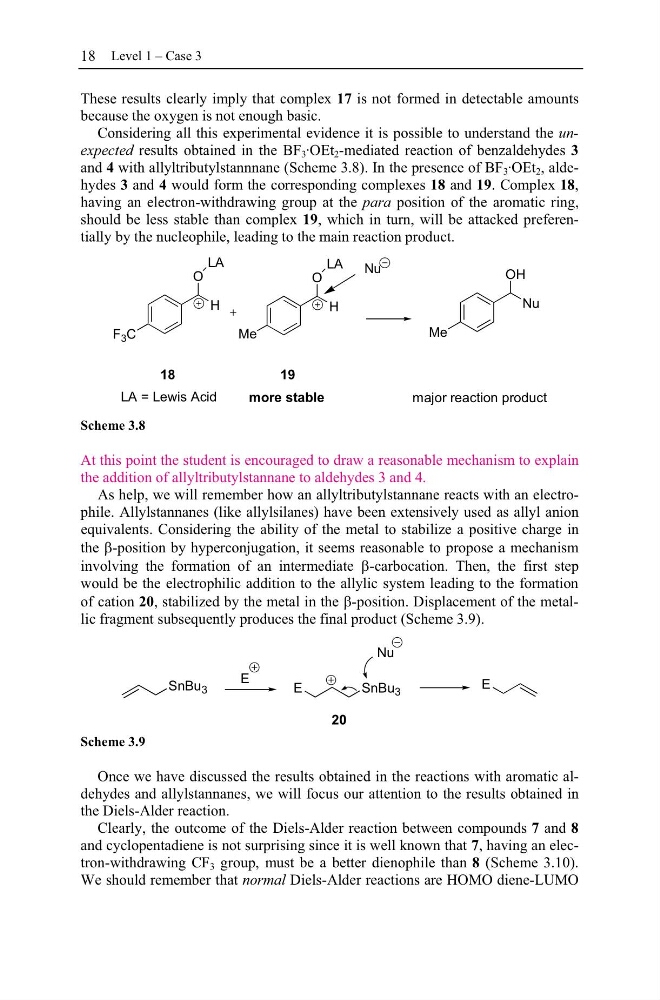
Considering all this experimental evidence it is possible to understand the unexpected results obtained in th t e BF 3 ·OEt 2 -mediated reaction of benzaldehydes 3
and 4 with allyltributylstannnane (Scheme 3.8). In th t e presence of BF 3 ·OEt 2 , aldehydes 3 and 4 would fo f f rm the corre r r sponding comp m lexes 18 and 19. Comp m lex 18,
having an electron-withdrawing group at the para position of the aromatic ring,
should be less stab a le than comp m lex 19, which in turn, will be attacked preferentially by the nucleophile, leading to th t e main reaction product.
F 3 C
O
H
LA
O
LA
Me
H
OH
Me
Nu
18
19
more stable
maj a or reaction product
Nu
LA = Lewis Acid
Scheme 3.8
At this point the student is encouraged to draw a reasonable mechanism to explain
the addition of allyltributylstannane to aldehydes 3 and 4.
help, we will rememb m er how an allyltributylstannane reacts with an electrophile. Allylstannanes (like allylsilanes) have been extensively used as allyl anion
equivalents. Considering the ability of the metal to stabilize a positive charge in
the E-position by hyperconjugation, it seems reasonable to propose a mechanism
involving the formation of an intermediate E-carbocation. Then, the first step
would be the electrophilic addition to the allylic system leading to the formation
of cation 20, stabilized by the metal in the E-position. Displacement of the metallic fragment subsequently produces the final product (Scheme 3.9).
SnBu 3
E
SnBu 3
E
20
E
Nu
Scheme 3.9
Once we have discussed the results obtained in the reactions with aromatic aldehydes and allylstannanes, we will focus our attention to the results obtained in
the Diels-Alder reaction.
Clearly, the outcome of the Diels-Alder reaction between compounds 7 and 8
and cyclopentadiene is not surprising since it is well known that 7, having an electron-withdrawing CF 3 group, must be a better dienophile than 8 (Scheme 3.10).
We should remember that normal Diels-Alder reactions are HOMO diene-LUMO
l
18
These results clearly imply that co
m m
mp m lex 17 is not fo f f rmed in detectable amounts
because the oxygen is not enough basic.
Considering all this experimental evidence it is possible to understand the unexpected results obtained in th t e BF 3 ·OEt 2 -mediated reaction of benzaldehydes 3
and 4 with allyltributylstannnane (Scheme 3.8). In th t e presence of BF 3 ·OEt 2 , aldehydes 3 and 4 would fo f f rm the corre r r sponding comp m lexes 18 and 19. Comp m lex 18,
having an electron-withdrawing group at the para position of the aromatic ring,
should be less stab a le than comp m lex 19, which in turn, will be attacked preferentially by the nucleophile, leading to th t e main reaction product.
F 3 C
O
H
LA
O
LA
Me
H
OH
Me
Nu
18
19
more stable
maj a or reaction product
Nu
LA = Lewis Acid
Scheme 3.8
At this point the student is encouraged to draw a reasonable mechanism to explain
the addition of allyltributylstannane to aldehydes 3 and 4.
help, we will rememb m er how an allyltributylstannane reacts with an electrophile. Allylstannanes (like allylsilanes) have been extensively used as allyl anion
equivalents. Considering the ability of the metal to stabilize a positive charge in
the E-position by hyperconjugation, it seems reasonable to propose a mechanism
involving the formation of an intermediate E-carbocation. Then, the first step
would be the electrophilic addition to the allylic system leading to the formation
of cation 20, stabilized by the metal in the E-position. Displacement of the metallic fragment subsequently produces the final product (Scheme 3.9).
SnBu 3
E
SnBu 3
E
20
E
Nu
Scheme 3.9
Once we have discussed the results obtained in the reactions with aromatic aldehydes and allylstannanes, we will focus our attention to the results obtained in
the Diels-Alder reaction.
Clearly, the outcome of the Diels-Alder reaction between compounds 7 and 8
and cyclopentadiene is not surprising since it is well known that 7, having an electron-withdrawing CF 3 group, must be a better dienophile than 8 (Scheme 3.10).
We should remember that normal Diels-Alder reactions are HOMO diene-LUMO
l