

Substrate Selective Reactions in the Presence of Lewis Acids
17
F 3 C
H
O
BF 3 .OEt 2
KCF K K 3
BF 3 .OEt 2
KCH K K 3
H 3 C
H
O
H 3 C
H
O
BF 3
H
O
BF 3
F 3 C
KCH K K 3 > KCF K K 3
less stable
11
12
less basic
more electrophilic
Scheme 3.7
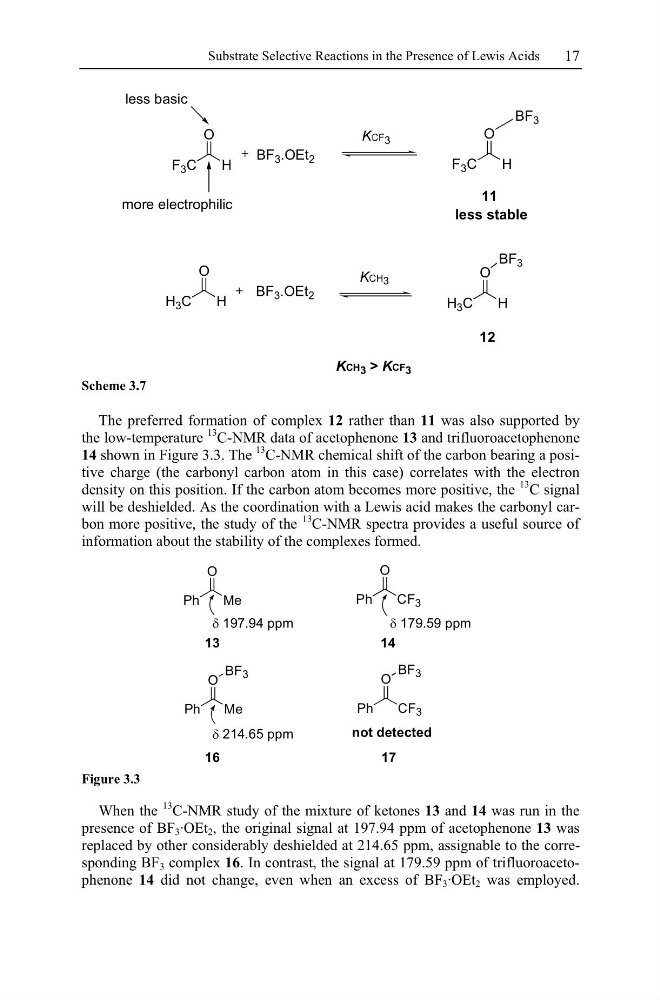
The preferred formation of complex 12 rather than 11 was also supported by
the low-temperature
13 C-NMR data of acetophenone 13 and trifluoroacetophenone
14 shown in Figure 3.3. The
13 C-NMR chemical shift of the carbon bearing a positive charge (the carbonyl carbon atom in this case) correlates with the electron
r
density on this position. If the carbon atom becomes more positive, the
13 C signal
will be deshielded. As the coordination with a Lewis acid makes the carbonyl carbon more positive, the study of the
13 C-NMR spectra provides a useful source of
information about the stability of the complexes formed.
Ph
Me
O
Ph
CF 3
O
Ph
Me
O
BF 3
Ph
CF 3
O
BF 3
G 197.94 ppm
G 214.65 ppm
G 179.59 ppm
not detected
13
14
16
17
Figure 3.3
When the
13 C-NMR study of the mixture of ketones 13 and 14 was run in the
presence of BF 3 ·OEt 2 , the original signal at 197.94 ppm of acetophenone
t
13 was
replaced by other considerably deshielded at 214.65 ppm, assignable to the corresponding BF 3 complex 16. In contrast, the signal at 179.59 ppm of trifluoroacetophenone 14 did not change, even when an excess of BF 3 ·OEt 2 was employed.
17
F 3 C
H
O
BF 3 .OEt 2
KCF K K 3
BF 3 .OEt 2
KCH K K 3
H 3 C
H
O
H 3 C
H
O
BF 3
H
O
BF 3
F 3 C
KCH K K 3 > KCF K K 3
less stable
11
12
less basic
more electrophilic
Scheme 3.7
The preferred formation of complex 12 rather than 11 was also supported by
the low-temperature
13 C-NMR data of acetophenone 13 and trifluoroacetophenone
14 shown in Figure 3.3. The
13 C-NMR chemical shift of the carbon bearing a positive charge (the carbonyl carbon atom in this case) correlates with the electron
r
density on this position. If the carbon atom becomes more positive, the
13 C signal
will be deshielded. As the coordination with a Lewis acid makes the carbonyl carbon more positive, the study of the
13 C-NMR spectra provides a useful source of
information about the stability of the complexes formed.
Ph
Me
O
Ph
CF 3
O
Ph
Me
O
BF 3
Ph
CF 3
O
BF 3
G 197.94 ppm
G 214.65 ppm
G 179.59 ppm
not detected
13
14
16
17
Figure 3.3
When the
13 C-NMR study of the mixture of ketones 13 and 14 was run in the
presence of BF 3 ·OEt 2 , the original signal at 197.94 ppm of acetophenone
t
13 was
replaced by other considerably deshielded at 214.65 ppm, assignable to the corresponding BF 3 complex 16. In contrast, the signal at 179.59 ppm of trifluoroacetophenone 14 did not change, even when an excess of BF 3 ·OEt 2 was employed.