

Level 3 – Case 37
248
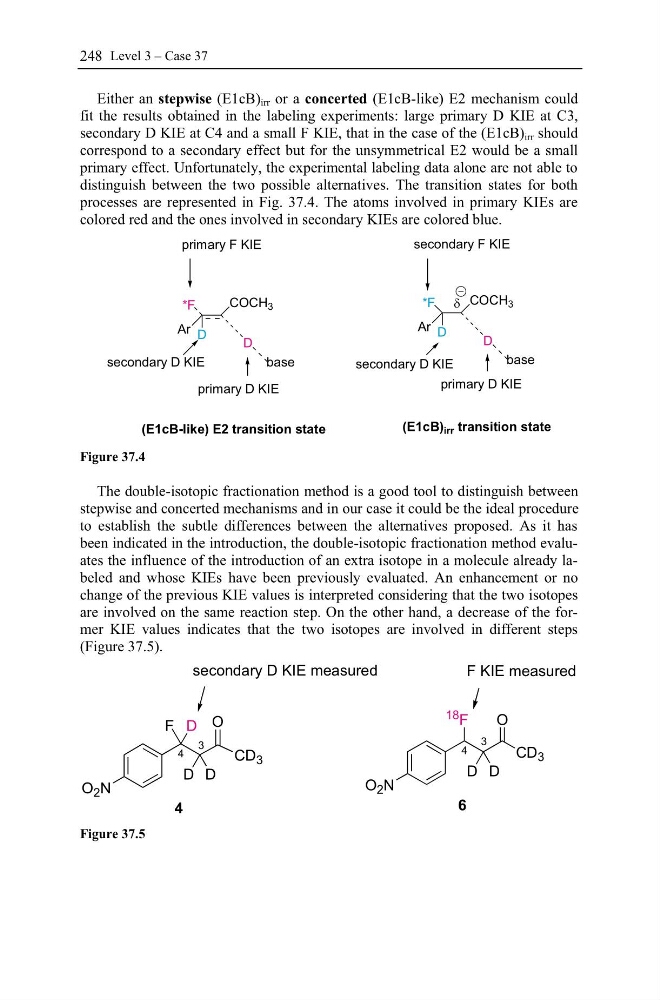
Either an stepwise (E1cB) irr or a
r
concerted (E1cB-like) E2 mechanism could
fit the results obtained in the labeling experiments: large primary D KIE at C3,
secondary D KIE at C4 and a small F KIE, that in the case of the (E1cB) irr should
r
correspond to a secondary effect but for the unsymmetrical E2 would be a small
primary effect. Unfortunately, the experimental labeling data alone are not able to
distinguish between the two possible alternatives. The transition states for both
processes are represented in Fig. 37.4. The atoms involved in primary KIEs are
colored red and the ones involved in secondary KIEs are colored blue.
D
*F
COCH 3
Ar D
D
*F
COCH 3
Ar D
base b
(E1cB-like) E2 transition state
primary F KIE
primary D KIE
secondary D KIE
secondary D KIE
base b
G
(E1cB) irr transition state
r
primary D KIE
secondary F KIE
Figure 37.4
The double-isotopic fractionation method is a good tool to distinguish between
stepwise and concerted mechanisms and in our case it could be the ideal procedure
to establish the subtle differences between the alternatives proposed. As it has
been indicated in the introduction, the double-isotopic fractionation method evaluates the influence of the introduction of an extra isotope in a molecule already labeled and whose KIEs have been previously evaluated. An enhancement or no
change of the previous KIE values is interpreted considering that the two isotopes
are involved on the same reaction step. On the other hand, a decrease of the former KIE values indicates that the two isotopes are involved in different steps
(Figure 37.5).
CD 3
O
O 2 N
D D
F D
CD 3
O
O 2 N
D D
18 F
4
secondary D KIE measured
F KIE measured
4
4
3
3
Figure 37.5
248
Either an stepwise (E1cB) irr or a
r
concerted (E1cB-like) E2 mechanism could
fit the results obtained in the labeling experiments: large primary D KIE at C3,
secondary D KIE at C4 and a small F KIE, that in the case of the (E1cB) irr should
r
correspond to a secondary effect but for the unsymmetrical E2 would be a small
primary effect. Unfortunately, the experimental labeling data alone are not able to
distinguish between the two possible alternatives. The transition states for both
processes are represented in Fig. 37.4. The atoms involved in primary KIEs are
colored red and the ones involved in secondary KIEs are colored blue.
D
*F
COCH 3
Ar D
D
*F
COCH 3
Ar D
base b
(E1cB-like) E2 transition state
primary F KIE
primary D KIE
secondary D KIE
secondary D KIE
base b
G
(E1cB) irr transition state
r
primary D KIE
secondary F KIE
Figure 37.4
The double-isotopic fractionation method is a good tool to distinguish between
stepwise and concerted mechanisms and in our case it could be the ideal procedure
to establish the subtle differences between the alternatives proposed. As it has
been indicated in the introduction, the double-isotopic fractionation method evaluates the influence of the introduction of an extra isotope in a molecule already labeled and whose KIEs have been previously evaluated. An enhancement or no
change of the previous KIE values is interpreted considering that the two isotopes
are involved on the same reaction step. On the other hand, a decrease of the former KIE values indicates that the two isotopes are involved in different steps
(Figure 37.5).
CD 3
O
O 2 N
D D
F D
CD 3
O
O 2 N
D D
18 F
4
secondary D KIE measured
F KIE measured
4
4
3
3
Figure 37.5