

Base-promoted HF Elimination from 4-Fluoro-4-(4’-nitrophenyl)butan-2-one 247
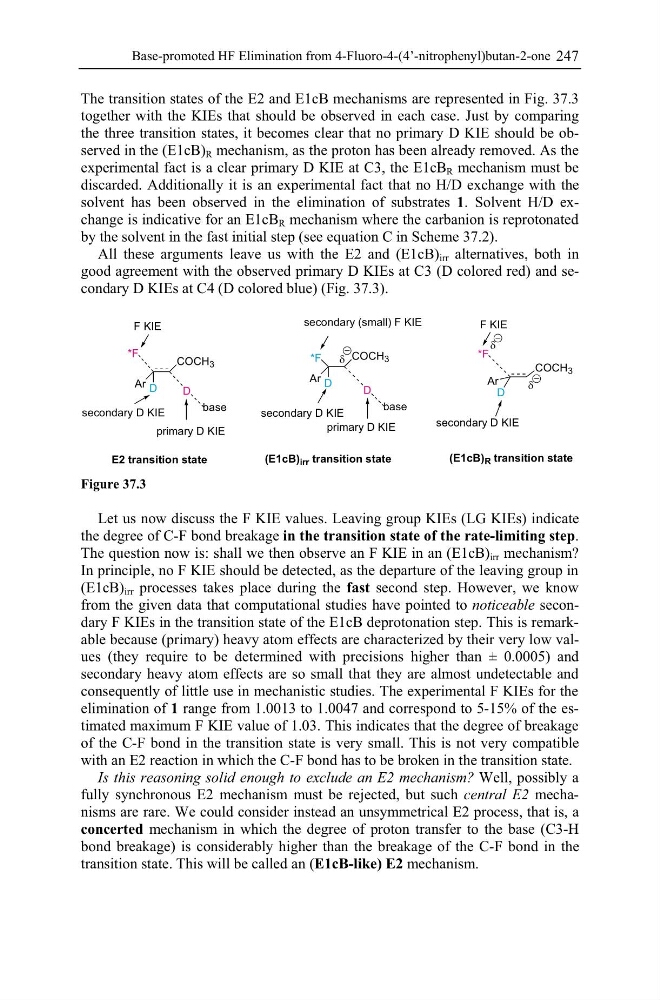
The transition states of the E2 and E1cB mechanisms are represented in Fig. 37.3
together with the KIEs that should be observed in each case. Just by comparing
the three transition states, it becomes clear that no primary D KIE should be obr
served in the (E1cB) R mechanism, as the proton has
R
been already removed. As the
experimental fact is a clear primary D KIE at C3, the E1cB R mechanism must be
R
discarded. Additionally it is an experimental fact that no H/D exchange with the
solvent has been observed in the elimination of substrates 1. Solvent H/D exchange is indicative for an E1cB R mechanism where the carbanion is reprotonated
R
by the solvent in the fast initial step (see equation C in Scheme 37.2).
All these arguments leave us with the E2 and (E1cB) irr alternatives, both in
r
good agreement with the observed primary D KIEs at C3 (D colored red) and secondary D KIEs at C4 (D colored blue) (Fig. 37.3).
D
*F
COCH 3
Ar D
D
*F
COCH 3
Ar D
COCH 3
*F
D
Ar
base b
base b
G
E2 transition state
(E1cB) irr transition state
r
F KIE
primary D KIE
primary D KIE
secondary (small) F KIE
secondary D KIE
secondary D KIE
G
(E1cB) R transition state
R
G
secondary D KIE
F KIE
Figure 37.3
Let us now discuss the F KIE values. Leaving group KIEs (LG KIEs) indicate
the degree of C-F bond breakage in the transition state of the rate-limiting step.
The question now is: shall we then observe an F KIE in an (E1cB) irr mechanism?
r
In principle, no F KIE should be detected, as the departure of the leaving group in
(E1cB) irr processes takes place during the
r
fast second step. However, we know
from the given data that computational studies have pointed to noticeable secondary F KIEs in the transition state of the E1cB deprotonation step. This is remarkable because (primary) heavy atom effects are characterized by their very low values (they require to be determined with precisions higher than ± 0.0005) and
secondary heavy atom effects are so small that they are almost undetectable and
consequently of little use in mechanistic studies. The experimental F KIEs for the
elimination of 1 range from 1.0013 to 1.0047 and correspond to 5-15% of the estimated maximum F KIE value of 1.03. This indicates that the degree of breakage
of the C-F bond in the transition state is very small. This is not very compatible
with an E2 reaction in which the C-F bond has to be broken in the transition state.
Is this reasoning solid enough to exclude an E2 mechanism? Well, possibly a
fully synchronous E2 mechanism must be rejected, but such central E2 mechanisms are rare. We could consider instead an unsymmetrical E2 process, that is, a
concerted mechanism in which the degree of proton transfer to the base (C3-H
bond breakage) is considerably higher than the breakage of the C-F bond in the
transition state. This will be called an (E1cB-like) E2 mechanism.
The transition states of the E2 and E1cB mechanisms are represented in Fig. 37.3
together with the KIEs that should be observed in each case. Just by comparing
the three transition states, it becomes clear that no primary D KIE should be obr
served in the (E1cB) R mechanism, as the proton has
R
been already removed. As the
experimental fact is a clear primary D KIE at C3, the E1cB R mechanism must be
R
discarded. Additionally it is an experimental fact that no H/D exchange with the
solvent has been observed in the elimination of substrates 1. Solvent H/D exchange is indicative for an E1cB R mechanism where the carbanion is reprotonated
R
by the solvent in the fast initial step (see equation C in Scheme 37.2).
All these arguments leave us with the E2 and (E1cB) irr alternatives, both in
r
good agreement with the observed primary D KIEs at C3 (D colored red) and secondary D KIEs at C4 (D colored blue) (Fig. 37.3).
D
*F
COCH 3
Ar D
D
*F
COCH 3
Ar D
COCH 3
*F
D
Ar
base b
base b
G
E2 transition state
(E1cB) irr transition state
r
F KIE
primary D KIE
primary D KIE
secondary (small) F KIE
secondary D KIE
secondary D KIE
G
(E1cB) R transition state
R
G
secondary D KIE
F KIE
Figure 37.3
Let us now discuss the F KIE values. Leaving group KIEs (LG KIEs) indicate
the degree of C-F bond breakage in the transition state of the rate-limiting step.
The question now is: shall we then observe an F KIE in an (E1cB) irr mechanism?
r
In principle, no F KIE should be detected, as the departure of the leaving group in
(E1cB) irr processes takes place during the
r
fast second step. However, we know
from the given data that computational studies have pointed to noticeable secondary F KIEs in the transition state of the E1cB deprotonation step. This is remarkable because (primary) heavy atom effects are characterized by their very low values (they require to be determined with precisions higher than ± 0.0005) and
secondary heavy atom effects are so small that they are almost undetectable and
consequently of little use in mechanistic studies. The experimental F KIEs for the
elimination of 1 range from 1.0013 to 1.0047 and correspond to 5-15% of the estimated maximum F KIE value of 1.03. This indicates that the degree of breakage
of the C-F bond in the transition state is very small. This is not very compatible
with an E2 reaction in which the C-F bond has to be broken in the transition state.
Is this reasoning solid enough to exclude an E2 mechanism? Well, possibly a
fully synchronous E2 mechanism must be rejected, but such central E2 mechanisms are rare. We could consider instead an unsymmetrical E2 process, that is, a
concerted mechanism in which the degree of proton transfer to the base (C3-H
bond breakage) is considerably higher than the breakage of the C-F bond in the
transition state. This will be called an (E1cB-like) E2 mechanism.