

Vicarious Nucleophilic Substitution 241
Q Qu ue es st ti io on ns s
1. Most of the kinetic data obtained to determine the influence of the base concentration in the VNS reaction have been obtained from competitive experiments
between VNS and S N Ar reactions in fluoro nitrobenzenes like 4 with carbanions derived from sulfones 5. Could you explain why? (R is a substituent that
cannot be replaced by S N Ar).
NO 2
R
F F
PhSO 2 CH 2 Cl
4
5
2. Draw a mechanism for the reaction between nitrobenzene and ethyl 2-chloropropionate in the presence of sodium hydride (DMSO as solvent) followed by
addition of benzyl bromide. Justify the regiochemistry of the reaction.
A An ns sw we er r t to o Q Qu ue es st ti io on n 1 1
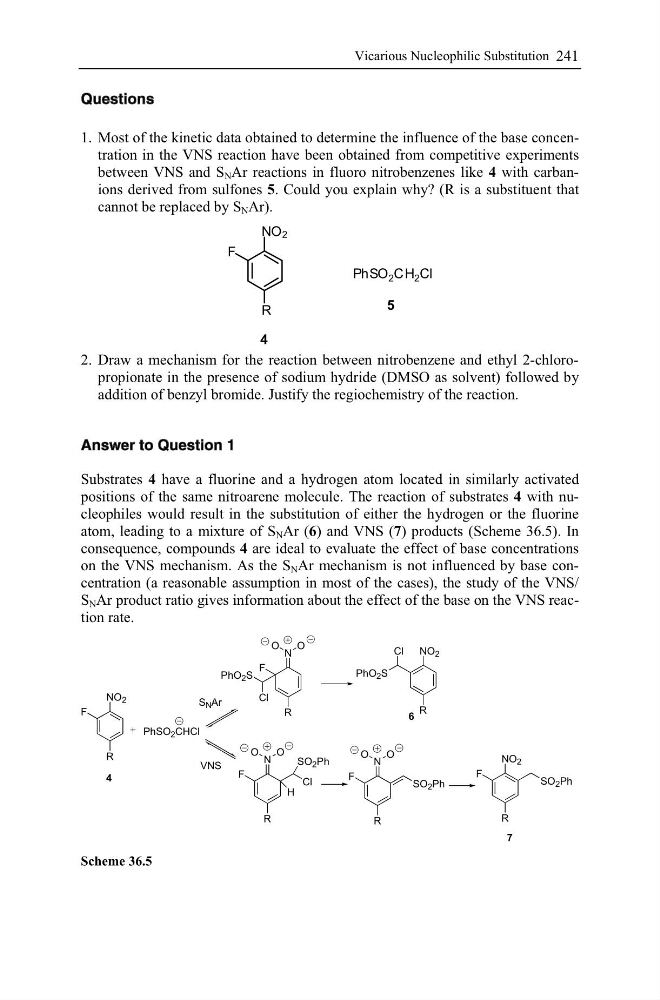
Substrates 4 have a fluorine and a hydrogen atom located in similarly activated
positions of the same nitroarene molecule. The reaction of substrates 4 with nucleophiles would result in the substitution of either the hydrogen or the fluorine
atom, leading to a mixture of S N Ar (6) and VNS (7) products (Scheme 36.5). In
consequence, compounds 4 are ideal to evaluate the effect of base concentrations
on the VNS mechanism. As the S N Ar mechanism is not influenced by base concentration (a reasonable assumption in most of the cases), the study of the VNS/
t
S N Ar product ratio gives information about the effect of the base on the VNS reaction rate.
NO 2
R
F
PhSO 2 CHCl
VNS
O
F
R
PhO 2 S
Cl
N
O
N
O
O
F
Cl
SO 2 Ph
H
R
R
NO 2
Cl
PhO 2 S
N
O
O
F
SO 2 Ph
R
NO 2
R
F
SO 2 Ph
4
7
6
S N Ar
Scheme 36.5
Q Qu ue es st ti io on ns s
1. Most of the kinetic data obtained to determine the influence of the base concentration in the VNS reaction have been obtained from competitive experiments
between VNS and S N Ar reactions in fluoro nitrobenzenes like 4 with carbanions derived from sulfones 5. Could you explain why? (R is a substituent that
cannot be replaced by S N Ar).
NO 2
R
F F
PhSO 2 CH 2 Cl
4
5
2. Draw a mechanism for the reaction between nitrobenzene and ethyl 2-chloropropionate in the presence of sodium hydride (DMSO as solvent) followed by
addition of benzyl bromide. Justify the regiochemistry of the reaction.
A An ns sw we er r t to o Q Qu ue es st ti io on n 1 1
Substrates 4 have a fluorine and a hydrogen atom located in similarly activated
positions of the same nitroarene molecule. The reaction of substrates 4 with nucleophiles would result in the substitution of either the hydrogen or the fluorine
atom, leading to a mixture of S N Ar (6) and VNS (7) products (Scheme 36.5). In
consequence, compounds 4 are ideal to evaluate the effect of base concentrations
on the VNS mechanism. As the S N Ar mechanism is not influenced by base concentration (a reasonable assumption in most of the cases), the study of the VNS/
t
S N Ar product ratio gives information about the effect of the base on the VNS reaction rate.
NO 2
R
F
PhSO 2 CHCl
VNS
O
F
R
PhO 2 S
Cl
N
O
N
O
O
F
Cl
SO 2 Ph
H
R
R
NO 2
Cl
PhO 2 S
N
O
O
F
SO 2 Ph
R
NO 2
R
F
SO 2 Ph
4
7
6
S N Ar
Scheme 36.5