

Level 3 – Case 36
240
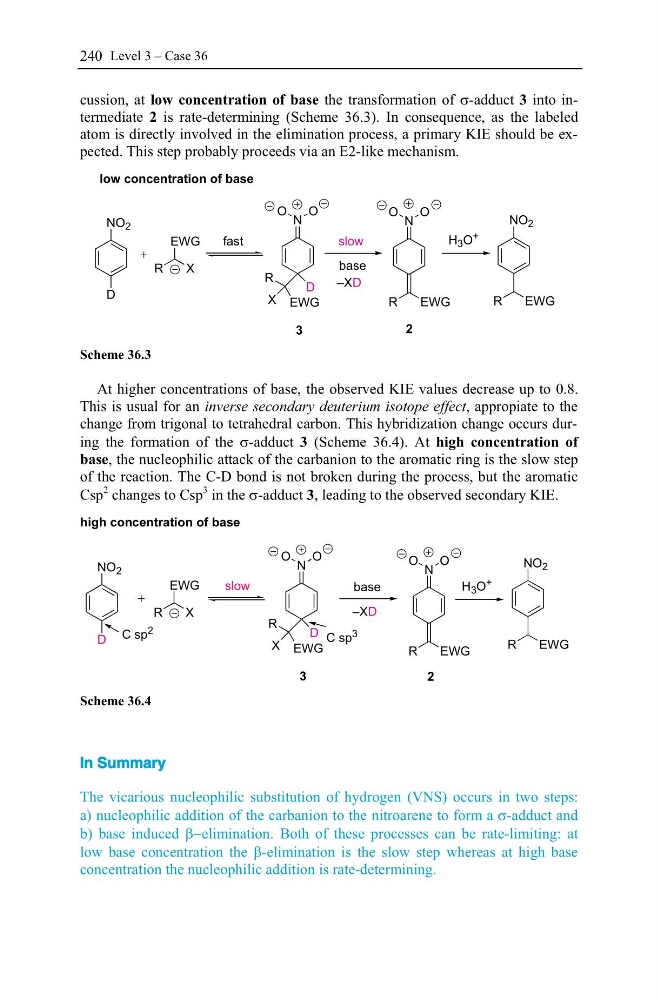
cussion, at low concentration of base the transformation of V-adduct 3 into intermediate 2 is rate-determining (Scheme 36.3). In consequence, as the labeled
atom is directly involved in the elimination process, a primary KIE should be expected. This step probably proceeds via an E2-like mechanism.
NO 2
D
EWG
R
X
N
O
O
D
EWG
X
R
N
O
O
EWG
R
–XD
H 3 O +
NO 2
EWG
R
base
3
2
fast
slow
low concentration of base
Scheme 36.3
At higher concentrations of base, the observed KIE values decrease up to 0.8.
This is usual for an inverse secondary deuterium isotope effect, appropiate to the
change from trigonal to tetrahedral carbon. This hybridization change occurs during the formation of the V-adduct 3 (Scheme 36.4). At high concentration of
t
base, the nucleophilic attack of the carbanion to the aromatic ring is the slow step
of the reaction. The C-D bond is not broken during the process, but the aromatic
Csp
2 changes to Csp
3 in the V-adduct 3, leading to the observed secondary KIE.
NO 2
D
EWG
R
X
N
O
O
D
EWG
X
R
N
O
O
EWG
R
–XD
H 3 O +
NO 2
EWG
R
base
3
2
slow
C sp 2
C sp 3
high concentration of base
Scheme 36.4
In Summary
The vicarious nucleophilic substitution of hydrogen (VNS) occurs in two steps:
a) nucleophilic addition of the carbanion to the nitroarene to form a V-adduct and
b) base induced Eelimination. Both of these processes can be rate-limiting: at
low base concentration the E-elimination is the slow step whereas at high base
concentration the nucleophilic addition is rate-determining.
240
cussion, at low concentration of base the transformation of V-adduct 3 into intermediate 2 is rate-determining (Scheme 36.3). In consequence, as the labeled
atom is directly involved in the elimination process, a primary KIE should be expected. This step probably proceeds via an E2-like mechanism.
NO 2
D
EWG
R
X
N
O
O
D
EWG
X
R
N
O
O
EWG
R
–XD
H 3 O +
NO 2
EWG
R
base
3
2
fast
slow
low concentration of base
Scheme 36.3
At higher concentrations of base, the observed KIE values decrease up to 0.8.
This is usual for an inverse secondary deuterium isotope effect, appropiate to the
change from trigonal to tetrahedral carbon. This hybridization change occurs during the formation of the V-adduct 3 (Scheme 36.4). At high concentration of
t
base, the nucleophilic attack of the carbanion to the aromatic ring is the slow step
of the reaction. The C-D bond is not broken during the process, but the aromatic
Csp
2 changes to Csp
3 in the V-adduct 3, leading to the observed secondary KIE.
NO 2
D
EWG
R
X
N
O
O
D
EWG
X
R
N
O
O
EWG
R
–XD
H 3 O +
NO 2
EWG
R
base
3
2
slow
C sp 2
C sp 3
high concentration of base
Scheme 36.4
In Summary
The vicarious nucleophilic substitution of hydrogen (VNS) occurs in two steps:
a) nucleophilic addition of the carbanion to the nitroarene to form a V-adduct and
b) base induced Eelimination. Both of these processes can be rate-limiting: at
low base concentration the E-elimination is the slow step whereas at high base
concentration the nucleophilic addition is rate-determining.