

Rearrangements of Cyclobutenones 161
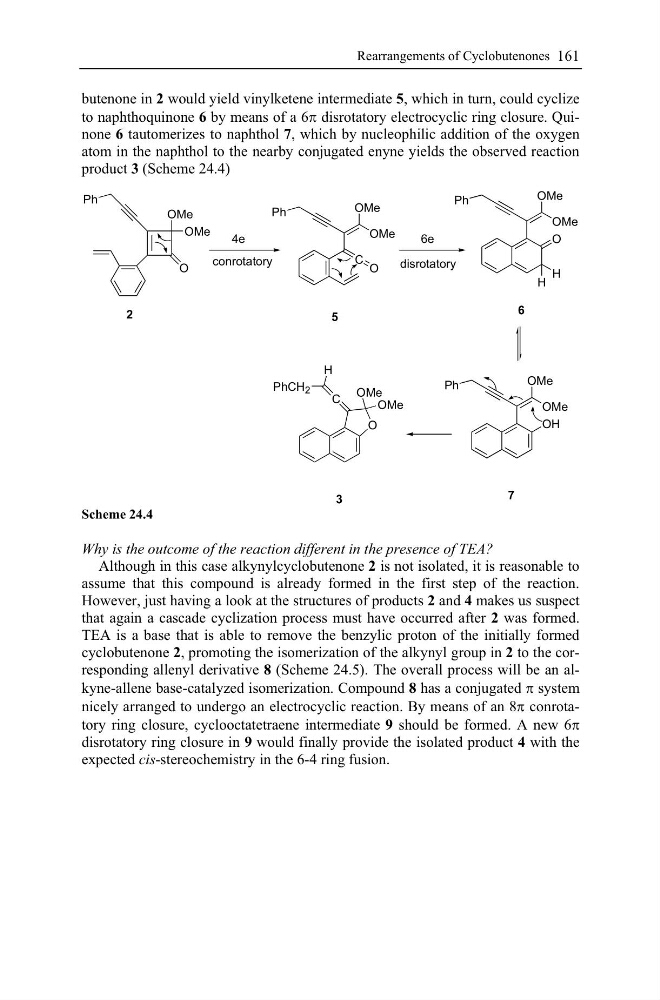
butenone in 2 would yield vinylketene intermediate 5, which in turn, could cyclize
to naphthoquinone 6 by means of a 6S disrotatory electrocyclic ring closure. Quinone 6 tautomerizes to naphthol 7, which by nucleophilic addition of the oxygen
atom in the naphthol to the nearby conjugated enyne yields the observed reaction
product 3 (Scheme 24.4)
O
OMe
OMe
C
H
PhCH 2
C
O
OMe
OMe
Ph
OMe
Ph
OMe
OH
OMe
Ph
OMe
O
H
H
4e
conrotatory
5
6e
disrotatory
6
7
3
O
OMe
OMe
Ph
Scheme 24.4
Why is the outcome of the reaction different in the presence of TEA?
Although in this case alkynylcyclobutenone 2 is not isolated, it is reasonable to
assume that this compound is already formed in the first step of the reaction.
However, just having a look at the structures of products 2 and 4 makes us suspect
that again a cascade cyclization process must have occurred after 2 was formed.
TEA is a base that is able to remove the benzylic proton of the initially formed
cyclobutenone 2, promoting the isomerization of the alkynyl group in 2 to the corresponding allenyl derivative 8 (Scheme 24.5). The overall process will be an alkyne-allene base-catalyzed isomerization. Compound 8 has a conjugated S system
nicely arranged to undergo an electrocyclic reaction. By means of an 8S conrotatory ring closure, cyclooctatetraene intermediate 9 should be formed. A new 6S
disrotatory ring closure in 9 would finally provide the isolated product 4 with the
expected cis-stereochemistry in the 6-4 ring fusion.
butenone in 2 would yield vinylketene intermediate 5, which in turn, could cyclize
to naphthoquinone 6 by means of a 6S disrotatory electrocyclic ring closure. Quinone 6 tautomerizes to naphthol 7, which by nucleophilic addition of the oxygen
atom in the naphthol to the nearby conjugated enyne yields the observed reaction
product 3 (Scheme 24.4)
O
OMe
OMe
C
H
PhCH 2
C
O
OMe
OMe
Ph
OMe
Ph
OMe
OH
OMe
Ph
OMe
O
H
H
4e
conrotatory
5
6e
disrotatory
6
7
3
O
OMe
OMe
Ph
Scheme 24.4
Why is the outcome of the reaction different in the presence of TEA?
Although in this case alkynylcyclobutenone 2 is not isolated, it is reasonable to
assume that this compound is already formed in the first step of the reaction.
However, just having a look at the structures of products 2 and 4 makes us suspect
that again a cascade cyclization process must have occurred after 2 was formed.
TEA is a base that is able to remove the benzylic proton of the initially formed
cyclobutenone 2, promoting the isomerization of the alkynyl group in 2 to the corresponding allenyl derivative 8 (Scheme 24.5). The overall process will be an alkyne-allene base-catalyzed isomerization. Compound 8 has a conjugated S system
nicely arranged to undergo an electrocyclic reaction. By means of an 8S conrotatory ring closure, cyclooctatetraene intermediate 9 should be formed. A new 6S
disrotatory ring closure in 9 would finally provide the isolated product 4 with the
expected cis-stereochemistry in the 6-4 ring fusion.