

Level 2 – Case 24
160
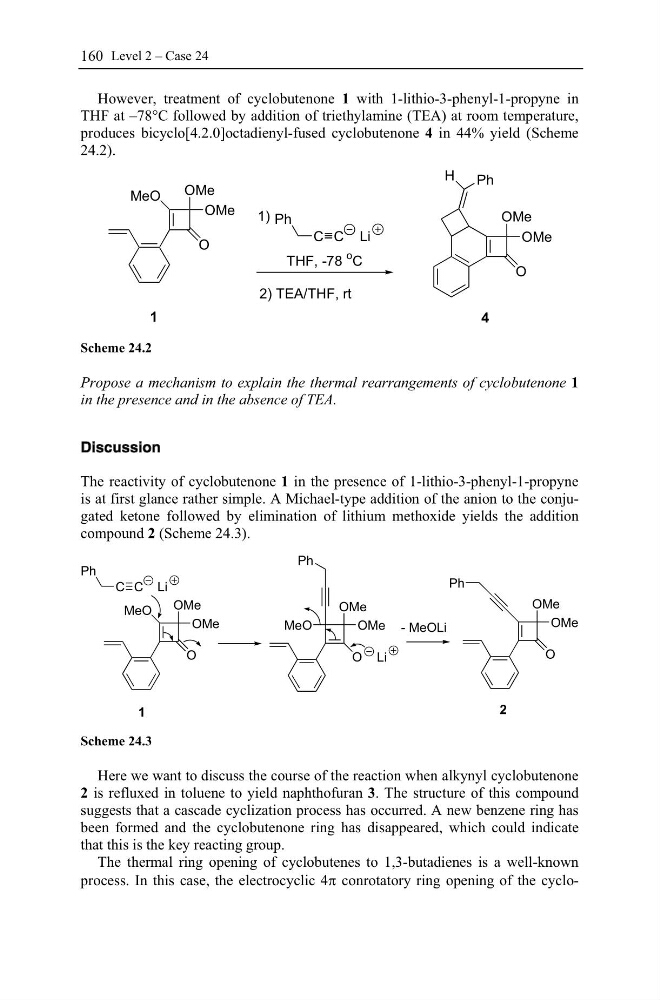
However, treatment of cyclobutenone 1 with 1-lithio-3-phenyl-1-propyne in
THF at –78°C followed by addition of triethylamine (TEA) at room temperature,
produces bicyclo[4.2.0]octadienyl-fused cyclobutenone 4 in 44% yield (Scheme
24.2).
O
OMe
OMe
MeO
C C Li
Ph
Ph
H
O
OMe
OMe
1)
2) TEA/THF, rt
THF, -78
o C
1
4
Scheme 24.2
Propose a mechanism to explain the thermal rearrangements of cyclobutenone 1
in the presence and in the absence of TEA.
D Di is sc cu us ss si io on n
The reactivity of cyclobutenone
f
1 in the presence of 1-lithio-3-phenyl-1-propyne
is at first glance rather simple. A Michael-type addition of the anion to the conjugated ketone followed by elimination of lithium methoxide yields the addition
f
compound 2 (Scheme 24.3).
O
OMe
OMe
MeO
C C Li
Ph
O
OMe
OMe
MeO
Ph
Li
O
OMe
OMe
Ph
- MeOLi
1
2
Here we want to discuss the course of the reaction when alkynyl cyclobutenone
2 is refluxed in toluene to yield naphthofuran 3. The structure of this compound
suggests that a cascade cyclization process has occurred. A new benzene ring has
been formed and the cyclobutenone ring has disappeared, which could indicate
that this is the key reacting group.
The thermal ring opening of cyclobutenes to 1,3-butadienes is a well-known
process. In this case, the electrocyclic 4S conrotatory ring opening of the cyclo-
160
However, treatment of cyclobutenone 1 with 1-lithio-3-phenyl-1-propyne in
THF at –78°C followed by addition of triethylamine (TEA) at room temperature,
produces bicyclo[4.2.0]octadienyl-fused cyclobutenone 4 in 44% yield (Scheme
24.2).
O
OMe
OMe
MeO
C C Li
Ph
Ph
H
O
OMe
OMe
1)
2) TEA/THF, rt
THF, -78
o C
1
4
Scheme 24.2
Propose a mechanism to explain the thermal rearrangements of cyclobutenone 1
in the presence and in the absence of TEA.
D Di is sc cu us ss si io on n
The reactivity of cyclobutenone
f
1 in the presence of 1-lithio-3-phenyl-1-propyne
is at first glance rather simple. A Michael-type addition of the anion to the conjugated ketone followed by elimination of lithium methoxide yields the addition
f
compound 2 (Scheme 24.3).
O
OMe
OMe
MeO
C C Li
Ph
O
OMe
OMe
MeO
Ph
Li
O
OMe
OMe
Ph
- MeOLi
1
2
Here we want to discuss the course of the reaction when alkynyl cyclobutenone
2 is refluxed in toluene to yield naphthofuran 3. The structure of this compound
suggests that a cascade cyclization process has occurred. A new benzene ring has
been formed and the cyclobutenone ring has disappeared, which could indicate
that this is the key reacting group.
The thermal ring opening of cyclobutenes to 1,3-butadienes is a well-known
process. In this case, the electrocyclic 4S conrotatory ring opening of the cyclo-