

Level 1 – Case 1
4
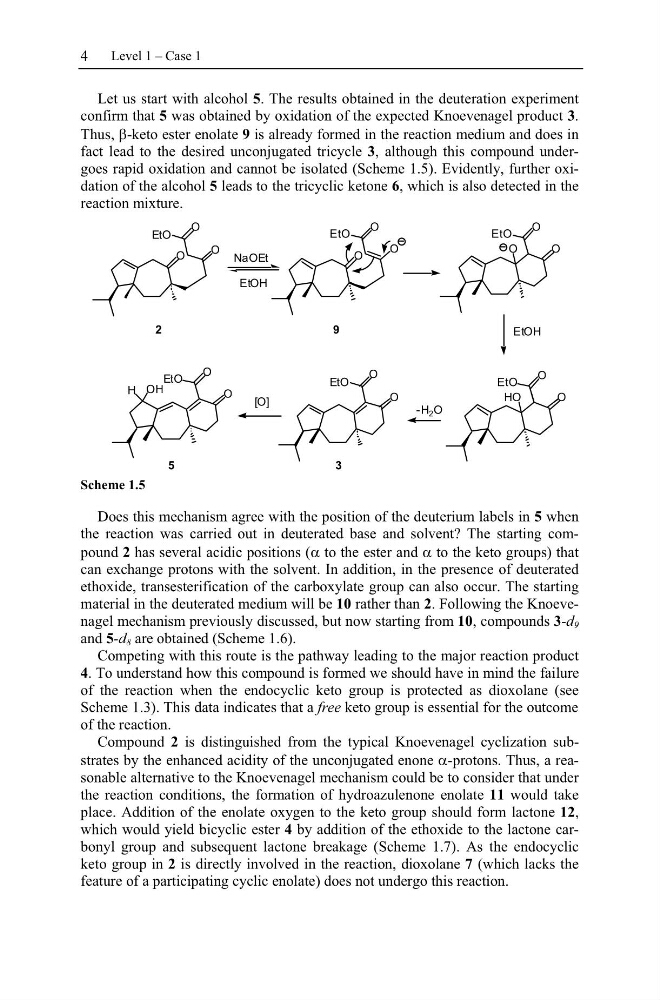
Let us start with alcohol 5. The results obtained in the deuteration experiment
confirm that 5 was obtained by oxidation of the expected Knoevenagel product 3.
Thus, E-keto ester enolate 9 is already formed in the reaction medium and does in
fact lead to the desired unconjugated tricycle 3, although this compound undergoes rapid oxidation and cannot be isolated (Scheme 1.5). Evidently, further oxidation of the alcohol 5 leads to the tricyclic ketone 6, which is also detected in the
reaction mixture.
O O
EtO
O O
O O NaOEt
[O]
EtOH
O O
EtO
H OH O
O O
O O
EtO
O O
O O
O O
EtO
O O
-H 2 O
O
O O
EtO
O O
O O
EtO
HO
O O
EtOH
9
3
5
2
Scheme 1.5
Does this mechanism agree with the position of the deuterium labels in 5 when
the reaction was carried out in deuterated base and solvent? The starting comd
pound 2 has several acidic positions (D to the ester and D to the keto groups) that
can exchange protons with the solvent. In addition, in the presence of deuterated
ethoxide, transesterification of the carboxylate group can also occur. The starting
material in the deuterated medium will be 10 rather than 2. Following the Knoevenagel mechanism previously discussed, but now starting from 10, compounds 3-d 9
d
and 5-d 8
d d are obtained (Scheme 1.6).
Competing with this route is the pathway leading to the major reaction product
4. To understand how this compound is formed we should have in mind the failure
of the reaction when the endocyclic keto group is protected as dioxolane (see
Scheme 1.3). This data indicates that a free keto group is essential for the outcome
of the reaction.
Compound 2 is distinguished from the typical Knoevenagel cyclization substrates by the enhanced acidity of the unconjugated enone D-protons. Thus, a reasonable alternative to the Knoevenagel mechanism could be to consider that under
the reaction conditions, the formation of hydroazulenone enolate 11 would take
place. Addition of the enolate oxygen to the keto group should form lactone 12,
which would yield bicyclic ester 4 by addition of the ethoxide to the lactone carbonyl group and subsequent lactone breakage (Scheme 1.7). As the endocyclic
keto group in 2 is directly involved in the reaction, dioxolane 7 (which lacks the
feature of a participating cyclic enolate) does not undergo this reaction.
4
Let us start with alcohol 5. The results obtained in the deuteration experiment
confirm that 5 was obtained by oxidation of the expected Knoevenagel product 3.
Thus, E-keto ester enolate 9 is already formed in the reaction medium and does in
fact lead to the desired unconjugated tricycle 3, although this compound undergoes rapid oxidation and cannot be isolated (Scheme 1.5). Evidently, further oxidation of the alcohol 5 leads to the tricyclic ketone 6, which is also detected in the
reaction mixture.
O O
EtO
O O
O O NaOEt
[O]
EtOH
O O
EtO
H OH O
O O
O O
EtO
O O
O O
O O
EtO
O O
-H 2 O
O
O O
EtO
O O
O O
EtO
HO
O O
EtOH
9
3
5
2
Scheme 1.5
Does this mechanism agree with the position of the deuterium labels in 5 when
the reaction was carried out in deuterated base and solvent? The starting comd
pound 2 has several acidic positions (D to the ester and D to the keto groups) that
can exchange protons with the solvent. In addition, in the presence of deuterated
ethoxide, transesterification of the carboxylate group can also occur. The starting
material in the deuterated medium will be 10 rather than 2. Following the Knoevenagel mechanism previously discussed, but now starting from 10, compounds 3-d 9
d
and 5-d 8
d d are obtained (Scheme 1.6).
Competing with this route is the pathway leading to the major reaction product
4. To understand how this compound is formed we should have in mind the failure
of the reaction when the endocyclic keto group is protected as dioxolane (see
Scheme 1.3). This data indicates that a free keto group is essential for the outcome
of the reaction.
Compound 2 is distinguished from the typical Knoevenagel cyclization substrates by the enhanced acidity of the unconjugated enone D-protons. Thus, a reasonable alternative to the Knoevenagel mechanism could be to consider that under
the reaction conditions, the formation of hydroazulenone enolate 11 would take
place. Addition of the enolate oxygen to the keto group should form lactone 12,
which would yield bicyclic ester 4 by addition of the ethoxide to the lactone carbonyl group and subsequent lactone breakage (Scheme 1.7). As the endocyclic
keto group in 2 is directly involved in the reaction, dioxolane 7 (which lacks the
feature of a participating cyclic enolate) does not undergo this reaction.