

A Surprise in the Synthesis of Guanacastepene A
3
O
EtO
O
O
O
NaOEt
EtOH
OEt
O
O
O
7
8
Scheme 1.3
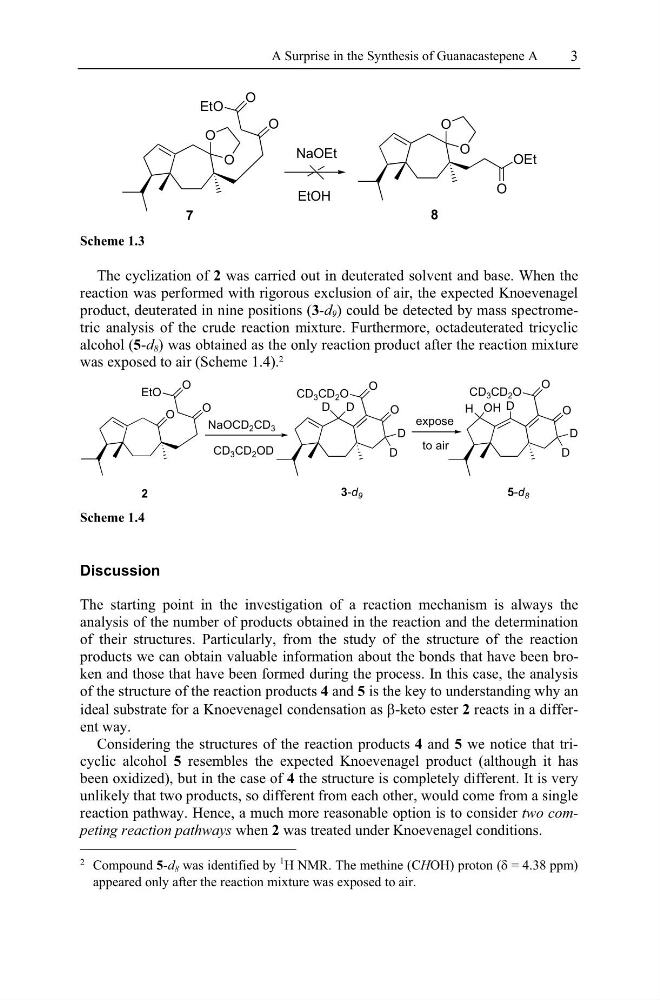
The cyclization of 2 was carried out in deuterated solvent and base. When the
d
reaction was performed with rigorous exclusion of air, the expected Knoevenagel
product, deuterated in nine positions (3-d 9
d ) could be detected by mass spectrometric analysis of the crude reaction mixture. Furthermore, octadeuterated tricyclic
alcohol (5-d 8
d d ) was obtained as the only reaction product after the reaction mixture
was exposed to air (Scheme 1.4).
2
O
EtO
O
NaOCD 2 CD 3
CD 3 CD 2 OD
D D
D
D
D
D
H OH D
2
3-d 9
5-d 8
expose
to air
O
O
O
CD 3 CD 2 O
O
CD 3 CD 2 O
O
Scheme 1.4
Discussion
The starting point in the investigation of a reaction mechanism is always the
analysis of the number of products obtained in the reaction and the determination
of their structures. Particularly, from the study of the structure of the reaction
t
products we can obtain valuable information about the bonds that have been broken and those that have been formed during the process. In this case, the analysis
of the structure of the reaction products 4 and 5 is the key to understanding why an
ideal substrate for a Knoevenagel condensation as E-keto ester 2 reacts in a different way.
Considering the structures of the reaction products 4 and 5 we notice that tricyclic alcohol 5 resembles the expected Knoevenagel product (although it has
been oxidized), but in the case of 4 the structure is completely different. It is very
unlikely that two products, so different from each other, would come from a single
reaction pathway. Hence, a much more reasonable option is to consider two competing reaction pathways when 2 was treated under Knoevenagel conditions.
2 Compound 5-d 8
d d was identified by
1 H NMR. The methine (CHOH) proton (
H H
G = 4.38 ppm)
appeared only after the reaction mixture was exposed to air.
3
O
EtO
O
O
O
NaOEt
EtOH
OEt
O
O
O
7
8
Scheme 1.3
The cyclization of 2 was carried out in deuterated solvent and base. When the
d
reaction was performed with rigorous exclusion of air, the expected Knoevenagel
product, deuterated in nine positions (3-d 9
d ) could be detected by mass spectrometric analysis of the crude reaction mixture. Furthermore, octadeuterated tricyclic
alcohol (5-d 8
d d ) was obtained as the only reaction product after the reaction mixture
was exposed to air (Scheme 1.4).
2
O
EtO
O
NaOCD 2 CD 3
CD 3 CD 2 OD
D D
D
D
D
D
H OH D
2
3-d 9
5-d 8
expose
to air
O
O
O
CD 3 CD 2 O
O
CD 3 CD 2 O
O
Scheme 1.4
Discussion
The starting point in the investigation of a reaction mechanism is always the
analysis of the number of products obtained in the reaction and the determination
of their structures. Particularly, from the study of the structure of the reaction
t
products we can obtain valuable information about the bonds that have been broken and those that have been formed during the process. In this case, the analysis
of the structure of the reaction products 4 and 5 is the key to understanding why an
ideal substrate for a Knoevenagel condensation as E-keto ester 2 reacts in a different way.
Considering the structures of the reaction products 4 and 5 we notice that tricyclic alcohol 5 resembles the expected Knoevenagel product (although it has
been oxidized), but in the case of 4 the structure is completely different. It is very
unlikely that two products, so different from each other, would come from a single
reaction pathway. Hence, a much more reasonable option is to consider two competing reaction pathways when 2 was treated under Knoevenagel conditions.
2 Compound 5-d 8
d d was identified by
1 H NMR. The methine (CHOH) proton (
H H
G = 4.38 ppm)
appeared only after the reaction mixture was exposed to air.