

2.7 Relationships among Analytical Properties
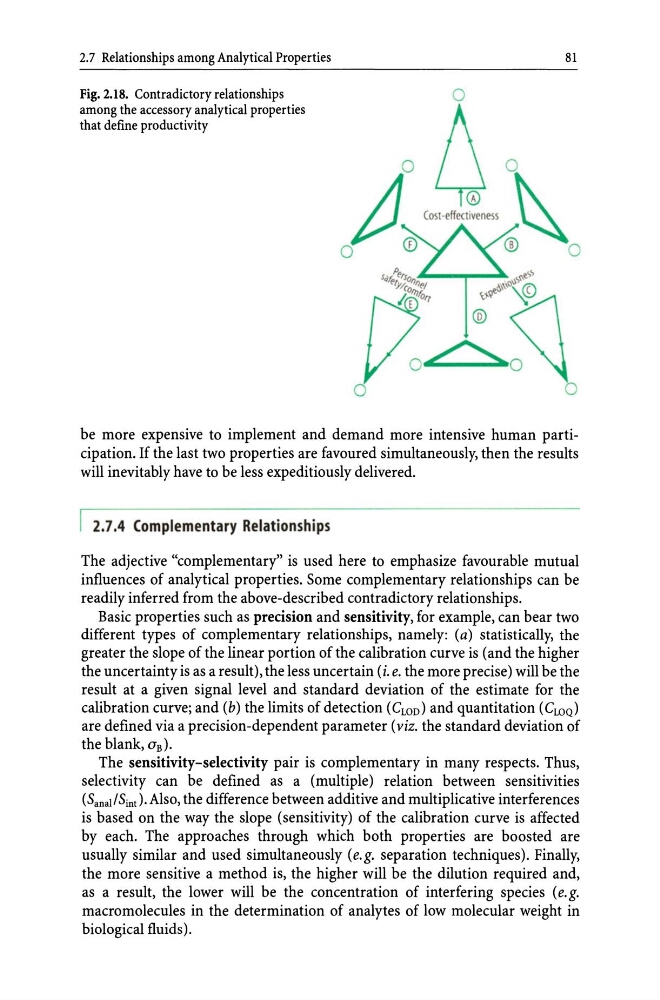
Fig. 2.18. Contradictory relationships
among the accessory analytical properties
that define productivity
81
o
o
0
jJ ( ' ' ' ' f f ' ' ~' ' ' ' ~
o
CD
®
0
be more expensive to implement and demand more intensive human participation. If the last two properties are favoured simultaneously, then the results
will inevitably have to be less expeditiously delivered.
I 2.7.4 Complementary Relationships
The adjective "complementary" is used here to emphasize favourable mutual
influences of analytical properties. Some complementary relationships can be
readily inferred from the above-described contradictory relationships.
Basic properties such as precision and sensitivity, for example, can bear two
different types of complementary relationships, namely: (a) statistically, the
greater the slope of the linear portion of the calibration curve is (and the higher
the uncertainty is as a result), the less uncertain (i. e. the more precise) will be the
result at a given signal level and standard deviation of the estimate for the
calibration curve; and (b) the limits of detection (CLOD) and quantitation (C LOQ )
are defined via a precision-dependent parameter (viz. the standard deviation of
the blank, aB).
The sensitivity-selectivity pair is complementary in many respects. Thus,
selectivity can be defined as a (multiple) relation between sensitivities
(Sanal / Sint). Also, the difference between additive and multiplicative interferences
is based on the way the slope (sensitivity) of the calibration curve is affected
by each. The approaches through which both properties are boosted are
usually similar and used simultaneously (e.g. separation techniques). Finally,
the more sensitive a method is, the higher will be the dilution required and,
as a result, the lower will be the concentration of interfering species (e. g.
macromolecules in the determination of analytes of low molecular weight in
biological fluids) .
Fig. 2.18. Contradictory relationships
among the accessory analytical properties
that define productivity
81
o
o
0
jJ ( ' ' ' ' f f ' ' ~' ' ' ' ~
o
CD
®
0
be more expensive to implement and demand more intensive human participation. If the last two properties are favoured simultaneously, then the results
will inevitably have to be less expeditiously delivered.
I 2.7.4 Complementary Relationships
The adjective "complementary" is used here to emphasize favourable mutual
influences of analytical properties. Some complementary relationships can be
readily inferred from the above-described contradictory relationships.
Basic properties such as precision and sensitivity, for example, can bear two
different types of complementary relationships, namely: (a) statistically, the
greater the slope of the linear portion of the calibration curve is (and the higher
the uncertainty is as a result), the less uncertain (i. e. the more precise) will be the
result at a given signal level and standard deviation of the estimate for the
calibration curve; and (b) the limits of detection (CLOD) and quantitation (C LOQ )
are defined via a precision-dependent parameter (viz. the standard deviation of
the blank, aB).
The sensitivity-selectivity pair is complementary in many respects. Thus,
selectivity can be defined as a (multiple) relation between sensitivities
(Sanal / Sint). Also, the difference between additive and multiplicative interferences
is based on the way the slope (sensitivity) of the calibration curve is affected
by each. The approaches through which both properties are boosted are
usually similar and used simultaneously (e.g. separation techniques). Finally,
the more sensitive a method is, the higher will be the dilution required and,
as a result, the lower will be the concentration of interfering species (e. g.
macromolecules in the determination of analytes of low molecular weight in
biological fluids) .