

2.5 Basic Analytical Properties
1
Detection
region
j
1
Bhnd legion
r-------- "--"==~
DeCISion
region
1
Quantnallon
region
l
UMITOF
QUANTITATION
Analyte
(on(enuatlon
Analyte
Signal
69
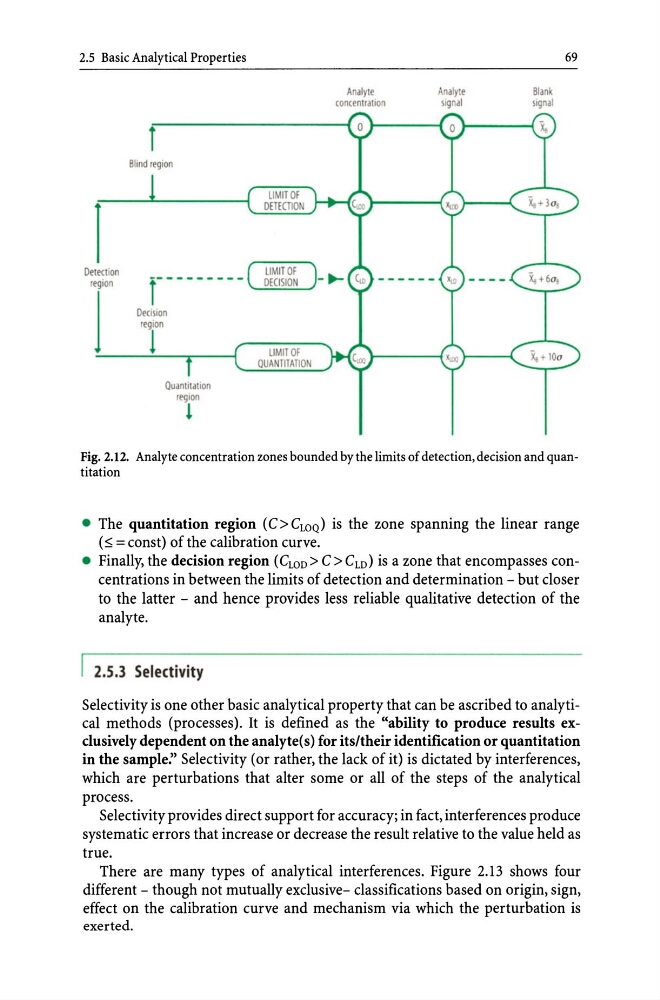
Fig. 2.12. Analyte concentration zones bounded by the limits of detection, decision and quantitation
• The quantitation region (C > C LOQ ) is the zone spanning the linear range
(:::; = const) of the calibration curve .
• Finally, the decision region (CLOD> C > CLD ) is a zone that encompasses concentrations in between the limits of detection and determination - but closer
to the latter - and hence provides less reliable qualitative detection of the
analyte.
2.S.3 Selectivity
Selectivity is one other basic analytical property that can be ascribed to analytical methods (processes). It is defined as the "ability to produce results exclusively dependent on the analyte(s) for its/their identification or quantitation
in the sample!' Selectivity (or rather, the lack of it) is dictated by interferences,
which are perturbations that alter some or all of the steps of the analytical
process.
Selectivity provides direct support for accuracy; in fact, interferences produce
systematic errors that increase or decrease the result relative to the value held as
true.
There are many types of analytical interferences. Figure 2.13 shows four
different - though not mutually exclusive- classifications based on origin, sign,
effect on the calibration curve and mechanism via which the perturbation is
exerted.
1
Detection
region
j
1
Bhnd legion
r-------- "--"==~
DeCISion
region
1
Quantnallon
region
l
UMITOF
QUANTITATION
Analyte
(on(enuatlon
Analyte
Signal
69
Fig. 2.12. Analyte concentration zones bounded by the limits of detection, decision and quantitation
• The quantitation region (C > C LOQ ) is the zone spanning the linear range
(:::; = const) of the calibration curve .
• Finally, the decision region (CLOD> C > CLD ) is a zone that encompasses concentrations in between the limits of detection and determination - but closer
to the latter - and hence provides less reliable qualitative detection of the
analyte.
2.S.3 Selectivity
Selectivity is one other basic analytical property that can be ascribed to analytical methods (processes). It is defined as the "ability to produce results exclusively dependent on the analyte(s) for its/their identification or quantitation
in the sample!' Selectivity (or rather, the lack of it) is dictated by interferences,
which are perturbations that alter some or all of the steps of the analytical
process.
Selectivity provides direct support for accuracy; in fact, interferences produce
systematic errors that increase or decrease the result relative to the value held as
true.
There are many types of analytical interferences. Figure 2.13 shows four
different - though not mutually exclusive- classifications based on origin, sign,
effect on the calibration curve and mechanism via which the perturbation is
exerted.