

8.6 Assessment of Analytical Quality
329
Assessment actions can be carried out by three different types of human groups,
namely: laboratory staff, personnel from the body to which the laboratory belongs but not directly engaged in it (e. g. staff from the QAU established within
the framework of GLPs), or individuals belonging to neither the laboratory nor
its parent body. When the first criterion in Fig. 8.11 - the most widely used - is
adopted, the laboratory staff sets the distinction; when the second criterion is
assumed, the decision is made by the parent body. For simplicity, only the first
criterion is considered here.
Internal assessment is conducted by laboratory staff concerned exclusively
with laboratory quality alone or with routine tasks and assessment duties as
well. Accurately, unequivocally distinguishing internal assessment and quality
control activities is made difficult by the fact that both are conducted by the
same personnel - no doubt, they share some characteristics. In any case, assessment activities involve more than quality control activities (e.g. qualitative
aspects, global assessment, examining organization and management). Blind
samples are a typical example of ill-defined interface between quality control
and assessment - someone in the laboratory staff must ultimately introduce
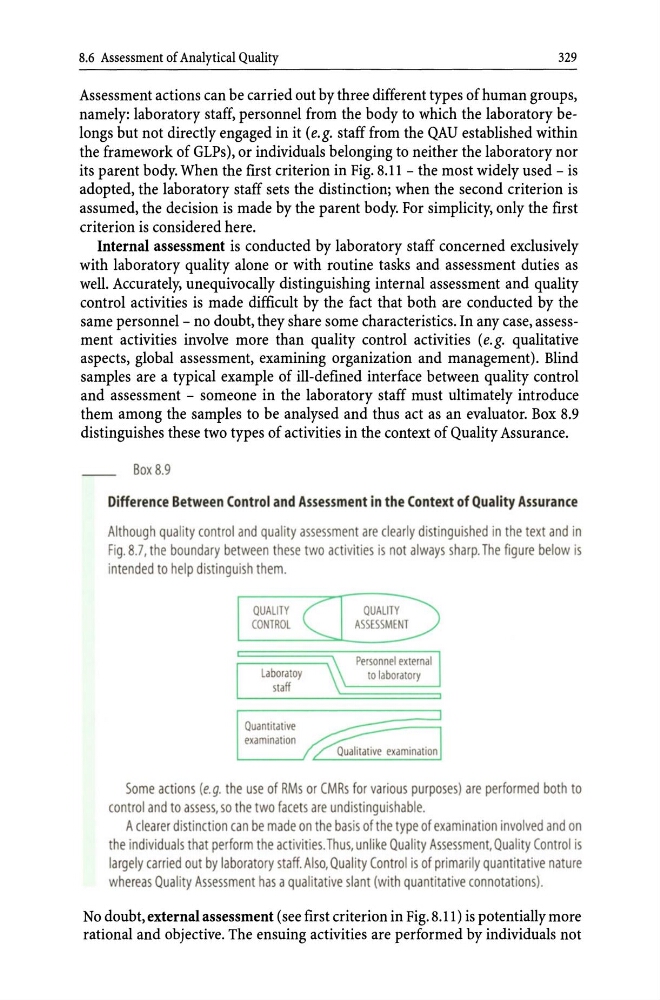
them among the samples to be analysed and thus act as an evaluator. Box 8.9
distinguishes these two types of activities in the context of Quality Assurance.
Box 8.9
Difference Between Control and Assessment in the Context of Quality Assurance
Although quality control and quality assessment are clearly distinguished in the text and in
Fig. 8.7, the boundary between these two activities is not always sharp. The figure below is
intended to help distinguish them.
QUALITY
CONTROL
LaboralOy
staff
Quantitative
examination
QUALITY
ASSESSMENT
Personnel external
to laboratory
Some actions (e. g. the use of RMs or CMRs for various purposes) are performed both to
control and to assess, so the two facets are undistinguishable.
A clearer distinction can be made on the basis of the type of examination involved and on
the individuals that perform the activities. Thus, un like Quality Assessment, Quality Control is
largely carried out by laboratory staff. Also, Quality Control is of primarily quantitative nature
whereas Quality Assessment has a qualitative slant (with quantitative connotations).
No doubt, external assessment (see first criterion in Fig. 8.11) is potentially more
rational and objective. The ensuing activities are performed by individuals not
329
Assessment actions can be carried out by three different types of human groups,
namely: laboratory staff, personnel from the body to which the laboratory belongs but not directly engaged in it (e. g. staff from the QAU established within
the framework of GLPs), or individuals belonging to neither the laboratory nor
its parent body. When the first criterion in Fig. 8.11 - the most widely used - is
adopted, the laboratory staff sets the distinction; when the second criterion is
assumed, the decision is made by the parent body. For simplicity, only the first
criterion is considered here.
Internal assessment is conducted by laboratory staff concerned exclusively
with laboratory quality alone or with routine tasks and assessment duties as
well. Accurately, unequivocally distinguishing internal assessment and quality
control activities is made difficult by the fact that both are conducted by the
same personnel - no doubt, they share some characteristics. In any case, assessment activities involve more than quality control activities (e.g. qualitative
aspects, global assessment, examining organization and management). Blind
samples are a typical example of ill-defined interface between quality control
and assessment - someone in the laboratory staff must ultimately introduce
them among the samples to be analysed and thus act as an evaluator. Box 8.9
distinguishes these two types of activities in the context of Quality Assurance.
Box 8.9
Difference Between Control and Assessment in the Context of Quality Assurance
Although quality control and quality assessment are clearly distinguished in the text and in
Fig. 8.7, the boundary between these two activities is not always sharp. The figure below is
intended to help distinguish them.
QUALITY
CONTROL
LaboralOy
staff
Quantitative
examination
QUALITY
ASSESSMENT
Personnel external
to laboratory
Some actions (e. g. the use of RMs or CMRs for various purposes) are performed both to
control and to assess, so the two facets are undistinguishable.
A clearer distinction can be made on the basis of the type of examination involved and on
the individuals that perform the activities. Thus, un like Quality Assessment, Quality Control is
largely carried out by laboratory staff. Also, Quality Control is of primarily quantitative nature
whereas Quality Assessment has a qualitative slant (with quantitative connotations).
No doubt, external assessment (see first criterion in Fig. 8.11) is potentially more
rational and objective. The ensuing activities are performed by individuals not