

328
8 Analytical Chemistry and Quality
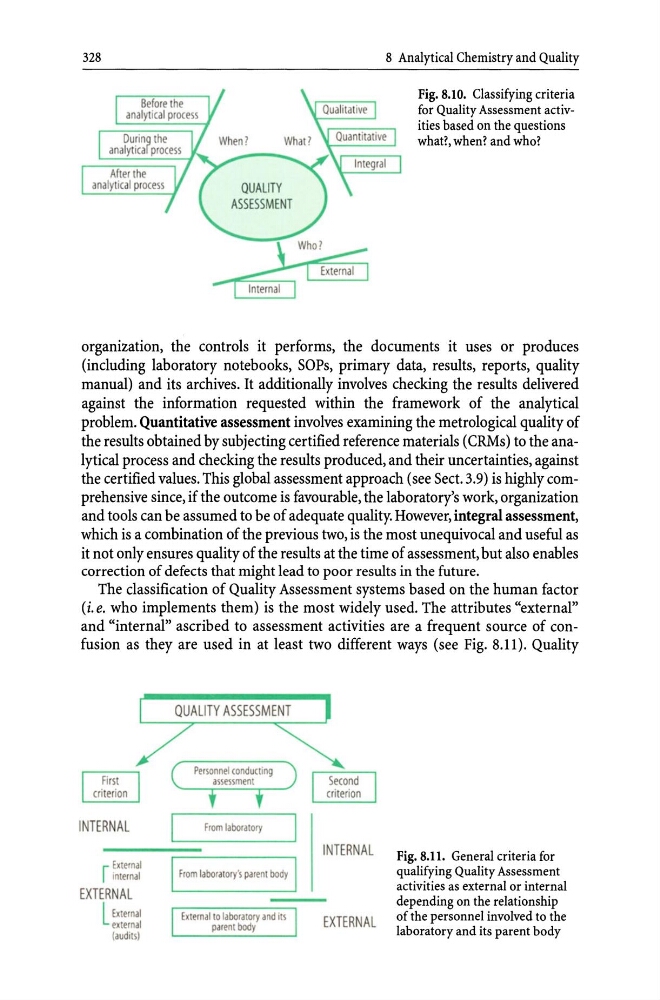
Fig.8.l0. Classifying criteria
for Quality Assessment activities based on the questions
what?, when? and who?
organization, the controls it performs, the documents it uses or produces
(including laboratory notebooks, SOPs, primary data, results, reports, quality
manual) and its archives. It additionally involves checking the results delivered
against the information requested within the framework of the analytical
problem. Quantitative assessment involves examining the metrological quality of
the results obtained by subjecting certified reference materials (CRMs) to the analytical process and checking the results produced, and their uncertainties, against
the certified values. This global assessment approach (see Sect. 3.9) is highly comprehensive since, if the outcome is favourable, the laboratory's work, organization
and tools can be assumed to be of adequate quality. However, integral assessment,
which is a combination of the previous two, is the most unequivocal and useful as
it not only ensures quality of the results at the time of assessment, but also enables
correction of defects that might lead to poor results in the future.
The classification of Quality Assessment systems based on the human factor
(i. e. who implements them) is the most widely used. The attributes "external"
and "internal" ascribed to assessment activities are a frequent source of confusion as they are used in at least two different ways (see Fig. 8.11). Quality
INTERNAL
r
External
internal
EXTERNAL
L External
external
(audits)
From laboratory
From laboratory's parent body
External to laboratory and I S
parent body
INTERNAL
EXTERNAL
Fig. 8.11. General criteria for
qualifying Quality Assessment
activities as external or internal
depending on the relationship
of the personnel involved to the
laboratory and its parent body
8 Analytical Chemistry and Quality
Fig.8.l0. Classifying criteria
for Quality Assessment activities based on the questions
what?, when? and who?
organization, the controls it performs, the documents it uses or produces
(including laboratory notebooks, SOPs, primary data, results, reports, quality
manual) and its archives. It additionally involves checking the results delivered
against the information requested within the framework of the analytical
problem. Quantitative assessment involves examining the metrological quality of
the results obtained by subjecting certified reference materials (CRMs) to the analytical process and checking the results produced, and their uncertainties, against
the certified values. This global assessment approach (see Sect. 3.9) is highly comprehensive since, if the outcome is favourable, the laboratory's work, organization
and tools can be assumed to be of adequate quality. However, integral assessment,
which is a combination of the previous two, is the most unequivocal and useful as
it not only ensures quality of the results at the time of assessment, but also enables
correction of defects that might lead to poor results in the future.
The classification of Quality Assessment systems based on the human factor
(i. e. who implements them) is the most widely used. The attributes "external"
and "internal" ascribed to assessment activities are a frequent source of confusion as they are used in at least two different ways (see Fig. 8.11). Quality
INTERNAL
r
External
internal
EXTERNAL
L External
external
(audits)
From laboratory
From laboratory's parent body
External to laboratory and I S
parent body
INTERNAL
EXTERNAL
Fig. 8.11. General criteria for
qualifying Quality Assessment
activities as external or internal
depending on the relationship
of the personnel involved to the
laboratory and its parent body