

16
1 Introduction to Analytical Chemistry
Analytical
tools and
processes
CD
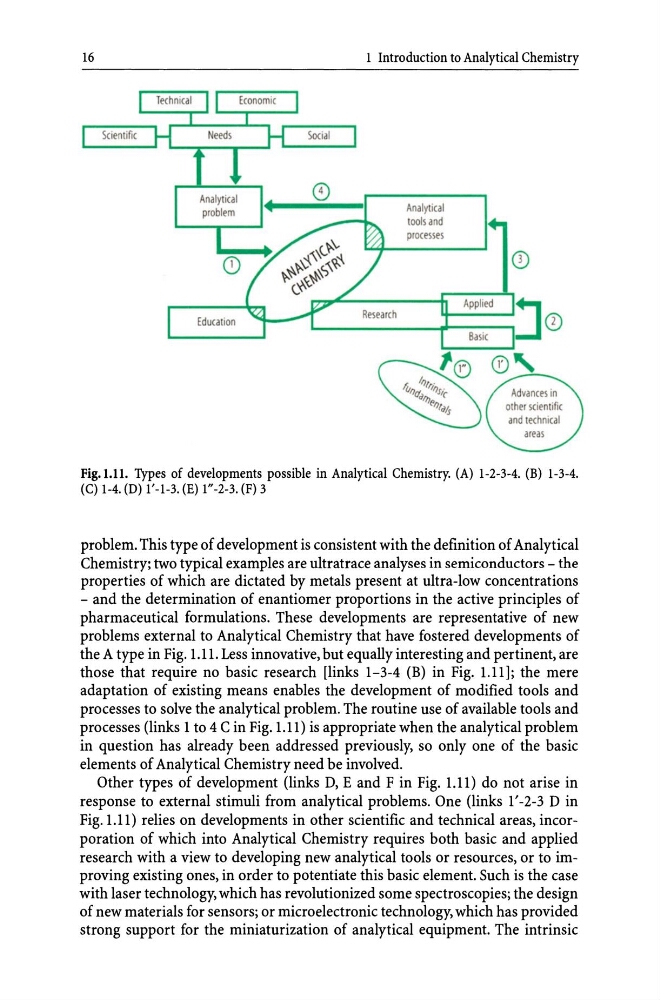
Fig.l.ll. Types of developments possible in Analytical Chemistry. (A) 1-2-3-4. (B) 1-3-4.
(C) 1-4. (D) 1'-1-3. (E) 1"-2-3. (F) 3
problem. This type of development is consistent with the definition of Analytical
Chemistry; two typical examples are ultratrace analyses in semiconductors - the
properties of which are dictated by metals present at ultra-low concentrations
- and the determination of enantiomer proportions in the active principles of
pharmaceutical formulations. These developments are representative of new
problems external to Analytical Chemistry that have fostered developments of
the A type in Fig. 1.11. Less innovative, but equally interesting and pertinent, are
those that require no basic research [links 1-3-4 (B) in Fig. 1.11]; the mere
adaptation of existing means enables the development of modified tools and
processes to solve the analytical problem. The routine use of available tools and
processes (links 1 to 4 C in Fig. 1.11) is appropriate when the analytical problem
in question has already been addressed previously, so only one of the basic
elements of Analytical Chemistry need be involved.
Other types of development (links D, E and F in Fig. 1.11) do not arise in
response to external stimuli from analytical problems. One (links 1'-2-3 D in
Fig. 1.11) relies on developments in other scientific and technical areas, incorporation of which into Analytical Chemistry requires both basic and applied
research with a view to developing new analytical tools or resources, or to improving existing ones, in order to potentiate this basic element. Such is the case
with laser technology, which has revolutionized some spectroscopies; the design
of new materials for sensors; or microelectronic technology, which has provided
strong support for the miniaturization of analytical equipment. The intrinsic
1 Introduction to Analytical Chemistry
Analytical
tools and
processes
CD
Fig.l.ll. Types of developments possible in Analytical Chemistry. (A) 1-2-3-4. (B) 1-3-4.
(C) 1-4. (D) 1'-1-3. (E) 1"-2-3. (F) 3
problem. This type of development is consistent with the definition of Analytical
Chemistry; two typical examples are ultratrace analyses in semiconductors - the
properties of which are dictated by metals present at ultra-low concentrations
- and the determination of enantiomer proportions in the active principles of
pharmaceutical formulations. These developments are representative of new
problems external to Analytical Chemistry that have fostered developments of
the A type in Fig. 1.11. Less innovative, but equally interesting and pertinent, are
those that require no basic research [links 1-3-4 (B) in Fig. 1.11]; the mere
adaptation of existing means enables the development of modified tools and
processes to solve the analytical problem. The routine use of available tools and
processes (links 1 to 4 C in Fig. 1.11) is appropriate when the analytical problem
in question has already been addressed previously, so only one of the basic
elements of Analytical Chemistry need be involved.
Other types of development (links D, E and F in Fig. 1.11) do not arise in
response to external stimuli from analytical problems. One (links 1'-2-3 D in
Fig. 1.11) relies on developments in other scientific and technical areas, incorporation of which into Analytical Chemistry requires both basic and applied
research with a view to developing new analytical tools or resources, or to improving existing ones, in order to potentiate this basic element. Such is the case
with laser technology, which has revolutionized some spectroscopies; the design
of new materials for sensors; or microelectronic technology, which has provided
strong support for the miniaturization of analytical equipment. The intrinsic