

1.4 Essential Features of Analytical Chemistry
Metrology
Scientific and technical
social and economic
problems
~ - - - - - - ... 1 L... ...--_ IN_F_ OR _M _A _ Tl_ ON _---II----.
•
.:- -ChaPW2~:; :
--- -Analytical
properties
t
; ",
; 'b I
I ri:: I
,' ~/ r-I . . . . . . . . Q - u .... al: .... i ty--,I .. _ J
.. , ,
~------------ ______ I
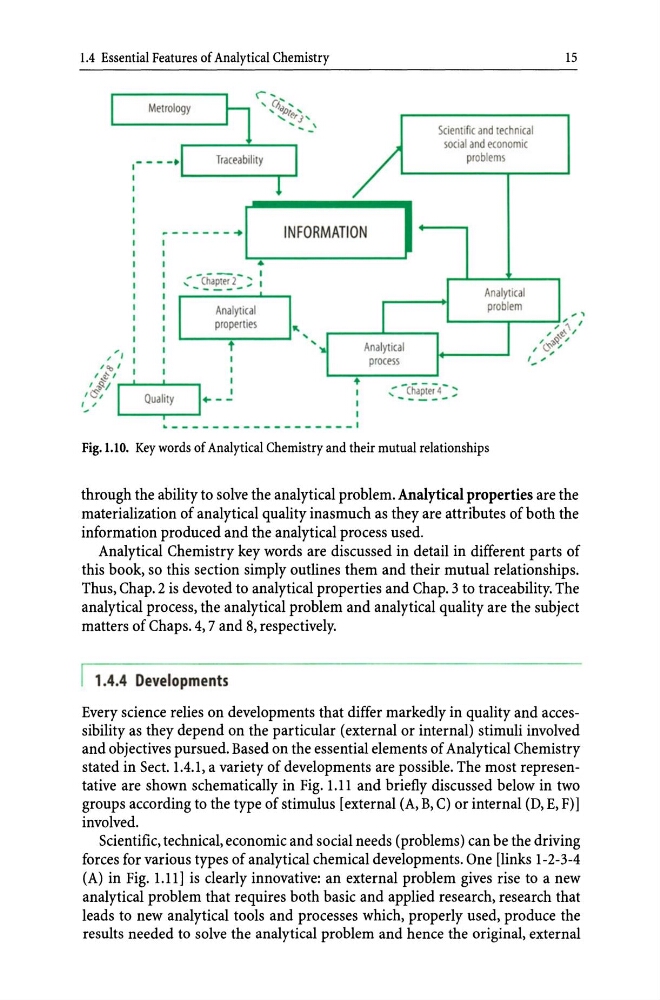
Fig.l.lO. Key words of Analytical Chemistry and their mutual relationships
15
through the ability to solve the analytical problem. Analytical properties are the
materialization of analytical quality inasmuch as they are attributes of both the
information produced and the analytical process used.
Analytical Chemistry key words are discussed in detail in different parts of
this book, so this section simply outlines them and their mutual relationships.
Thus, Chap. 2 is devoted to analytical properties and Chap. 3 to traceability. The
analytical process, the analytical problem and analytical quality are the subject
matters of Chaps. 4, 7 and 8, respectively.
I 1.4.4 Developments
Every science relies on developments that differ markedly in quality and accessibility as they depend on the particular (external or internal) stimuli involved
and objectives pursued. Based on the essential elements of Analytical Chemistry
stated in Sect. 1.4.1, a variety of developments are possible. The most representative are shown schematically in Fig. 1.11 and briefly discussed below in two
groups according to the type of stimulus [external (A, B, C) or internal (D, E, F)]
involved.
Scientific, technical, economic and social needs (problems) can be the driving
forces for various types of analytical chemical developments. One [links 1-2-3-4
(A) in Fig. 1.11] is dearly innovative: an external problem gives rise to a new
analytical problem that requires both basic and applied research, research that
leads to new analytical tools and processes which, properly used, produce the
results needed to solve the analytical problem and hence the original, external
Metrology
Scientific and technical
social and economic
problems
~ - - - - - - ... 1 L... ...--_ IN_F_ OR _M _A _ Tl_ ON _---II----.
•
.:- -ChaPW2~:; :
--- -Analytical
properties
t
; ",
; 'b I
I ri:: I
,' ~/ r-I . . . . . . . . Q - u .... al: .... i ty--,I .. _ J
.. , ,
~------------ ______ I
Fig.l.lO. Key words of Analytical Chemistry and their mutual relationships
15
through the ability to solve the analytical problem. Analytical properties are the
materialization of analytical quality inasmuch as they are attributes of both the
information produced and the analytical process used.
Analytical Chemistry key words are discussed in detail in different parts of
this book, so this section simply outlines them and their mutual relationships.
Thus, Chap. 2 is devoted to analytical properties and Chap. 3 to traceability. The
analytical process, the analytical problem and analytical quality are the subject
matters of Chaps. 4, 7 and 8, respectively.
I 1.4.4 Developments
Every science relies on developments that differ markedly in quality and accessibility as they depend on the particular (external or internal) stimuli involved
and objectives pursued. Based on the essential elements of Analytical Chemistry
stated in Sect. 1.4.1, a variety of developments are possible. The most representative are shown schematically in Fig. 1.11 and briefly discussed below in two
groups according to the type of stimulus [external (A, B, C) or internal (D, E, F)]
involved.
Scientific, technical, economic and social needs (problems) can be the driving
forces for various types of analytical chemical developments. One [links 1-2-3-4
(A) in Fig. 1.11] is dearly innovative: an external problem gives rise to a new
analytical problem that requires both basic and applied research, research that
leads to new analytical tools and processes which, properly used, produce the
results needed to solve the analytical problem and hence the original, external