

Questions
301
I Questions
(1) What is "fitness for purpose" in Analytical Chemistry?
(2) Based on the contents of Box 7.1, name several social-economic problems
calling for analytical information.
(3) Give some examples to materialize the different ways of defining "problem"
in Analytical Chemistry (see Fig. 7.2).
(4) Why are the client's needs and opinion so significant to the applied side of
Analytical Chemistry?
(5) Identify the ranking-problem-object-sample-analyte sequence in five
specific examples. Use Box 1.11 as reference.
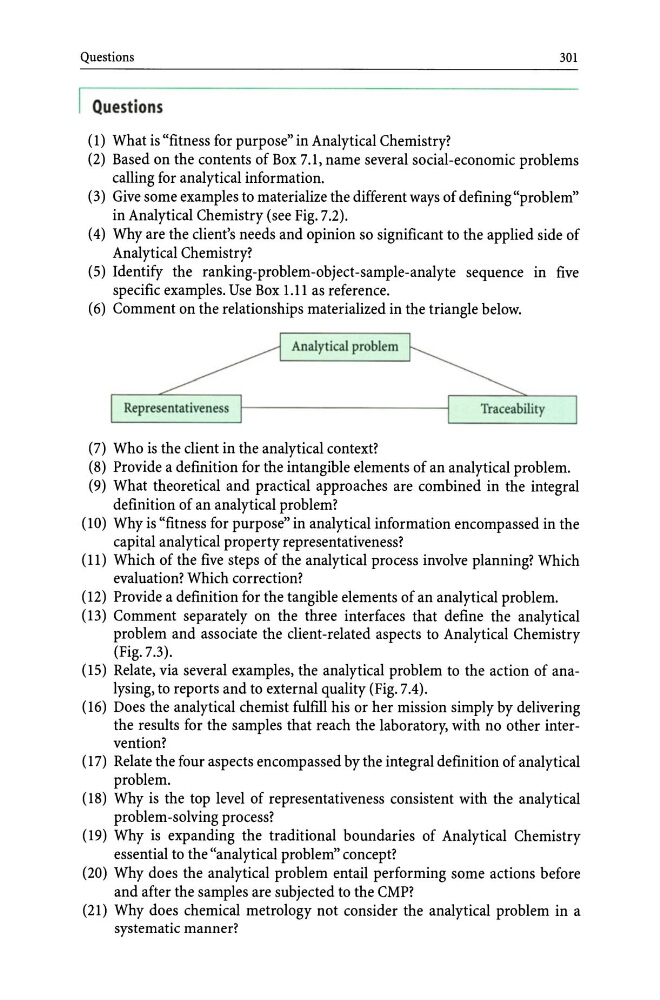
(6) Comment on the relationships materialized in the triangle below.
Analytical problem
Representativeness
Traceability
(7) Who is the client in the analytical context?
(8) Provide a definition for the intangible elements of an analytical problem.
(9) What theoretical and practical approaches are combined in the integral
definition of an analytical problem?
(10) Why is "fitness for purpose" in analytical information encompassed in the
capital analytical property representativeness?
(11) Which of the five steps of the analytical process involve planning? Which
evaluation? Which correction?
(12) Provide a definition for the tangible elements of an analytical problem.
(13) Comment separately on the three interfaces that define the analytical
problem and associate the client-related aspects to Analytical Chemistry
(Fig. 7.3).
(15) Relate, via several examples, the analytical problem to the action of analysing, to reports and to external quality (Fig. 7.4).
(16) Does the analytical chemist fulfill his or her mission simply by delivering
the results for the samples that reach the laboratory, with no other intervention?
(17) Relate the four aspects encompassed by the integral definition of analytical
problem.
(18) Why is the top level of representativeness consistent with the analytical
problem-solving process?
(19) Why is expanding the traditional boundaries of Analytical Chemistry
essential to the "analytical problem" concept?
(20) Why does the analytical problem entail performing some actions before
and after the samples are subjected to the CMP?
(21) Why does chemical metrology not consider the analytical problem in a
systematic manner?
301
I Questions
(1) What is "fitness for purpose" in Analytical Chemistry?
(2) Based on the contents of Box 7.1, name several social-economic problems
calling for analytical information.
(3) Give some examples to materialize the different ways of defining "problem"
in Analytical Chemistry (see Fig. 7.2).
(4) Why are the client's needs and opinion so significant to the applied side of
Analytical Chemistry?
(5) Identify the ranking-problem-object-sample-analyte sequence in five
specific examples. Use Box 1.11 as reference.
(6) Comment on the relationships materialized in the triangle below.
Analytical problem
Representativeness
Traceability
(7) Who is the client in the analytical context?
(8) Provide a definition for the intangible elements of an analytical problem.
(9) What theoretical and practical approaches are combined in the integral
definition of an analytical problem?
(10) Why is "fitness for purpose" in analytical information encompassed in the
capital analytical property representativeness?
(11) Which of the five steps of the analytical process involve planning? Which
evaluation? Which correction?
(12) Provide a definition for the tangible elements of an analytical problem.
(13) Comment separately on the three interfaces that define the analytical
problem and associate the client-related aspects to Analytical Chemistry
(Fig. 7.3).
(15) Relate, via several examples, the analytical problem to the action of analysing, to reports and to external quality (Fig. 7.4).
(16) Does the analytical chemist fulfill his or her mission simply by delivering
the results for the samples that reach the laboratory, with no other intervention?
(17) Relate the four aspects encompassed by the integral definition of analytical
problem.
(18) Why is the top level of representativeness consistent with the analytical
problem-solving process?
(19) Why is expanding the traditional boundaries of Analytical Chemistry
essential to the "analytical problem" concept?
(20) Why does the analytical problem entail performing some actions before
and after the samples are subjected to the CMP?
(21) Why does chemical metrology not consider the analytical problem in a
systematic manner?