

7.3 Integral Definition of Analytical Problem
287
interfacial nature, (b) its relationships in the context of the rankings inherent in
Analytical Chemistry, (c) its relationship to the capital property traceability and
(d) its involvement in the collapse of traditional laboratory barriers.
The analytical problem can be viewed as an active two-way interface between
the "client" requiring the information and the analytical chemist supplying it.
Quality in this context can be defined in a practical, categorical manner, as
satisfying the client; the analytical problem therefore possesses a high strategic
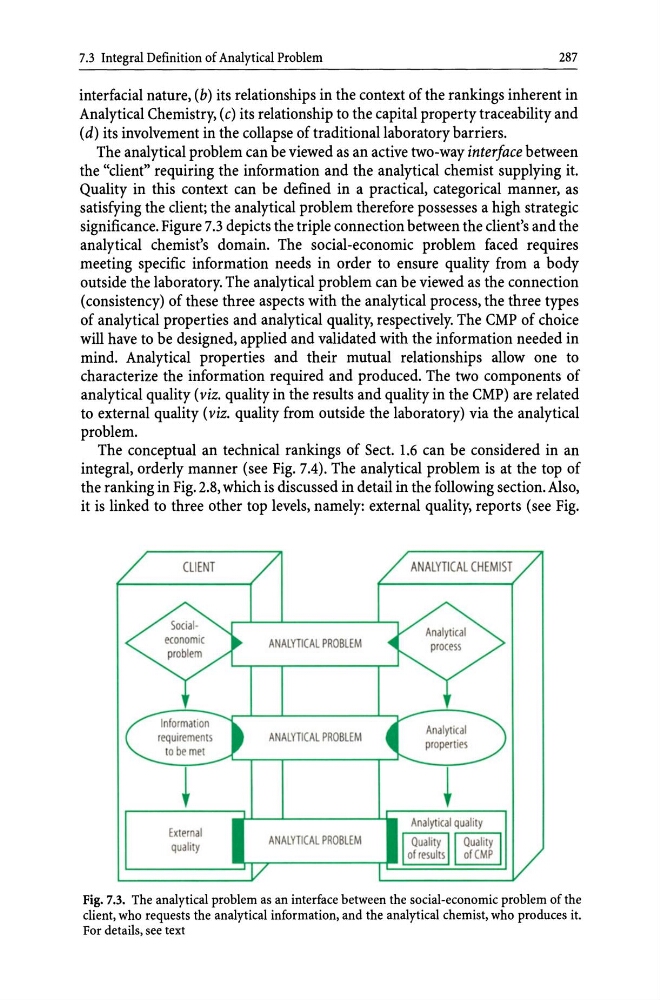
significance. Figure 7.3 depicts the triple connection between the client's and the
analytical chemist's domain. The social-economic problem faced requires
meeting specific information needs in order to ensure quality from a body
outside the laboratory. The analytical problem can be viewed as the connection
(consistency) of these three aspects with the analytical process, the three types
of analytical properties and analytical quality, respectively. The CMP of choice
will have to be designed, applied and validated with the information needed in
mind. Analytical properties and their mutual relationships allow one to
characterize the information required and produced. The two components of
analytical quality (viz. quality in the results and quality in the CMP) are related
to external quality (viz. quality from outside the laboratory) via the analytical
problem.
The conceptual an technical rankings of Sect. 1.6 can be considered in an
integral, orderly manner (see Fig. 7.4). The analytical problem is at the top of
the ranking in Fig. 2.8, which is discussed in detail in the following section. Also,
it is linked to three other top levels, namely: external quality, reports (see Fig.
ANALYTICAL CHEMIST
ANALYTICAL PROBLEM
requirements
ANALYTICAL PROBLEM
to bernet
~
~
External
quality
ANALYTICAL PROBLEM
Fig. 7.3. The analytical problem as an interface between the social-economic problem of the
client, who requests the analytical information, and the analytical chemist, who produces it.
For details, see text
287
interfacial nature, (b) its relationships in the context of the rankings inherent in
Analytical Chemistry, (c) its relationship to the capital property traceability and
(d) its involvement in the collapse of traditional laboratory barriers.
The analytical problem can be viewed as an active two-way interface between
the "client" requiring the information and the analytical chemist supplying it.
Quality in this context can be defined in a practical, categorical manner, as
satisfying the client; the analytical problem therefore possesses a high strategic
significance. Figure 7.3 depicts the triple connection between the client's and the
analytical chemist's domain. The social-economic problem faced requires
meeting specific information needs in order to ensure quality from a body
outside the laboratory. The analytical problem can be viewed as the connection
(consistency) of these three aspects with the analytical process, the three types
of analytical properties and analytical quality, respectively. The CMP of choice
will have to be designed, applied and validated with the information needed in
mind. Analytical properties and their mutual relationships allow one to
characterize the information required and produced. The two components of
analytical quality (viz. quality in the results and quality in the CMP) are related
to external quality (viz. quality from outside the laboratory) via the analytical
problem.
The conceptual an technical rankings of Sect. 1.6 can be considered in an
integral, orderly manner (see Fig. 7.4). The analytical problem is at the top of
the ranking in Fig. 2.8, which is discussed in detail in the following section. Also,
it is linked to three other top levels, namely: external quality, reports (see Fig.
ANALYTICAL CHEMIST
ANALYTICAL PROBLEM
requirements
ANALYTICAL PROBLEM
to bernet
~
~
External
quality
ANALYTICAL PROBLEM
Fig. 7.3. The analytical problem as an interface between the social-economic problem of the
client, who requests the analytical information, and the analytical chemist, who produces it.
For details, see text