

272
Pure analyte
standards
Calibration
Sample
Sample
6 Quantitative Aspects of Analytical Chemistry
INTERPOLATION AND EXTRAPOLATION METHODS
Preliminary
operations (PO)
Analytical process (CMP)
Signals
Signal·
concentration
relation
Result
Comparison
~ (concentration
of analyte in
sample)
COMPARATIVE METHODS
Measurement and
transducing of
analytical signal
Signals
Analytical process (CMP)
Result
(concentration of
analyte in sample)
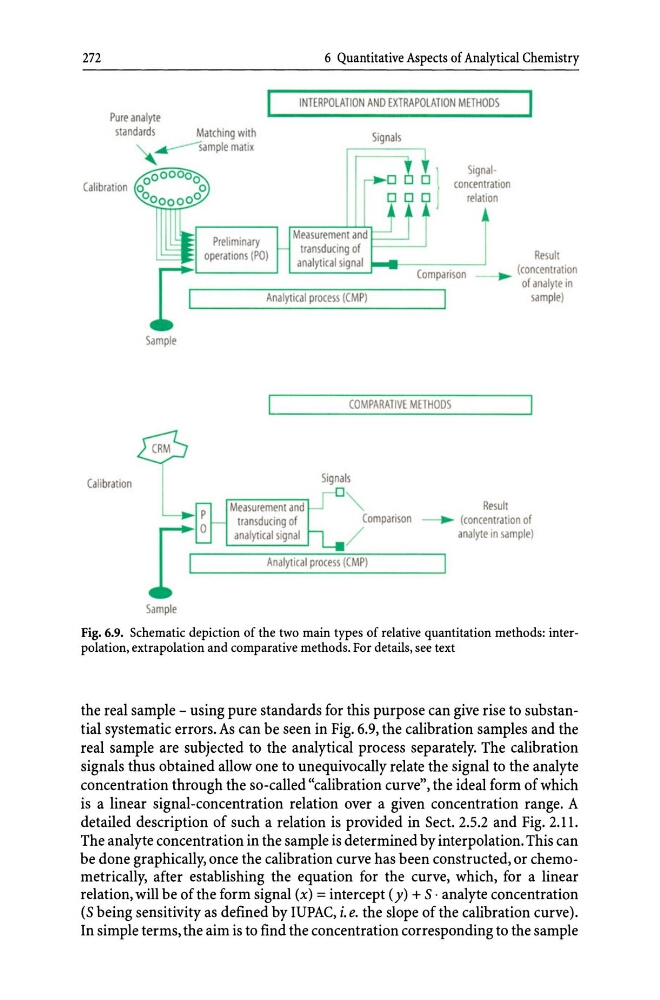
Fig. 6.9. Schematic depiction of the two main types of relative quantitation methods: interpolation, extrapolation and comparative methods. For details, see text
the real sample - using pure standards for this purpose can give rise to substantial systematic errors. As can be seen in Fig. 6.9, the calibration samples and the
real sample are subjected to the analytical process separately. The calibration
signals thus obtained allow one to unequivocally relate the signal to the analyte
concentration through the so-called "calibration curve", the ideal form of which
is a linear signal-concentration relation over a given concentration range. A
detailed description of such a relation is provided in Sect. 2.5.2 and Fig. 2.11.
The analyte concentration in the sample is determined by interpolation. This can
be done graphically, once the calibration curve has been constructed, or chemometrically, after establishing the equation for the curve, which, for a linear
relation, will be of the form signal (x) = intercept (y) + S · analyte concentration
(S being sensitivity as defined by IUPAC, i. e. the slope of the calibration curve).
In simple terms, the aim is to find the concentration corresponding to the sample
Pure analyte
standards
Calibration
Sample
Sample
6 Quantitative Aspects of Analytical Chemistry
INTERPOLATION AND EXTRAPOLATION METHODS
Preliminary
operations (PO)
Analytical process (CMP)
Signals
Signal·
concentration
relation
Result
Comparison
~ (concentration
of analyte in
sample)
COMPARATIVE METHODS
Measurement and
transducing of
analytical signal
Signals
Analytical process (CMP)
Result
(concentration of
analyte in sample)
Fig. 6.9. Schematic depiction of the two main types of relative quantitation methods: interpolation, extrapolation and comparative methods. For details, see text
the real sample - using pure standards for this purpose can give rise to substantial systematic errors. As can be seen in Fig. 6.9, the calibration samples and the
real sample are subjected to the analytical process separately. The calibration
signals thus obtained allow one to unequivocally relate the signal to the analyte
concentration through the so-called "calibration curve", the ideal form of which
is a linear signal-concentration relation over a given concentration range. A
detailed description of such a relation is provided in Sect. 2.5.2 and Fig. 2.11.
The analyte concentration in the sample is determined by interpolation. This can
be done graphically, once the calibration curve has been constructed, or chemometrically, after establishing the equation for the curve, which, for a linear
relation, will be of the form signal (x) = intercept (y) + S · analyte concentration
(S being sensitivity as defined by IUPAC, i. e. the slope of the calibration curve).
In simple terms, the aim is to find the concentration corresponding to the sample