

12
1 Introduction to Analytical Chemistry
I 1.4.1 Basic Elements
For Analytical Chemistry to conform to the above definition, it should embody
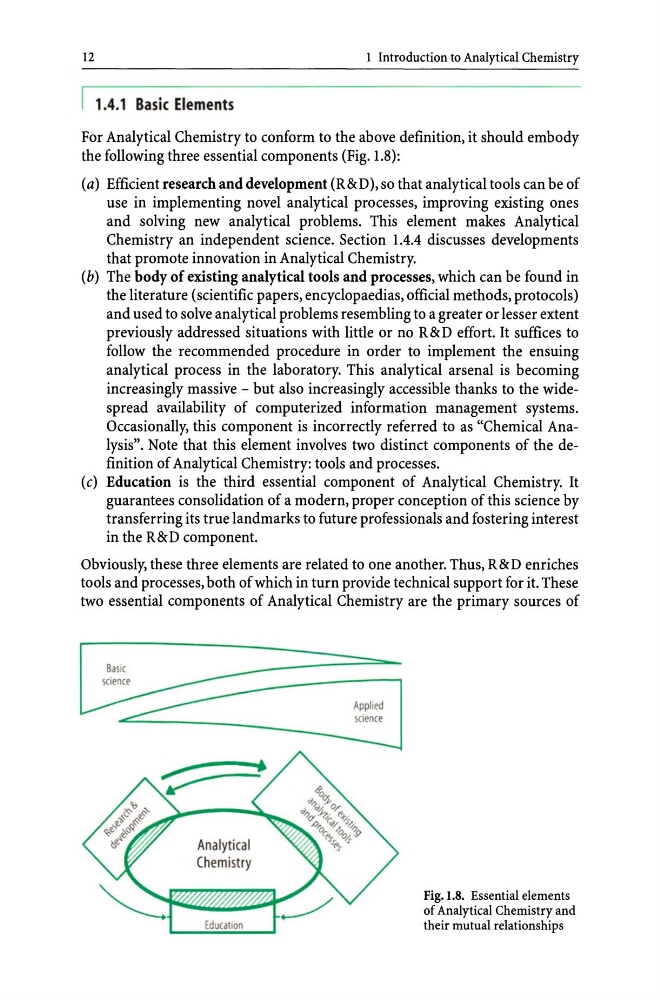
the following three essential components (Fig. 1.8):
(a) Efficient research and development (R&D),so that analytical tools can be of
use in implementing novel analytical processes, improving existing ones
and solving new analytical problems. This element makes Analytical
Chemistry an independent science. Section 1.4.4 discusses developments
that promote innovation in Analytical Chemistry.
(b) The body of existing analytical tools and processes, which can be found in
the literature (scientific papers, encyclopaedias, official methods, protocols)
and used to solve analytical problems resembling to a greater or lesser extent
previously addressed situations with little or no R&D effort. It suffices to
follow the recommended procedure in order to implement the ensuing
analytical process in the laboratory. This analytical arsenal is becoming
increasingly massive - but also increasingly accessible thanks to the widespread availability of computerized information management systems.
Occasionally, this component is incorrectly referred to as "Chemical Analysis". Note that this element involves two distinct components of the definition of Analytical Chemistry: tools and processes.
(c) Education is the third essential component of Analytical Chemistry. It
guarantees consolidation of a modern, proper conception of this science by
transferring its true landmarks to future professionals and fostering interest
in the R&D component.
Obviously, these three elements are related to one another. Thus, R&D enriches
tools and processes, both of which in turn provide technical support for it. These
two essential components of Analytical Chemistry are the primary sources of
Basic
sCience
-::l
...::::---------~----=:J
Fig. 1.8. Essential elements
of Analytical Chemistry and
their mutual relationships
1 Introduction to Analytical Chemistry
I 1.4.1 Basic Elements
For Analytical Chemistry to conform to the above definition, it should embody
the following three essential components (Fig. 1.8):
(a) Efficient research and development (R&D),so that analytical tools can be of
use in implementing novel analytical processes, improving existing ones
and solving new analytical problems. This element makes Analytical
Chemistry an independent science. Section 1.4.4 discusses developments
that promote innovation in Analytical Chemistry.
(b) The body of existing analytical tools and processes, which can be found in
the literature (scientific papers, encyclopaedias, official methods, protocols)
and used to solve analytical problems resembling to a greater or lesser extent
previously addressed situations with little or no R&D effort. It suffices to
follow the recommended procedure in order to implement the ensuing
analytical process in the laboratory. This analytical arsenal is becoming
increasingly massive - but also increasingly accessible thanks to the widespread availability of computerized information management systems.
Occasionally, this component is incorrectly referred to as "Chemical Analysis". Note that this element involves two distinct components of the definition of Analytical Chemistry: tools and processes.
(c) Education is the third essential component of Analytical Chemistry. It
guarantees consolidation of a modern, proper conception of this science by
transferring its true landmarks to future professionals and fostering interest
in the R&D component.
Obviously, these three elements are related to one another. Thus, R&D enriches
tools and processes, both of which in turn provide technical support for it. These
two essential components of Analytical Chemistry are the primary sources of
Basic
sCience
-::l
...::::---------~----=:J
Fig. 1.8. Essential elements
of Analytical Chemistry and
their mutual relationships