

6.2 Calculable Quantitation Methods
259
I 6.2.1.1 Gravimetry
This is a classical quantitation technique that provides the mass (or concentration) of an analyte from weighings of the analyte itself, a stoichiometric reaction
product or a derivative. The instrument used for this purpose is an analytical
balance, which is calibrated with transfer weights (see Box 3.5). The CMP uses no
analytical chemical reference materials and involves no method calibration, but
only equipment (balance) calibration, by means of non-analytical standards.
The short traceability chain, which leads to the kilogram prototype, usually
results in high accuracy and precision that make gravimetry a potential primary
method. On the other hand, accessory analytical properties are not so good: the
CMP is labour-intensive, time-consuming and difficult to automate as a whole.
__ Box 6.6
An Analytica l Process Based on the Gravimetric Technique
and Chemical Precipitation
8
Aliquot
Prepared
SAMPLE
~
first weighing 0 sample o +R
~
Filtration
o
Weighed form
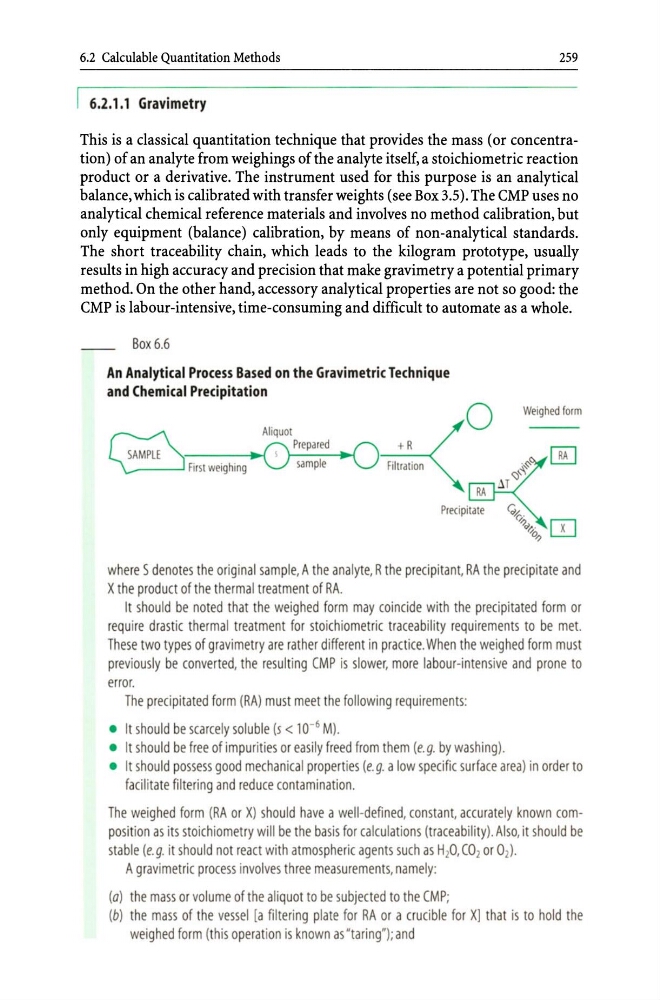
where S denotes the original sample, A the analyte, R the precipitant, RA the precipitate and
X the product of the thermal treatment of RA.
It should be noted that the weighed form may coincide with the precipitated form or
require drastic thermal treatment for stoichiometric traceability requirements to be met.
These two types of gravimetry are rather different in practice. When the weighed form must
previously be converted, the resulting CMP is slower, more labour-intensive and prone to
error.
The precipitated form (RA) must meet the following requirements:
• It should be scarcely soluble (5 < 10- 6 M).
• It should be free of impurities or easily freed from them (e. g. by washing).
• It should possess good mechanical properties (e. g. a low specific surface area) in order to
facilitate filtering and reduce contamination.
The weighed form (RA or X l should have a well-defined, constant, accurately known composition as its stoichiometry will be the basis for calculations (traceability). Also, it should be
stable (e. g. it should not react with atmospheric agents such as H20, CO2 or 02)'
A gravimetric process involves three measurements, namely:
(a) the mass or volume of the aliquot to be subjected to the CMP;
(b) the mass of the vessel [a filtering plate for RA or a crucible for Xl that is to hold the
weighed form (this operation is known as "taring"); and
259
I 6.2.1.1 Gravimetry
This is a classical quantitation technique that provides the mass (or concentration) of an analyte from weighings of the analyte itself, a stoichiometric reaction
product or a derivative. The instrument used for this purpose is an analytical
balance, which is calibrated with transfer weights (see Box 3.5). The CMP uses no
analytical chemical reference materials and involves no method calibration, but
only equipment (balance) calibration, by means of non-analytical standards.
The short traceability chain, which leads to the kilogram prototype, usually
results in high accuracy and precision that make gravimetry a potential primary
method. On the other hand, accessory analytical properties are not so good: the
CMP is labour-intensive, time-consuming and difficult to automate as a whole.
__ Box 6.6
An Analytica l Process Based on the Gravimetric Technique
and Chemical Precipitation
8
Aliquot
Prepared
SAMPLE
~
first weighing 0 sample o +R
~
Filtration
o
Weighed form
where S denotes the original sample, A the analyte, R the precipitant, RA the precipitate and
X the product of the thermal treatment of RA.
It should be noted that the weighed form may coincide with the precipitated form or
require drastic thermal treatment for stoichiometric traceability requirements to be met.
These two types of gravimetry are rather different in practice. When the weighed form must
previously be converted, the resulting CMP is slower, more labour-intensive and prone to
error.
The precipitated form (RA) must meet the following requirements:
• It should be scarcely soluble (5 < 10- 6 M).
• It should be free of impurities or easily freed from them (e. g. by washing).
• It should possess good mechanical properties (e. g. a low specific surface area) in order to
facilitate filtering and reduce contamination.
The weighed form (RA or X l should have a well-defined, constant, accurately known composition as its stoichiometry will be the basis for calculations (traceability). Also, it should be
stable (e. g. it should not react with atmospheric agents such as H20, CO2 or 02)'
A gravimetric process involves three measurements, namely:
(a) the mass or volume of the aliquot to be subjected to the CMP;
(b) the mass of the vessel [a filtering plate for RA or a crucible for Xl that is to hold the
weighed form (this operation is known as "taring"); and