

258
6 Quantitative Aspects of Analytical Chemistry
In order to measure temperature (PMP) one can use, for example, a precalibrated thermocouple. The "sample" has little influence here; in fact, the same instrument can be used (over
a certain temperature range) to measure this parameter in water, air and solids, with minimal
changes. This is also the case with measurements of distances between trees, walls, locations,
etc. In PMPs, the instrument may have to be adapted to different situations but will always
rely on direct measurements.
Direct measurements in absolute (MPs are scant. The instrument (a balance) is calibrated
with weight transfers (see Box 3.5). The gravimetric determination of calcium in a rock involves time-consuming operations such as grinding, dissolution, interference removal, addition of the precipitant (C 2 01-), and filtration, washing, and calcination of the precipitate at
500 °C prior to its gravimetric weighing (measurement). In add ition, one must previously
weigh the rock aliquot to be subjected to the CMP if the result is to be properly expressed
(e.g. % Ca, mg Ca/kg).
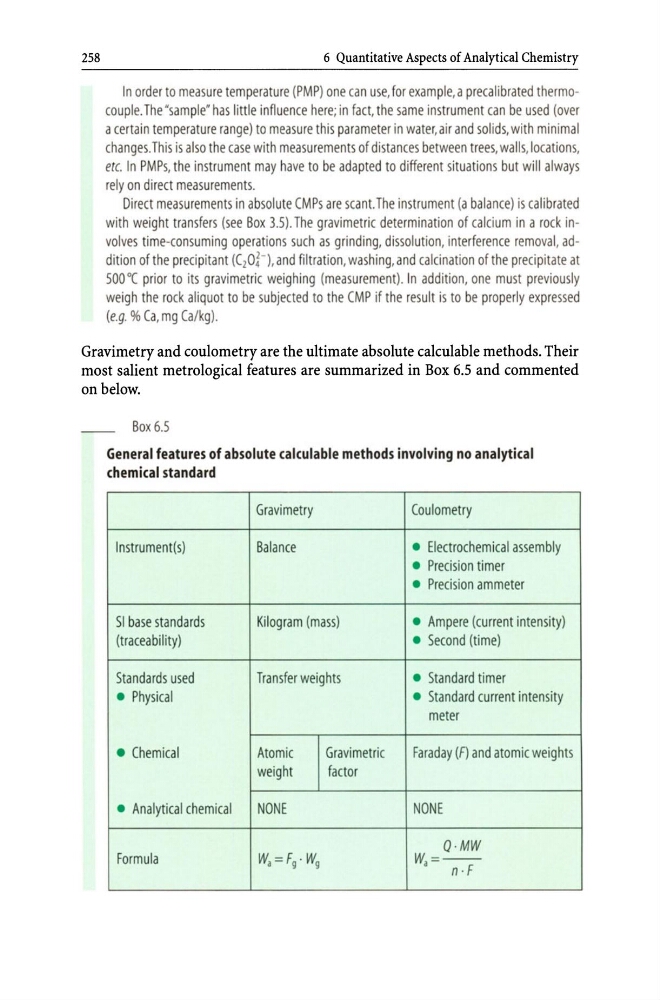
Gravimetry and coulometry are the ultimate absolute calculable methods. Their
most salient metrological features are summarized in Box 6.5 and commented
on below.
_ _ Box 6.5
General features of absolute calculable methods involving no analytical
chemical standard
Gravimetry
Coulometry
Instrument(s)
Balance
• Electrochemical assembly
• Precision timer
• Precision ammeter
51 base standards
Kilogram (mass)
• Ampere (current intensity)
(traceability)
• Second (time)
Standards used
Transfer weights
• Standard timer
• Physical
• Standard current intensity
meter
• Chemical
Atomic
Gravimetric
Faraday (F) and atomic weights
weight
factor
• Analytical chemical
NONE
NONE
Q·MW
Formula
W~ = [ g' Wg
W a = - -
n · [
6 Quantitative Aspects of Analytical Chemistry
In order to measure temperature (PMP) one can use, for example, a precalibrated thermocouple. The "sample" has little influence here; in fact, the same instrument can be used (over
a certain temperature range) to measure this parameter in water, air and solids, with minimal
changes. This is also the case with measurements of distances between trees, walls, locations,
etc. In PMPs, the instrument may have to be adapted to different situations but will always
rely on direct measurements.
Direct measurements in absolute (MPs are scant. The instrument (a balance) is calibrated
with weight transfers (see Box 3.5). The gravimetric determination of calcium in a rock involves time-consuming operations such as grinding, dissolution, interference removal, addition of the precipitant (C 2 01-), and filtration, washing, and calcination of the precipitate at
500 °C prior to its gravimetric weighing (measurement). In add ition, one must previously
weigh the rock aliquot to be subjected to the CMP if the result is to be properly expressed
(e.g. % Ca, mg Ca/kg).
Gravimetry and coulometry are the ultimate absolute calculable methods. Their
most salient metrological features are summarized in Box 6.5 and commented
on below.
_ _ Box 6.5
General features of absolute calculable methods involving no analytical
chemical standard
Gravimetry
Coulometry
Instrument(s)
Balance
• Electrochemical assembly
• Precision timer
• Precision ammeter
51 base standards
Kilogram (mass)
• Ampere (current intensity)
(traceability)
• Second (time)
Standards used
Transfer weights
• Standard timer
• Physical
• Standard current intensity
meter
• Chemical
Atomic
Gravimetric
Faraday (F) and atomic weights
weight
factor
• Analytical chemical
NONE
NONE
Q·MW
Formula
W~ = [ g' Wg
W a = - -
n · [