

248
6 Quantitative Aspects of Analytical Chemistry
I 6.1 Fundamentals
6.1.1 Introduction
Quantitative analyses involve the extraction of numerical information of absolute (e.g. mass units) or relative nature (e.g. a concentration or percentage)
about one or more analytes present in a sample.
Quantitative Analysis is the intermediate link in the analytical chain of analysis types according to purpose (see Fig. 1.20). On the one hand, one must
previously have ascertained whether not only the target analyte, but also other
substances that might interfere with the analytical signal used for its quantitation, are present or absent. On the other, Structural Analysis can only be undertaken properly once the quantitative composition of a sample or object is
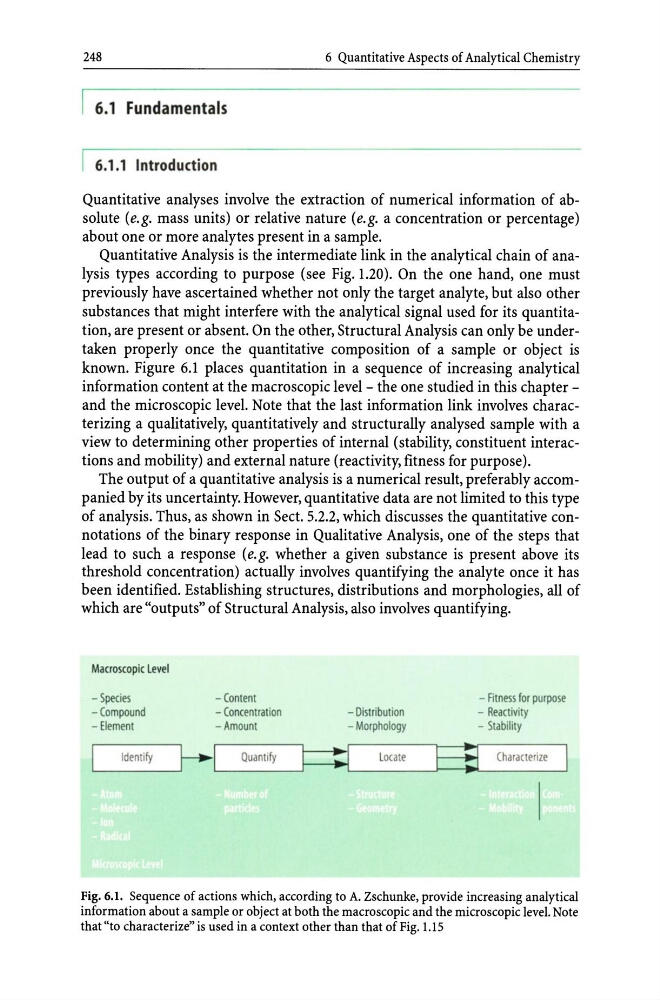
known. Figure 6.1 places quanti tat ion in a sequence of increasing analytical
information content at the macroscopic level - the one studied in this chapter -
and the microscopic level. Note that the last information link involves characterizing a qualitatively, quantitatively and structurally analysed sample with a
view to determining other properties of internal (stability, constituent interactions and mobility) and external nature (reactivity, fitness for purpose).
The output of a quantitative analysis is a numerical result, preferably accompanied by its uncertainty. However, quantitative data are not limited to this type
of analysis. Thus, as shown in Sect. 5.2.2, which discusses the quantitative connotations of the binary response in Qualitative Analysis, one of the steps that
lead to such a response (e.g. whether a given substance is present above its
threshold concentration) actually involves quantifying the analyte once it has
been identified. Establishing structures, distributions and morphologies, all of
which are "outputs" of Structural Analysis, also involves quantifying.
Macroscopic Level
- Species
- Content
- Fitness for purpose
- Compound
- Concentration
- Distribution
- Reactivity
- Element
- Amount
- Morphology
- Stability
~ __ ld_ en_li~ __ ~~L-~Q= ua ~n= ti~ ~~ __ ~~ __ -=L o= (a=te ~~~~~~ Ch:a:ra=(te=ri =ze ~
Fig. 6.1. Sequence of actions which, according to A. Zschunke, provide increasing analytical
information about a sample or object at both the macroscopic and the microscopic level. Note
that "to characterize" is used in a context other than that of Fig. 1.15
6 Quantitative Aspects of Analytical Chemistry
I 6.1 Fundamentals
6.1.1 Introduction
Quantitative analyses involve the extraction of numerical information of absolute (e.g. mass units) or relative nature (e.g. a concentration or percentage)
about one or more analytes present in a sample.
Quantitative Analysis is the intermediate link in the analytical chain of analysis types according to purpose (see Fig. 1.20). On the one hand, one must
previously have ascertained whether not only the target analyte, but also other
substances that might interfere with the analytical signal used for its quantitation, are present or absent. On the other, Structural Analysis can only be undertaken properly once the quantitative composition of a sample or object is
known. Figure 6.1 places quanti tat ion in a sequence of increasing analytical
information content at the macroscopic level - the one studied in this chapter -
and the microscopic level. Note that the last information link involves characterizing a qualitatively, quantitatively and structurally analysed sample with a
view to determining other properties of internal (stability, constituent interactions and mobility) and external nature (reactivity, fitness for purpose).
The output of a quantitative analysis is a numerical result, preferably accompanied by its uncertainty. However, quantitative data are not limited to this type
of analysis. Thus, as shown in Sect. 5.2.2, which discusses the quantitative connotations of the binary response in Qualitative Analysis, one of the steps that
lead to such a response (e.g. whether a given substance is present above its
threshold concentration) actually involves quantifying the analyte once it has
been identified. Establishing structures, distributions and morphologies, all of
which are "outputs" of Structural Analysis, also involves quantifying.
Macroscopic Level
- Species
- Content
- Fitness for purpose
- Compound
- Concentration
- Distribution
- Reactivity
- Element
- Amount
- Morphology
- Stability
~ __ ld_ en_li~ __ ~~L-~Q= ua ~n= ti~ ~~ __ ~~ __ -=L o= (a=te ~~~~~~ Ch:a:ra=(te=ri =ze ~
Fig. 6.1. Sequence of actions which, according to A. Zschunke, provide increasing analytical
information about a sample or object at both the macroscopic and the microscopic level. Note
that "to characterize" is used in a context other than that of Fig. 1.15