

230
5 Qualitative Aspects of Analytical Chemistry
a view to their identification. As noted above, the difference between Instrumental and Classical Qualitative analysis is that the latter uses the human
body as "instrument". The substantially increased identification power of available equipment obviously makes Instrumental Qualitative Analysis much more
reliable and widely applicable.
Identifying in this context involves comparing one or more signals obtained
at a single or many instrumental parameter values for three different aliquots
subjected to the analytical process, namely:
(a) A standard containing the analyte;
(b) a blank resembling the sample in composition but containing no analyte; and
(c) a sample, which mayor may not contain the analyte.
The probability of obtaining YES or NO as the binary response will depend on
the degree of consistency between the signals produced, their number and how
well-resolved they are. The use of a single signal (e.g. absorbance) obtained at a
single instrumental parameter value (e.g. wavelength) will obviously provide
less reliable qualitative identifications than will multiple signals recorded at
many different instrumental parameter values (e.g. the bands in an IR absorption spectrum). Molecular absorption spectra are much broader and general
than are atomic absorption spectra; the latter contain much better resolved
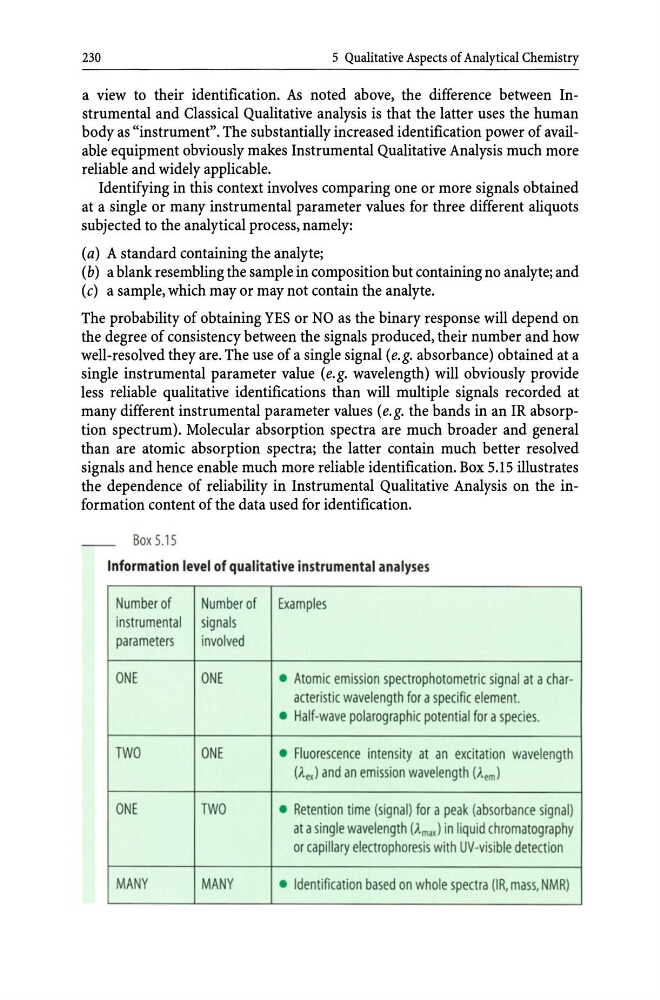
signals and hence enable much more reliable identification. Box 5.15 illustrates
the dependence of reliability in Instrumental Qualitative Analysis on the information content of the data used for identification.
Box 5.15
Information level of qualitative instrumental analyses
Number of
Number of Examples
instrumental signals
parameters
involved
ONE
ONE
• Atomic emission spectrophotometric signal at a characteristic wavelength for a specific element.
• Half-wave polarographic potential for a species.
TWO
ONE
• Fluorescence intensity at an excitation wavelength
(Aex ) and an emission wavelength (Aem )
ONE
TWO
• Retention time (signal) for a peak (absorbance signal)
at a single wavelength ()'max ) in liquid chromatography
or capillary electrophoresis with UV-visible detection
MANY
MANY
• Identification based on whole spectra (lR, mass, NMR)
5 Qualitative Aspects of Analytical Chemistry
a view to their identification. As noted above, the difference between Instrumental and Classical Qualitative analysis is that the latter uses the human
body as "instrument". The substantially increased identification power of available equipment obviously makes Instrumental Qualitative Analysis much more
reliable and widely applicable.
Identifying in this context involves comparing one or more signals obtained
at a single or many instrumental parameter values for three different aliquots
subjected to the analytical process, namely:
(a) A standard containing the analyte;
(b) a blank resembling the sample in composition but containing no analyte; and
(c) a sample, which mayor may not contain the analyte.
The probability of obtaining YES or NO as the binary response will depend on
the degree of consistency between the signals produced, their number and how
well-resolved they are. The use of a single signal (e.g. absorbance) obtained at a
single instrumental parameter value (e.g. wavelength) will obviously provide
less reliable qualitative identifications than will multiple signals recorded at
many different instrumental parameter values (e.g. the bands in an IR absorption spectrum). Molecular absorption spectra are much broader and general
than are atomic absorption spectra; the latter contain much better resolved
signals and hence enable much more reliable identification. Box 5.15 illustrates
the dependence of reliability in Instrumental Qualitative Analysis on the information content of the data used for identification.
Box 5.15
Information level of qualitative instrumental analyses
Number of
Number of Examples
instrumental signals
parameters
involved
ONE
ONE
• Atomic emission spectrophotometric signal at a characteristic wavelength for a specific element.
• Half-wave polarographic potential for a species.
TWO
ONE
• Fluorescence intensity at an excitation wavelength
(Aex ) and an emission wavelength (Aem )
ONE
TWO
• Retention time (signal) for a peak (absorbance signal)
at a single wavelength ()'max ) in liquid chromatography
or capillary electrophoresis with UV-visible detection
MANY
MANY
• Identification based on whole spectra (lR, mass, NMR)