

5.5 Classical Qualitative Analysis
225
sequential manner: a new precipitating reagent is added after the precipitate
containing the analytes in the previous group is filtered off. The first three
groups are initially precipitates, so they must be selectively dissolved to obtain
aliquots for the identification of the species in each group. The fourth group contains the so-called "soluble analytes". The scheme on the right of Fig. S.lO uses
two types of separation reagents; one (R I) produces global groups that require
further processing for identification whereas the other (R2 and R3 ) yields groups
where the analytes can be identified in a direct manner.
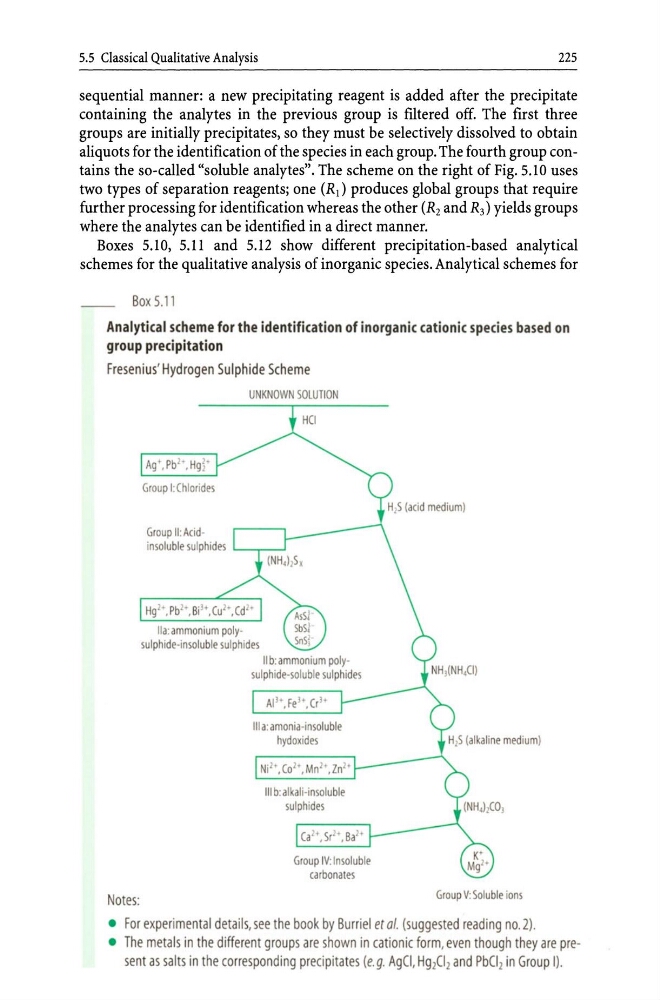
Boxes S.lO, S.l1 and S.12 show different precipitation-based analytical
schemes for the qualitative analysis of inorganic species. Analytical schemes for
Box 5. 11
Analytical scheme for the identification of inorganic cationic species based on
group precipitation
Fresenius' Hydrogen Sulphide Scheme
UNKNOWN SOLU TION
Notes:
Group II: Acidinsoluble sulphides L...--,----'
lIa: ammonium polysulphide-insoluble sulphides
II b: ammonium polysulphide-soluble su lphides
AII-.Fel ·.Crl +
lil a: amonia-insoluble
hydoxides
Group v: Soluble ions
• For experimental details, see the book by Burriel et 01. (suggested reading no.2) .
• The metals in the different groups are shown in cationic form, even though they are present as salts in the corresponding precipitates (e.g. AgCl, H9 2 CI 2 and PbCI 2 in Group I).
225
sequential manner: a new precipitating reagent is added after the precipitate
containing the analytes in the previous group is filtered off. The first three
groups are initially precipitates, so they must be selectively dissolved to obtain
aliquots for the identification of the species in each group. The fourth group contains the so-called "soluble analytes". The scheme on the right of Fig. S.lO uses
two types of separation reagents; one (R I) produces global groups that require
further processing for identification whereas the other (R2 and R3 ) yields groups
where the analytes can be identified in a direct manner.
Boxes S.lO, S.l1 and S.12 show different precipitation-based analytical
schemes for the qualitative analysis of inorganic species. Analytical schemes for
Box 5. 11
Analytical scheme for the identification of inorganic cationic species based on
group precipitation
Fresenius' Hydrogen Sulphide Scheme
UNKNOWN SOLU TION
Notes:
Group II: Acidinsoluble sulphides L...--,----'
lIa: ammonium polysulphide-insoluble sulphides
II b: ammonium polysulphide-soluble su lphides
AII-.Fel ·.Crl +
lil a: amonia-insoluble
hydoxides
Group v: Soluble ions
• For experimental details, see the book by Burriel et 01. (suggested reading no.2) .
• The metals in the different groups are shown in cationic form, even though they are present as salts in the corresponding precipitates (e.g. AgCl, H9 2 CI 2 and PbCI 2 in Group I).