

224
5 Qualitative Aspects of Analytical Chemistry
I 5.5.3.2 Schemes with Group Separation
This type of qualitative analytical scheme gathers species into small groups in
order to facilitate the sensitive, selective identification of the analytes in each.
The process is based on the systematic use of separation techniques under
appropriate operating conditions. The principal element of the scheme is the socalled "group reagent". Inorganic analyte species in the sample are normally
separated into groups by precipitation and filtration, and organic ones by either
liquid-liquid extraction or distillation.
Figure 5.10 depicts generic types of precipitation-based analytical schemes
for inorganic species. In the first case (left) analytes are grouped in a fully
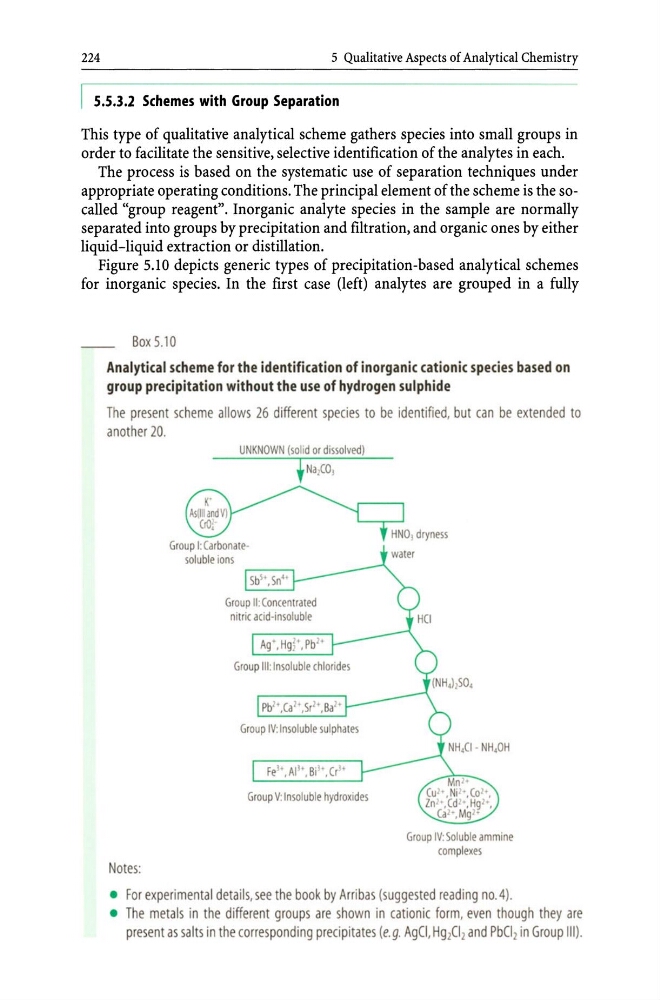
Box S.1 0
Analytical scheme for the identification of inorganic cationic species based on
group precipitation without the use of hydrogen sulphide
The present scheme allows 26 different species to be identified, but can be extended to
another 20.
UNKNOWN (solid or dissolved)
Notes:
Group IV: Soluble ammine
co mplexes
• For experimental details, see the book by Arribas (suggested reading no.4) .
• The metals in the different groups are shown in cationic form, even though they are
present as salts in the corresponding precipitates (e. g. AgCl, Hg2C12 and PbCI2 in Group III).
5 Qualitative Aspects of Analytical Chemistry
I 5.5.3.2 Schemes with Group Separation
This type of qualitative analytical scheme gathers species into small groups in
order to facilitate the sensitive, selective identification of the analytes in each.
The process is based on the systematic use of separation techniques under
appropriate operating conditions. The principal element of the scheme is the socalled "group reagent". Inorganic analyte species in the sample are normally
separated into groups by precipitation and filtration, and organic ones by either
liquid-liquid extraction or distillation.
Figure 5.10 depicts generic types of precipitation-based analytical schemes
for inorganic species. In the first case (left) analytes are grouped in a fully
Box S.1 0
Analytical scheme for the identification of inorganic cationic species based on
group precipitation without the use of hydrogen sulphide
The present scheme allows 26 different species to be identified, but can be extended to
another 20.
UNKNOWN (solid or dissolved)
Notes:
Group IV: Soluble ammine
co mplexes
• For experimental details, see the book by Arribas (suggested reading no.4) .
• The metals in the different groups are shown in cationic form, even though they are
present as salts in the corresponding precipitates (e. g. AgCl, Hg2C12 and PbCI2 in Group III).