

216
5 Qualitative Aspects of Analytical Chemistry
ments in fluids, pool water and urine, respectively, provided by reagent strips;
the colour taken by the strip allows one not only to identify the presence of the
analyte but also to obtain an estimate of its concentration.
The limited capacity of the human senses and brain to detect small changes,
low discrimination among signals and the scarce variety of information that can
be derived severely restrict the identification scope of Classical Qualitative
Analysis relative to Instrumental Analysis. As a result, reliability in this context
depends strongly on the sensitivity and selectivity of the particular CMP used
and, ultimately, on the chemical reaction(s} it involves. Boosting these two
analytical properties - primarily with the aid of separation techniques - has
been a permanent challenge to Classical Qualitative Analysis.
Figure 5.7 shows complementary classifications of Qualitative Classical Analysis
according to various criteria. One is inherent in the CMP, which can be a straightforward, direct test involving no complicated operations or a systematic process (a
"scheme") using separations to indirectly raise sensitivity and selectivity through
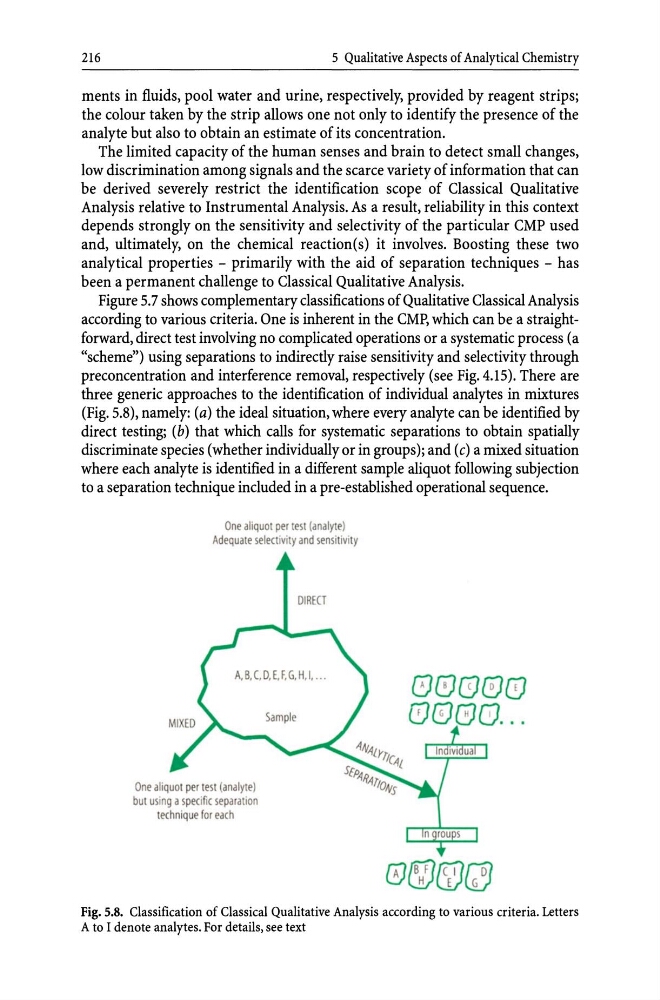
preconcentration and interference removal, respectively (see Fig. 4.15). There are
three generic approaches to the identification of individual analytes in mixtures
(Fig. 5.8), namely: (a) the ideal situation, where every analyte can be identified by
direct testing; (b) that which calls for systematic separations to obtain spatially
discriminate species (whether individually or in groups); and (c) a mixed situation
where each analyte is identified in a different sample aliquot following subjection
to a separation technique included in a pre-established operational sequence.
One aliquot per test (analyte)
Adequate selectivity and sensitivity
One aliquot per test (analyte)
but using a specific separation
technique for each
DIRECT
Fig. 5.8. Classification of Classical Qualitative Analysis according to various criteria. Letters
A to I denote analytes. For details, see text
5 Qualitative Aspects of Analytical Chemistry
ments in fluids, pool water and urine, respectively, provided by reagent strips;
the colour taken by the strip allows one not only to identify the presence of the
analyte but also to obtain an estimate of its concentration.
The limited capacity of the human senses and brain to detect small changes,
low discrimination among signals and the scarce variety of information that can
be derived severely restrict the identification scope of Classical Qualitative
Analysis relative to Instrumental Analysis. As a result, reliability in this context
depends strongly on the sensitivity and selectivity of the particular CMP used
and, ultimately, on the chemical reaction(s} it involves. Boosting these two
analytical properties - primarily with the aid of separation techniques - has
been a permanent challenge to Classical Qualitative Analysis.
Figure 5.7 shows complementary classifications of Qualitative Classical Analysis
according to various criteria. One is inherent in the CMP, which can be a straightforward, direct test involving no complicated operations or a systematic process (a
"scheme") using separations to indirectly raise sensitivity and selectivity through
preconcentration and interference removal, respectively (see Fig. 4.15). There are
three generic approaches to the identification of individual analytes in mixtures
(Fig. 5.8), namely: (a) the ideal situation, where every analyte can be identified by
direct testing; (b) that which calls for systematic separations to obtain spatially
discriminate species (whether individually or in groups); and (c) a mixed situation
where each analyte is identified in a different sample aliquot following subjection
to a separation technique included in a pre-established operational sequence.
One aliquot per test (analyte)
Adequate selectivity and sensitivity
One aliquot per test (analyte)
but using a specific separation
technique for each
DIRECT
Fig. 5.8. Classification of Classical Qualitative Analysis according to various criteria. Letters
A to I denote analytes. For details, see text