

5.5 Classical Qualitative Analysis
215
I 5.5 Classical Qualitative Analysis
5.5.1 General Notions
The distinction between Classical and Instrumental Analysis made in Sect. 1.7
rests on the type of instrument used to produce or acquire the analyte signal.
Classical Qualitative Analysis uses the human senses (mainly sight and smell)
to detect the presence of an analyte; the analyte is subjected to a chemical
(acid-base, complex-formation, precipitation, redox, condensation), biochemical or immune reaction which yields a product that is identified from a
well-defined change (e.g. the formation of a gas, colour or precipitate).
Identification in Classical Qualitative Analysis thus relies on comparisons of
the behaviour of an analyte standard, a blank and the unknown sample - which
mayor may not contain the analyte - towards a CMP. Comparisons can also rely
on the use of a reference scale from which the operator will read semi-quantitative information. Such is the case with pH, active chlorine and glucose measure- Without separation
(direct tests)
- With separation
(analytical schemes)
CLASSICAL QUALITATIVE ANALYSIS
CLASSIFICATIONS
- One analyte
- Several analytes
- Many analytes
- Inorganic
- Organic
- Biochemical
- Immunochemical
- Inorganic (cations, anions)
- Organic (neutral, charged)
- Biochemical
- Group
- Identification
- Masking
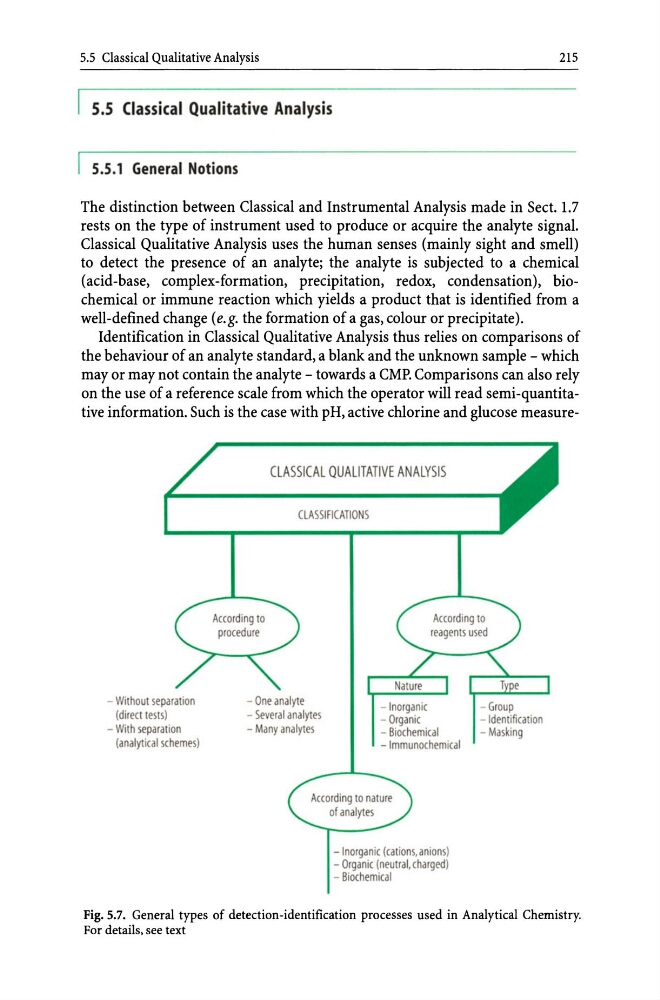
Fig. 5.7. General types of detection-identification processes used in Analytical Chemistry.
For details, see text
215
I 5.5 Classical Qualitative Analysis
5.5.1 General Notions
The distinction between Classical and Instrumental Analysis made in Sect. 1.7
rests on the type of instrument used to produce or acquire the analyte signal.
Classical Qualitative Analysis uses the human senses (mainly sight and smell)
to detect the presence of an analyte; the analyte is subjected to a chemical
(acid-base, complex-formation, precipitation, redox, condensation), biochemical or immune reaction which yields a product that is identified from a
well-defined change (e.g. the formation of a gas, colour or precipitate).
Identification in Classical Qualitative Analysis thus relies on comparisons of
the behaviour of an analyte standard, a blank and the unknown sample - which
mayor may not contain the analyte - towards a CMP. Comparisons can also rely
on the use of a reference scale from which the operator will read semi-quantitative information. Such is the case with pH, active chlorine and glucose measure- Without separation
(direct tests)
- With separation
(analytical schemes)
CLASSICAL QUALITATIVE ANALYSIS
CLASSIFICATIONS
- One analyte
- Several analytes
- Many analytes
- Inorganic
- Organic
- Biochemical
- Immunochemical
- Inorganic (cations, anions)
- Organic (neutral, charged)
- Biochemical
- Group
- Identification
- Masking
Fig. 5.7. General types of detection-identification processes used in Analytical Chemistry.
For details, see text