

204
5 Qualitative Aspects of Analytical Chemistry
5.2.1 Types of Binary Response
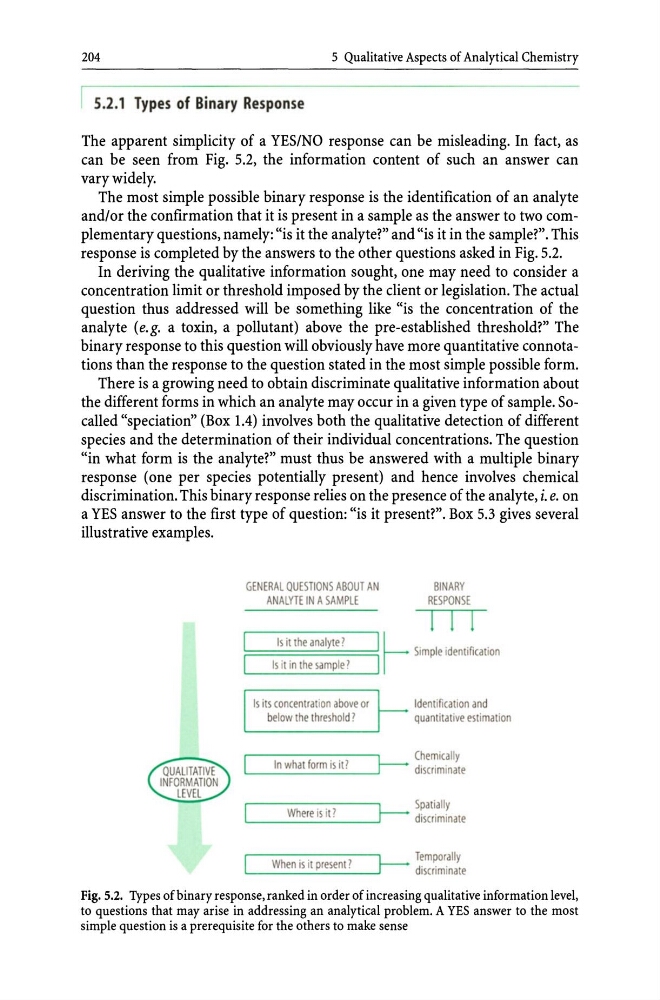
The apparent simplicity of a YES/NO response can be misleading. In fact, as
can be seen from Fig. 5.2, the information content of such an answer can
vary widely.
The most simple possible binary response is the identification of an analyte
and/or the confirmation that it is present in a sample as the answer to two complementary questions, namely: "is it the analyte?" and "is it in the sample?". This
response is completed by the answers to the other questions asked in Fig. 5.2.
In deriving the qualitative information sought, one may need to consider a
concentration limit or threshold imposed by the client or legislation. The actual
question thus addressed will be something like "is the concentration of the
analyte (e.g. a toxin, a pollutant) above the pre-established threshold?" The
binary response to this question will obviously have more quantitative connotations than the response to the question stated in the most simple possible form.
There is a growing need to obtain discriminate qualitative information about
the different forms in which an analyte may occur in a given type of sample. Socalled "speciation" (Box 1.4) involves both the qualitative detection of different
species and the determination of their individual concentrations. The question
"in what form is the analyte?" must thus be answered with a multiple binary
response (one per species potentially present) and hence involves chemical
discrimination. This binary response relies on the presence of the analyte, i. e. on
a YES answer to the first type of question: "is it present?". Box 5.3 gives several
illustrative examples.
GENERAL QUESTIONS ABOUT AN
ANAlYTE IN A SAMPLE
BINARY
RESPONSE
I I I
~====::'::::::=~
Simple identification
Is it the analyte 1
I ~
Is it in the sample 1
I
Is its concentration above or
below the threshold 1
Identification and
quantitative estimation
IChemically
,--_ In _w _h _a_ t f_ or_ m_ is_it_ 1 _ .-J
diSCrIminate
ISpatially
,--_ _ W _ he _re _i_ s i_ t 1 _ _ --'
discriminate
ITemporally
,--_ W _h_ en_is_it ...;. p _ re_ se_ n_ t 1_--,
diScriminate
Fig. 5.2. Types of binary response, ranked in order of increasing qualitative information level,
to questions that may arise in addressing an analytical problem. A YES answer to the most
simple question is a prerequisite for the others to make sense
5 Qualitative Aspects of Analytical Chemistry
5.2.1 Types of Binary Response
The apparent simplicity of a YES/NO response can be misleading. In fact, as
can be seen from Fig. 5.2, the information content of such an answer can
vary widely.
The most simple possible binary response is the identification of an analyte
and/or the confirmation that it is present in a sample as the answer to two complementary questions, namely: "is it the analyte?" and "is it in the sample?". This
response is completed by the answers to the other questions asked in Fig. 5.2.
In deriving the qualitative information sought, one may need to consider a
concentration limit or threshold imposed by the client or legislation. The actual
question thus addressed will be something like "is the concentration of the
analyte (e.g. a toxin, a pollutant) above the pre-established threshold?" The
binary response to this question will obviously have more quantitative connotations than the response to the question stated in the most simple possible form.
There is a growing need to obtain discriminate qualitative information about
the different forms in which an analyte may occur in a given type of sample. Socalled "speciation" (Box 1.4) involves both the qualitative detection of different
species and the determination of their individual concentrations. The question
"in what form is the analyte?" must thus be answered with a multiple binary
response (one per species potentially present) and hence involves chemical
discrimination. This binary response relies on the presence of the analyte, i. e. on
a YES answer to the first type of question: "is it present?". Box 5.3 gives several
illustrative examples.
GENERAL QUESTIONS ABOUT AN
ANAlYTE IN A SAMPLE
BINARY
RESPONSE
I I I
~====::'::::::=~
Simple identification
Is it the analyte 1
I ~
Is it in the sample 1
I
Is its concentration above or
below the threshold 1
Identification and
quantitative estimation
IChemically
,--_ In _w _h _a_ t f_ or_ m_ is_it_ 1 _ .-J
diSCrIminate
ISpatially
,--_ _ W _ he _re _i_ s i_ t 1 _ _ --'
discriminate
ITemporally
,--_ W _h_ en_is_it ...;. p _ re_ se_ n_ t 1_--,
diScriminate
Fig. 5.2. Types of binary response, ranked in order of increasing qualitative information level,
to questions that may arise in addressing an analytical problem. A YES answer to the most
simple question is a prerequisite for the others to make sense