

5.2 The Binary Response
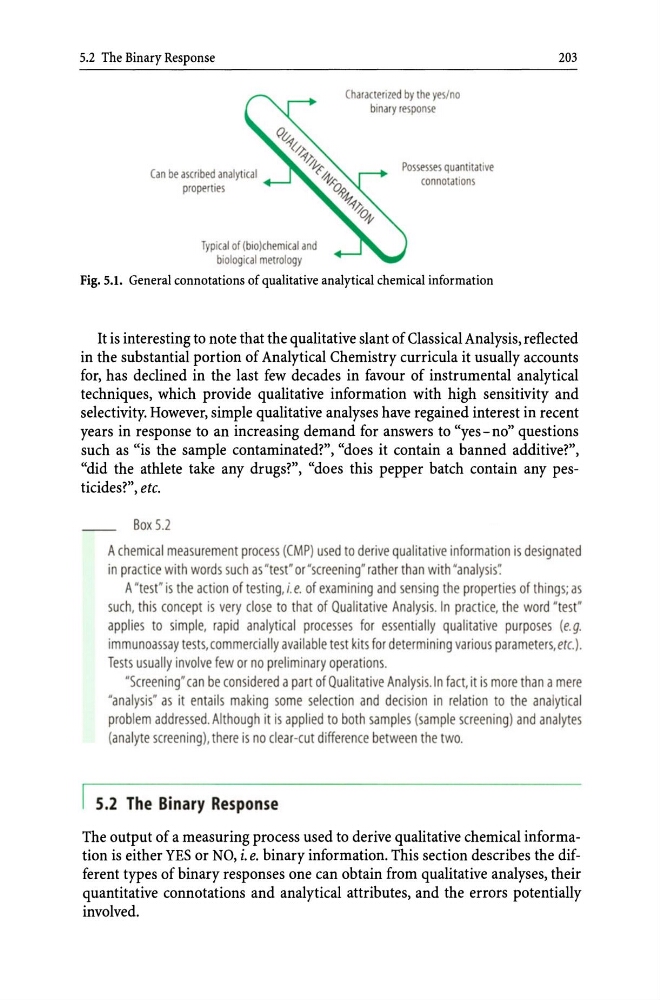
Can be ascribed analytical
properties
Typical of (bio)chemical and
biological metrology
Characterized by the yes/no
binary response
Possesses quantitative
connotations
Fig. 5.1. General connotations of qualitative analytical chemical information
203
It is interesting to note that the qualitative slant of Classical Analysis, reflected
in the substantial portion of Analytical Chemistry curricula it usually accounts
for, has declined in the last few decades in favour of instrumental analytical
techniques, which provide qualitative information with high sensitivity and
selectivity. However, simple qualitative analyses have regained interest in recent
years in response to an increasing demand for answers to "yes - no" questions
such as "is the sample contaminated?", "does it contain a banned additive?",
"did the athlete take any drugs?", "does this pepper batch contain any pesticides?", etc.
Box 5.2
A chemical measurement process (eMP) used to derive qualitative information is designated
in practice with words such as "test" or "screening" rather than with "ana lysis:
A "test" is the action of testing, i. e. of examining and sensing the properties of things; as
such, this concept is very close to that of Qualitative Analysis. In practice, the word "test"
applies to simple, rapid analytical processes for essentially qualitative purposes (e.g.
imm unoassay tests, commercially available test kits for determining various parameters,erc).
Tests usually involve few or no preliminary operations.
"Screening" can be considered a part of Qualitative Analysis.ln fact, it is more than a mere
"analysis" as it entails making some selection and decision in relation to the analytical
problem addressed. Although it is applied to both samples (sample screening) and analytes
(ana lyte screening). there is no clear-cut difference between the two.
5.2 The Binary Response
The output of a measuring process used to derive qualitative chemical information is either YES or NO, i. e. binary information. This section describes the different types of binary responses one can obtain from qualitative analyses, their
quantitative connotations and analytical attributes, and the errors potentially
involved.
Can be ascribed analytical
properties
Typical of (bio)chemical and
biological metrology
Characterized by the yes/no
binary response
Possesses quantitative
connotations
Fig. 5.1. General connotations of qualitative analytical chemical information
203
It is interesting to note that the qualitative slant of Classical Analysis, reflected
in the substantial portion of Analytical Chemistry curricula it usually accounts
for, has declined in the last few decades in favour of instrumental analytical
techniques, which provide qualitative information with high sensitivity and
selectivity. However, simple qualitative analyses have regained interest in recent
years in response to an increasing demand for answers to "yes - no" questions
such as "is the sample contaminated?", "does it contain a banned additive?",
"did the athlete take any drugs?", "does this pepper batch contain any pesticides?", etc.
Box 5.2
A chemical measurement process (eMP) used to derive qualitative information is designated
in practice with words such as "test" or "screening" rather than with "ana lysis:
A "test" is the action of testing, i. e. of examining and sensing the properties of things; as
such, this concept is very close to that of Qualitative Analysis. In practice, the word "test"
applies to simple, rapid analytical processes for essentially qualitative purposes (e.g.
imm unoassay tests, commercially available test kits for determining various parameters,erc).
Tests usually involve few or no preliminary operations.
"Screening" can be considered a part of Qualitative Analysis.ln fact, it is more than a mere
"analysis" as it entails making some selection and decision in relation to the analytical
problem addressed. Although it is applied to both samples (sample screening) and analytes
(ana lyte screening). there is no clear-cut difference between the two.
5.2 The Binary Response
The output of a measuring process used to derive qualitative chemical information is either YES or NO, i. e. binary information. This section describes the different types of binary responses one can obtain from qualitative analyses, their
quantitative connotations and analytical attributes, and the errors potentially
involved.