

176
4 The Measurement Process in Chemistry
have been substantial advances in this context, even though a number of
problems in various fields remain to be tackled.
As can be seen in Fig. 4.20, the previous three trends are inevitably related to
one another. Thus, simplification entails both reducing human intervention and
miniaturizing - particularly for integration purposes -, and miniaturization
leads to automation and simplification of the CMP.
Box4.12
The following example illustrates the practical implications of automating a CMP. The analytical method used involves the photometric determination of aluminium in a solution
obtained by pretreating a rock specimen. The procedure comprises the following five steps:
(1) acidification with 0.1 N HCI; (2) addition of ascorbic acid to reduce Fe 3 + to Fe 2 + in order to
avoid its interference; (3) addition of a ligand (Xylenol Orange, XO) to form a soluble. strongly
coloured chelate with the analyte; (4) use of a masking ligand (EDTA) to minimize or avoid
interferences from divalent and tervalent metal ions accompanying A1 3 + in the sample (EDTA
does not destroy the AI - XO coloured complex under the working conditions used); and (5)
measuring the absorbance of a sample aliquot.
The procedure can be performed in a manual or automated manner.
Manual procedure. Its conduct requires ordinary glassware (volumetriC flasks, pipettes)
and equipment (photometers, measuring cells). An aliquot of dissolved sample is collected by
means of a high-quality pipette - one with a calibration certificate - and transferred to a
calibrated flask - one of lower accuracy and precision than the pipette is acceptable for th is
purpose - containing 0.1 N HCI. 2 % w/w aqueous ascorbic acid, 0.1 % XO in ethanol/water
and 0.2 M aqueous EDTA. After 30 min. the flask is made to the mark and its contents
thoroughly mixed. Then, an aliquot is withdrawn and transferred to a glass cuvette of 1 cm
light path that is placed in the photometer compartment to measure the solution absorbance
at 560 nm. The same procedure is applied to standard solutions containing 0.5, ' , 2.4 and 6
~lg AI 3 +/mL in order to construct a calibration curve as a relative method is being used. The
aluminium concentration in the sample is obtained by interpolation.
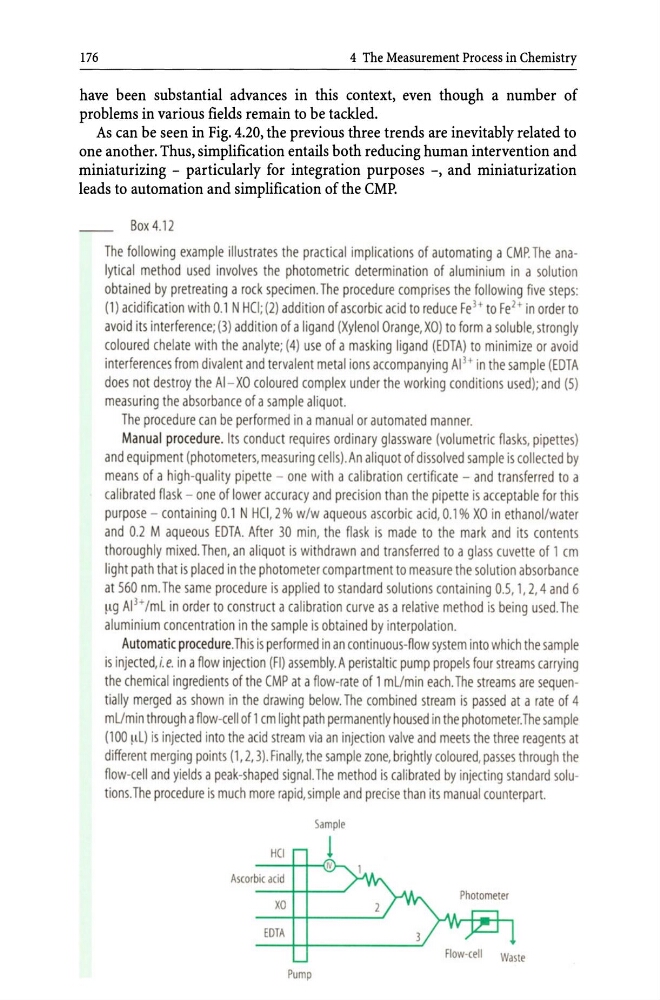
Automatic procedure.This is performed in an continuous-flow system into which the sample
is injected, i. e. in a flow injection (F!) assembly. A peristaltic pump propels four streams carrying
the chemical ingredients of the CMP at a flow-rate of , mUmin each. The streams are sequentially merged as shown in the drawing below. The combined stream is passed at a rate of 4
mL/min through a flow-cell of ' em light path permanently housed in the photometer.The sample
(100 flL) is injected into the acid stream via an injection valve and meets the three reagents at
different merging points (1 ,2,3). Finally. the sample zone. brightly coloured, passes through the
flow-cell and yields a peak-shaped signal. The method is calibrated by injecting standard solutions.The procedure is much more rapid, simple and precise than its manual counterpart.
Sample
Hel
Ascorbic acid
xo
EDTA
Flow-cell Waste
Pump
4 The Measurement Process in Chemistry
have been substantial advances in this context, even though a number of
problems in various fields remain to be tackled.
As can be seen in Fig. 4.20, the previous three trends are inevitably related to
one another. Thus, simplification entails both reducing human intervention and
miniaturizing - particularly for integration purposes -, and miniaturization
leads to automation and simplification of the CMP.
Box4.12
The following example illustrates the practical implications of automating a CMP. The analytical method used involves the photometric determination of aluminium in a solution
obtained by pretreating a rock specimen. The procedure comprises the following five steps:
(1) acidification with 0.1 N HCI; (2) addition of ascorbic acid to reduce Fe 3 + to Fe 2 + in order to
avoid its interference; (3) addition of a ligand (Xylenol Orange, XO) to form a soluble. strongly
coloured chelate with the analyte; (4) use of a masking ligand (EDTA) to minimize or avoid
interferences from divalent and tervalent metal ions accompanying A1 3 + in the sample (EDTA
does not destroy the AI - XO coloured complex under the working conditions used); and (5)
measuring the absorbance of a sample aliquot.
The procedure can be performed in a manual or automated manner.
Manual procedure. Its conduct requires ordinary glassware (volumetriC flasks, pipettes)
and equipment (photometers, measuring cells). An aliquot of dissolved sample is collected by
means of a high-quality pipette - one with a calibration certificate - and transferred to a
calibrated flask - one of lower accuracy and precision than the pipette is acceptable for th is
purpose - containing 0.1 N HCI. 2 % w/w aqueous ascorbic acid, 0.1 % XO in ethanol/water
and 0.2 M aqueous EDTA. After 30 min. the flask is made to the mark and its contents
thoroughly mixed. Then, an aliquot is withdrawn and transferred to a glass cuvette of 1 cm
light path that is placed in the photometer compartment to measure the solution absorbance
at 560 nm. The same procedure is applied to standard solutions containing 0.5, ' , 2.4 and 6
~lg AI 3 +/mL in order to construct a calibration curve as a relative method is being used. The
aluminium concentration in the sample is obtained by interpolation.
Automatic procedure.This is performed in an continuous-flow system into which the sample
is injected, i. e. in a flow injection (F!) assembly. A peristaltic pump propels four streams carrying
the chemical ingredients of the CMP at a flow-rate of , mUmin each. The streams are sequentially merged as shown in the drawing below. The combined stream is passed at a rate of 4
mL/min through a flow-cell of ' em light path permanently housed in the photometer.The sample
(100 flL) is injected into the acid stream via an injection valve and meets the three reagents at
different merging points (1 ,2,3). Finally. the sample zone. brightly coloured, passes through the
flow-cell and yields a peak-shaped signal. The method is calibrated by injecting standard solutions.The procedure is much more rapid, simple and precise than its manual counterpart.
Sample
Hel
Ascorbic acid
xo
EDTA
Flow-cell Waste
Pump