

168
4 The Measurement Process in Chemistry
or electrophoretic technique coupled on-line (column chromatography, capillary electrophoresis) or off-line (classical electrophoresis, planar chromatography) to detection.
Some of the more common sub-steps of preliminary operations (Fig. 4.9) can
also be considered sample treatments. Such is the case with preliminary nonanalytical reactions, which are used to facilitate development of the CMP.
Typical examples include the use of fluoride ion to avoid the interference of
ferric ion by formation of a stable, soluble, colourless complex (FeF~-) and that
of Jones reductor to ensure that all dissolved iron is converted into Fe 2 + for
titration with a standard solution of potassium dichromate. On the other hand,
the use of analytical chemical reactions in preliminary operations is usually
intended to convert the analyte into products to which the available instrument
will respond [e.g. the coloured complex FeL~+' obtained by addition of 1,10phenanthroline (the ligand, L) to facilitate the photometric determination of
iron traces]; alternatively, one such reaction can act as the main titrimetric
reaction (see Chap. 6).
~ Measurement and Transducing of the Analytical Signal
The second step of a CMP (Fig. 4.4) is carried out by using a measuring instrument, which is the materialization of an analytical technique (see Fig. 1.16).
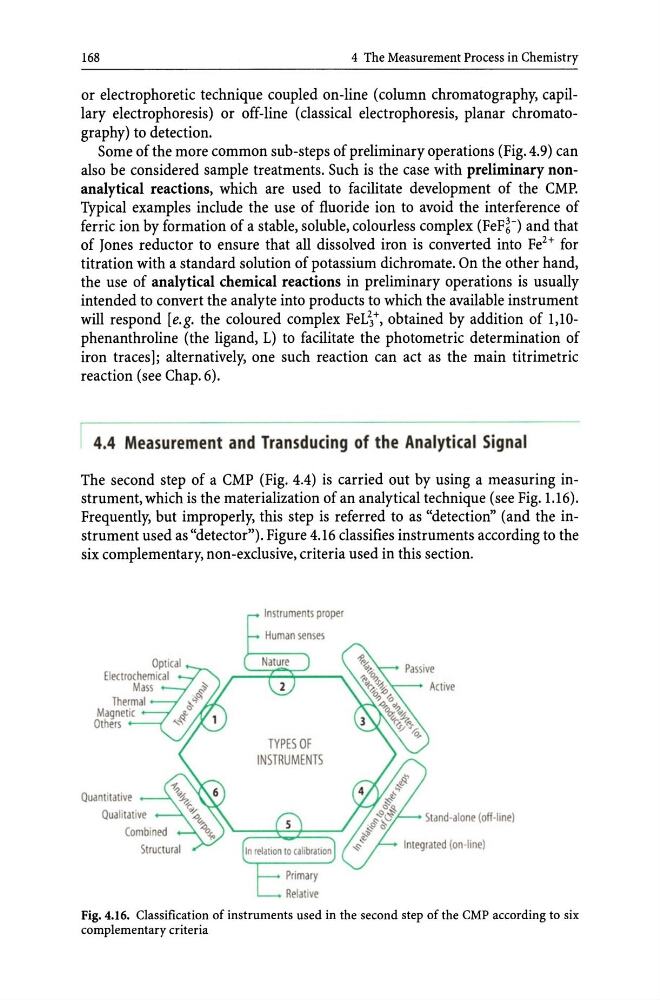
Frequently, but improperly, this step is referred to as "detection" (and the instrument used as "detector"). Figure 4.16 classifies instruments according to the
six complementary, non-exclusive, criteria used in this section.
Optical
Electrochemical
Mass
Thermal
Magnetic
Others
Quantitative
Instruments proper
Human senses
TYPES OF
INSTRUMENTS
Stand-alone (off-line)
Integrated (on-line)
Fig.4.16. Classification of instruments used in the second step of the CMP according to six
complementary criteria
4 The Measurement Process in Chemistry
or electrophoretic technique coupled on-line (column chromatography, capillary electrophoresis) or off-line (classical electrophoresis, planar chromatography) to detection.
Some of the more common sub-steps of preliminary operations (Fig. 4.9) can
also be considered sample treatments. Such is the case with preliminary nonanalytical reactions, which are used to facilitate development of the CMP.
Typical examples include the use of fluoride ion to avoid the interference of
ferric ion by formation of a stable, soluble, colourless complex (FeF~-) and that
of Jones reductor to ensure that all dissolved iron is converted into Fe 2 + for
titration with a standard solution of potassium dichromate. On the other hand,
the use of analytical chemical reactions in preliminary operations is usually
intended to convert the analyte into products to which the available instrument
will respond [e.g. the coloured complex FeL~+' obtained by addition of 1,10phenanthroline (the ligand, L) to facilitate the photometric determination of
iron traces]; alternatively, one such reaction can act as the main titrimetric
reaction (see Chap. 6).
~ Measurement and Transducing of the Analytical Signal
The second step of a CMP (Fig. 4.4) is carried out by using a measuring instrument, which is the materialization of an analytical technique (see Fig. 1.16).
Frequently, but improperly, this step is referred to as "detection" (and the instrument used as "detector"). Figure 4.16 classifies instruments according to the
six complementary, non-exclusive, criteria used in this section.
Optical
Electrochemical
Mass
Thermal
Magnetic
Others
Quantitative
Instruments proper
Human senses
TYPES OF
INSTRUMENTS
Stand-alone (off-line)
Integrated (on-line)
Fig.4.16. Classification of instruments used in the second step of the CMP according to six
complementary criteria