

4.3 Preliminary Operations
167
Box 4.10
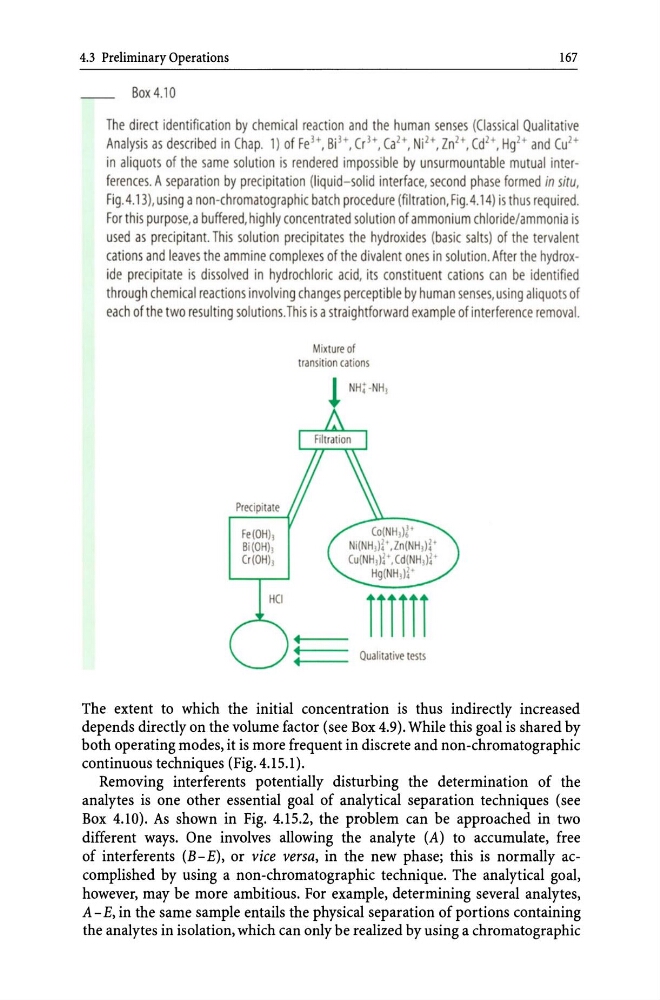
The direct identification by chemical reaction and the human senses (Classical Qualitative
Analysis as described in Chap. 1) of Fe 3 , Bi l , Cr 3 +, Ca 2 +, Ni 2 +, Zn2+, Cd 2 +, Hg2+ and Cu 2 +
in aliquots of the same solution is rendered impossible by unsurmountable mutual interferences. A separation by precipitation (liquid- solid interface, second phase formed in situ,
Fig. 4.13), using a non-chromatographic batch procedure (filtration, Fig. 4.14) is thus required.
For this purpose, a buffered, highly concentrated solution of ammonium chloride/ammonia is
used as precipitant. This solution precipitates the hydroxides (basic salts) of the tervalent
cations and leaves the ammine complexes of the divalent ones in solution. After the hydroxide precipitate is dissolved in hydrochloric acid, its constituent cations can be identified
through chemical reactions involving changes perceptible by human senses, using aliquots of
each of the two resulting solutionS.This is a straightforward example of interference removal.
Precipitate
Fe(OHh
Bi(OHh
Cr (OH h
Mixture of
transition cations
111111
Qualitative tests
The extent to which the initial concentration is thus indirectly increased
depends directly on the volume factor (see Box 4.9). While this goal is shared by
both operating modes, it is more frequent in discrete and non-chromatographic
continuous techniques (Fig. 4.15.1).
Removing interferents potentially disturbing the determination of the
analytes is one other essential goal of analytical separation techniques (see
Box 4.10). As shown in Fig. 4.15.2, the problem can be approached in two
different ways. One involves allowing the analyte (A) to accumulate, free
of interferents (B-E), or vice versa, in the new phase; this is normally accomplished by using a non-chromatographic technique. The analytical goal,
however, may be more ambitious. For example, determining several analytes,
A - E, in the same sample entails the physical separation of portions containing
the analytes in isolation, which can only be realized by using a chromatographic
167
Box 4.10
The direct identification by chemical reaction and the human senses (Classical Qualitative
Analysis as described in Chap. 1) of Fe 3 , Bi l , Cr 3 +, Ca 2 +, Ni 2 +, Zn2+, Cd 2 +, Hg2+ and Cu 2 +
in aliquots of the same solution is rendered impossible by unsurmountable mutual interferences. A separation by precipitation (liquid- solid interface, second phase formed in situ,
Fig. 4.13), using a non-chromatographic batch procedure (filtration, Fig. 4.14) is thus required.
For this purpose, a buffered, highly concentrated solution of ammonium chloride/ammonia is
used as precipitant. This solution precipitates the hydroxides (basic salts) of the tervalent
cations and leaves the ammine complexes of the divalent ones in solution. After the hydroxide precipitate is dissolved in hydrochloric acid, its constituent cations can be identified
through chemical reactions involving changes perceptible by human senses, using aliquots of
each of the two resulting solutionS.This is a straightforward example of interference removal.
Precipitate
Fe(OHh
Bi(OHh
Cr (OH h
Mixture of
transition cations
111111
Qualitative tests
The extent to which the initial concentration is thus indirectly increased
depends directly on the volume factor (see Box 4.9). While this goal is shared by
both operating modes, it is more frequent in discrete and non-chromatographic
continuous techniques (Fig. 4.15.1).
Removing interferents potentially disturbing the determination of the
analytes is one other essential goal of analytical separation techniques (see
Box 4.10). As shown in Fig. 4.15.2, the problem can be approached in two
different ways. One involves allowing the analyte (A) to accumulate, free
of interferents (B-E), or vice versa, in the new phase; this is normally accomplished by using a non-chromatographic technique. The analytical goal,
however, may be more ambitious. For example, determining several analytes,
A - E, in the same sample entails the physical separation of portions containing
the analytes in isolation, which can only be realized by using a chromatographic