

156
4 The Measurement Process in Chemistry
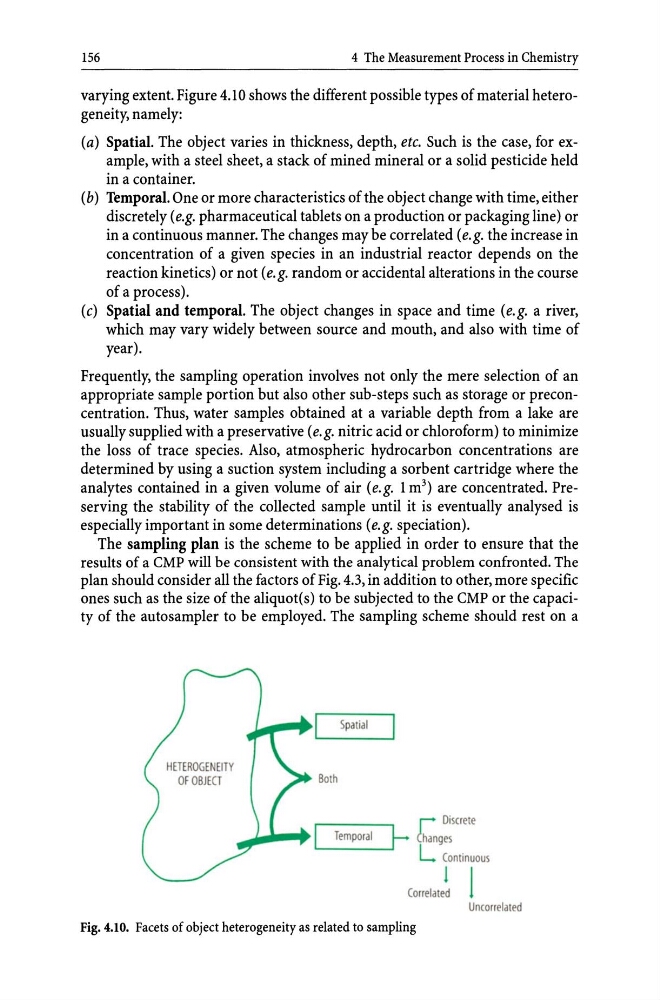
varying extent. Figure 4.10 shows the different possible types of material heterogeneity, namely:
(a) Spatial. The object varies in thickness, depth, etc. Such is the case, for example, with a steel sheet, a stack of mined mineral or a solid pesticide held
in a container.
(b) Temporal. One or more characteristics of the object change with time, either
discretely (e.g. pharmaceutical tablets on a production or packaging line) or
in a continuous manner. The changes may be correlated (e.g. the increase in
concentration of a given species in an industrial reactor depends on the
reaction kinetics) or not (e.g. random or accidental alterations in the course
of a process).
(c) Spatial and temporal. The object changes in space and time (e.g. a river,
which may vary widely between source and mouth, and also with time of
year).
Frequently, the sampling operation involves not only the mere selection of an
appropriate sample portion but also other sub-steps such as storage or preconcent ration. Thus, water samples obtained at a variable depth from a lake are
usually supplied with a preservative (e.g. nitric acid or chloroform) to minimize
the loss of trace species. Also, atmospheric hydrocarbon concentrations are
determined by using a suction system including a sorbent cartridge where the
analytes contained in a given volume of air (e.g. 1 m 3 ) are concentrated. Preserving the stability of the collected sample until it is eventually analysed is
especially important in some determinations (e.g. speciation).
The sampling plan is the scheme to be applied in order to ensure that the
results of a CMP will be consistent with the analytical problem confronted. The
plan should consider all the factors of Fig. 4.3, in addition to other, more specific
ones such as the size of the aliquot(s) to be subjected to the CMP or the capacity of the autos ampler to be employed. The sampling scheme should rest on a
Spatial
Both
Temporal
r Discrete
~ ~hanges
'------' L Continuous
correlate~ 1
Un correlated
Fig. 4.10. Facets of object heterogeneity as related to sampling
4 The Measurement Process in Chemistry
varying extent. Figure 4.10 shows the different possible types of material heterogeneity, namely:
(a) Spatial. The object varies in thickness, depth, etc. Such is the case, for example, with a steel sheet, a stack of mined mineral or a solid pesticide held
in a container.
(b) Temporal. One or more characteristics of the object change with time, either
discretely (e.g. pharmaceutical tablets on a production or packaging line) or
in a continuous manner. The changes may be correlated (e.g. the increase in
concentration of a given species in an industrial reactor depends on the
reaction kinetics) or not (e.g. random or accidental alterations in the course
of a process).
(c) Spatial and temporal. The object changes in space and time (e.g. a river,
which may vary widely between source and mouth, and also with time of
year).
Frequently, the sampling operation involves not only the mere selection of an
appropriate sample portion but also other sub-steps such as storage or preconcent ration. Thus, water samples obtained at a variable depth from a lake are
usually supplied with a preservative (e.g. nitric acid or chloroform) to minimize
the loss of trace species. Also, atmospheric hydrocarbon concentrations are
determined by using a suction system including a sorbent cartridge where the
analytes contained in a given volume of air (e.g. 1 m 3 ) are concentrated. Preserving the stability of the collected sample until it is eventually analysed is
especially important in some determinations (e.g. speciation).
The sampling plan is the scheme to be applied in order to ensure that the
results of a CMP will be consistent with the analytical problem confronted. The
plan should consider all the factors of Fig. 4.3, in addition to other, more specific
ones such as the size of the aliquot(s) to be subjected to the CMP or the capacity of the autos ampler to be employed. The sampling scheme should rest on a
Spatial
Both
Temporal
r Discrete
~ ~hanges
'------' L Continuous
correlate~ 1
Un correlated
Fig. 4.10. Facets of object heterogeneity as related to sampling