

4.3 Preliminary Operations
151
B
b
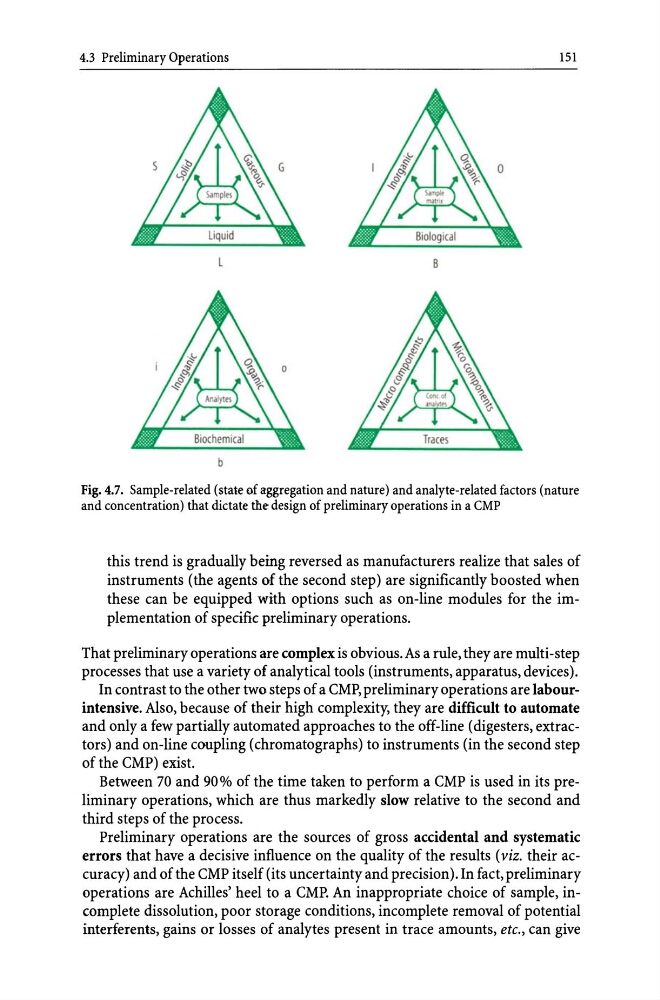
Fig.4.7. Sample-related (state of aggregation and nature) and analyte-related factors (nature
and concentration) that dictate the design of preliminary operations in a eMP
this trend is gradually being reversed as manufacturers realize that sales of
instruments (the agents of the second step) are significantly boosted when
these can be equipped with options such as on-line modules for the implementation of specific preliminary operations.
That preliminary operations are complex is obvious. As a rule, they are multi-step
processes that use a variety of analytical tools (instruments, apparatus, devices).
In contrast to the other two steps of a eMP, preliminary operations are labourintensive. Also, because of their high complexity, they are difficult to automate
and only a few partially automated approaches to the off-line (digesters, extractors) and on-line coupling (chromatographs) to instruments (in the second step
of the eMP) exist.
Between 70 and 90 % of the time taken to perform a eMP is used in its preliminary operations, which are thus markedly slow relative to the second and
third steps of the process.
Preliminary operations are the sources of gross accidental and systematic
errors that have a decisive influence on the quality of the results (viz. their accuracy) and of the eMP itself (its uncertainty and precision). In fact, preliminary
operations are Achilles' heel to a eMP. An inappropriate choice of sample, incomplete dissolution, poor storage conditions, incomplete removal of potential
interferents, gains or losses of analytes present in trace amounts, etc., can give
151
B
b
Fig.4.7. Sample-related (state of aggregation and nature) and analyte-related factors (nature
and concentration) that dictate the design of preliminary operations in a eMP
this trend is gradually being reversed as manufacturers realize that sales of
instruments (the agents of the second step) are significantly boosted when
these can be equipped with options such as on-line modules for the implementation of specific preliminary operations.
That preliminary operations are complex is obvious. As a rule, they are multi-step
processes that use a variety of analytical tools (instruments, apparatus, devices).
In contrast to the other two steps of a eMP, preliminary operations are labourintensive. Also, because of their high complexity, they are difficult to automate
and only a few partially automated approaches to the off-line (digesters, extractors) and on-line coupling (chromatographs) to instruments (in the second step
of the eMP) exist.
Between 70 and 90 % of the time taken to perform a eMP is used in its preliminary operations, which are thus markedly slow relative to the second and
third steps of the process.
Preliminary operations are the sources of gross accidental and systematic
errors that have a decisive influence on the quality of the results (viz. their accuracy) and of the eMP itself (its uncertainty and precision). In fact, preliminary
operations are Achilles' heel to a eMP. An inappropriate choice of sample, incomplete dissolution, poor storage conditions, incomplete removal of potential
interferents, gains or losses of analytes present in trace amounts, etc., can give