

4.2 General Steps of a Chemical Measurement Process
147
(b) Accessory analytical properties (expeditiousness, cost-effectiveness and
personnel-related factors), which determine laboratory productivity.
Because the analytical problem (Chap. 7) inevitably involves quality compromises, one should always bear in mind complementary and contradictory
relationships among analytical properties in adopting a specific eMP.
4.2 General Steps of a Chemical Measurement Process
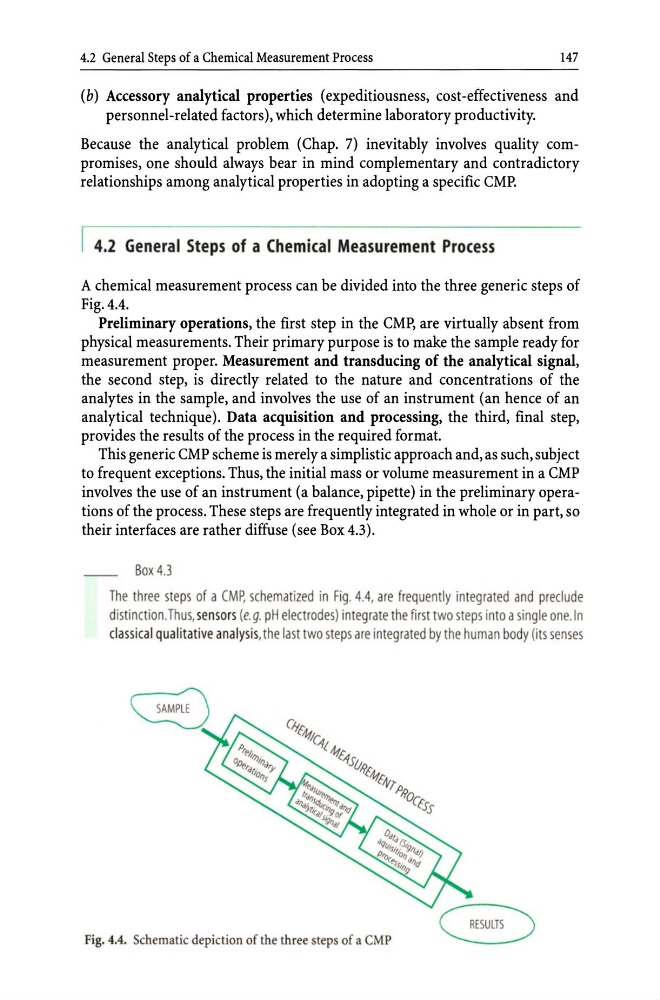
A chemical measurement process can be divided into the three generic steps of
Fig. 4.4.
Preliminary operations, the first step in the CMP, are virtually absent from
physical measurements. Their primary purpose is to make the sample ready for
measurement proper. Measurement and transducing of the analytical signal,
the second step, is directly related to the nature and concentrations of the
analytes in the sample, and involves the use of an instrument (an hence of an
analytical technique). Data acquisition and processing, the third, final step,
provides the results of the process in the required format.
This generic eMP scheme is merely a simplistic approach and, as such, subject
to frequent exceptions. Thus, the initial mass or volume measurement in a eMP
involves the use of an instrument (a balance, pipette) in the preliminary operations of the process. These steps are frequently integrated in whole or in part, so
their interfaces are rather diffuse (see Box 4.3).
Box 4.3
The three steps of a CMp, schematized in Fig. 4.4, are frequently integrated and preclude
distinction.Thus, sensors (e. g. pH electrodes) integrate the first two steps into a single one. In
classical qual itative ana lysis, the last two steps are integrated by the human body (its senses
Fig. 4.4. Schematic depiction of the three steps of a CMP
147
(b) Accessory analytical properties (expeditiousness, cost-effectiveness and
personnel-related factors), which determine laboratory productivity.
Because the analytical problem (Chap. 7) inevitably involves quality compromises, one should always bear in mind complementary and contradictory
relationships among analytical properties in adopting a specific eMP.
4.2 General Steps of a Chemical Measurement Process
A chemical measurement process can be divided into the three generic steps of
Fig. 4.4.
Preliminary operations, the first step in the CMP, are virtually absent from
physical measurements. Their primary purpose is to make the sample ready for
measurement proper. Measurement and transducing of the analytical signal,
the second step, is directly related to the nature and concentrations of the
analytes in the sample, and involves the use of an instrument (an hence of an
analytical technique). Data acquisition and processing, the third, final step,
provides the results of the process in the required format.
This generic eMP scheme is merely a simplistic approach and, as such, subject
to frequent exceptions. Thus, the initial mass or volume measurement in a eMP
involves the use of an instrument (a balance, pipette) in the preliminary operations of the process. These steps are frequently integrated in whole or in part, so
their interfaces are rather diffuse (see Box 4.3).
Box 4.3
The three steps of a CMp, schematized in Fig. 4.4, are frequently integrated and preclude
distinction.Thus, sensors (e. g. pH electrodes) integrate the first two steps into a single one. In
classical qual itative ana lysis, the last two steps are integrated by the human body (its senses
Fig. 4.4. Schematic depiction of the three steps of a CMP