

3.5 Analytical Chemical Standards
127
Box 3.14
Use of an internal standard
Internal standards are related to both equipment and method calibration as they are
primari ly intended to minimize fluctua tions in instrument readings and to assist in the
development of qualitative and quantitative references. The internal standard (IS) is always
different from that used for conventional ca libration and is added to both samples and
standards. Measurements (of analytes and standards) are standardized with respect to the
value provided by the IS.
Qualitative purposes
Used with I standards samples
Quantitative purposes
Internal standards should be compatible with the sample (e. g. miscible with it); also, they
should be chemically and physico-chemically similar to the analytes but depart clearly from
them as rega rds the signals produced.
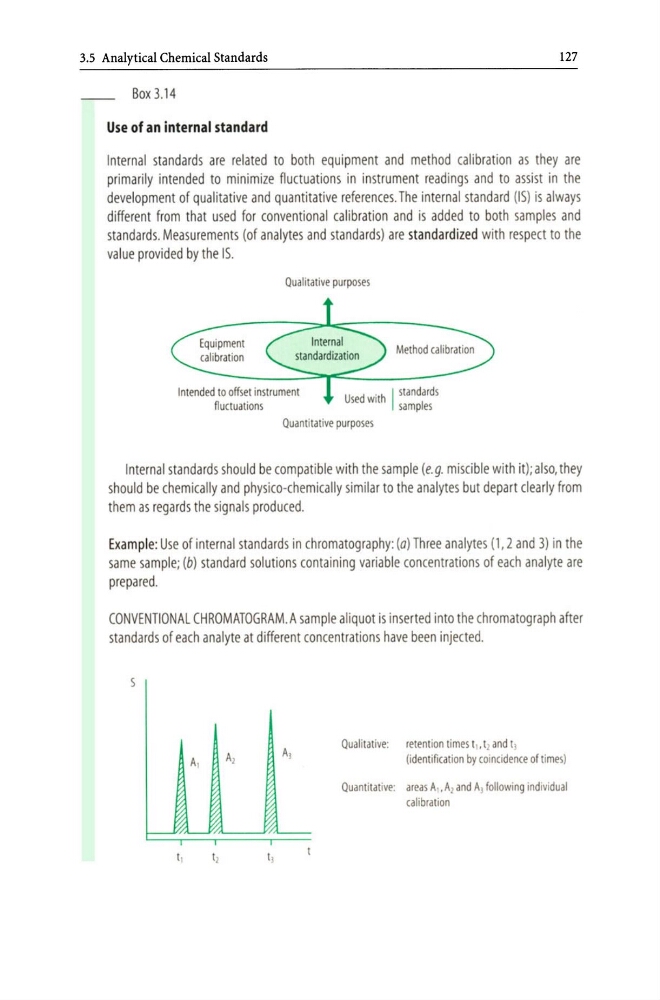
Example: Use of internal standa rds in chromatography: (a) Three analytes (1,2 and 3) in the
same sam ple; (b) standard solutions containing variable concentrations of each analyte are
prepared,
CONVENTIONAL CHROMATOGRAM,A sample aliquot is inserted into the chromatograph after
standards of each analyte at different concentrations have been injected.
s
AI
Qualitative: retention times tl , ti and t1
(identification by coincidence or times)
Quantitative: areas AI. Al and AJ following individual
calibration
127
Box 3.14
Use of an internal standard
Internal standards are related to both equipment and method calibration as they are
primari ly intended to minimize fluctua tions in instrument readings and to assist in the
development of qualitative and quantitative references. The internal standard (IS) is always
different from that used for conventional ca libration and is added to both samples and
standards. Measurements (of analytes and standards) are standardized with respect to the
value provided by the IS.
Qualitative purposes
Used with I standards samples
Quantitative purposes
Internal standards should be compatible with the sample (e. g. miscible with it); also, they
should be chemically and physico-chemically similar to the analytes but depart clearly from
them as rega rds the signals produced.
Example: Use of internal standa rds in chromatography: (a) Three analytes (1,2 and 3) in the
same sam ple; (b) standard solutions containing variable concentrations of each analyte are
prepared,
CONVENTIONAL CHROMATOGRAM,A sample aliquot is inserted into the chromatograph after
standards of each analyte at different concentrations have been injected.
s
AI
Qualitative: retention times tl , ti and t1
(identification by coincidence or times)
Quantitative: areas AI. Al and AJ following individual
calibration