

122
01 SPEC
03 SPEC
OS SPEC
081(
09 SPEC
12 SPEC
13 SPEC
15 SPEC
021C
04IC
OS IC
06IC
07lC
10 I(
111(
14iC
IM£ANSI
3 Traceability: Reference Materials
190
200
210
220
230
240
+ ...... + ...... + ...... + ...... + ...... + ...... + ...... + ...... + ...... + ...... +
... -.-~
I
... --.--~
I
: .... ~
... _._~
1
1
... --.--~ 1
1 .... ~
,
... --- . - --~
... -- --- -. -: - - ---~
1
... --. -- ~ 1
.... ~ 1
.... ~
1
... ·~ I
1+ ...
1
.... ~
1 ... __ • __ ~
1
1
+ - .. -- ..
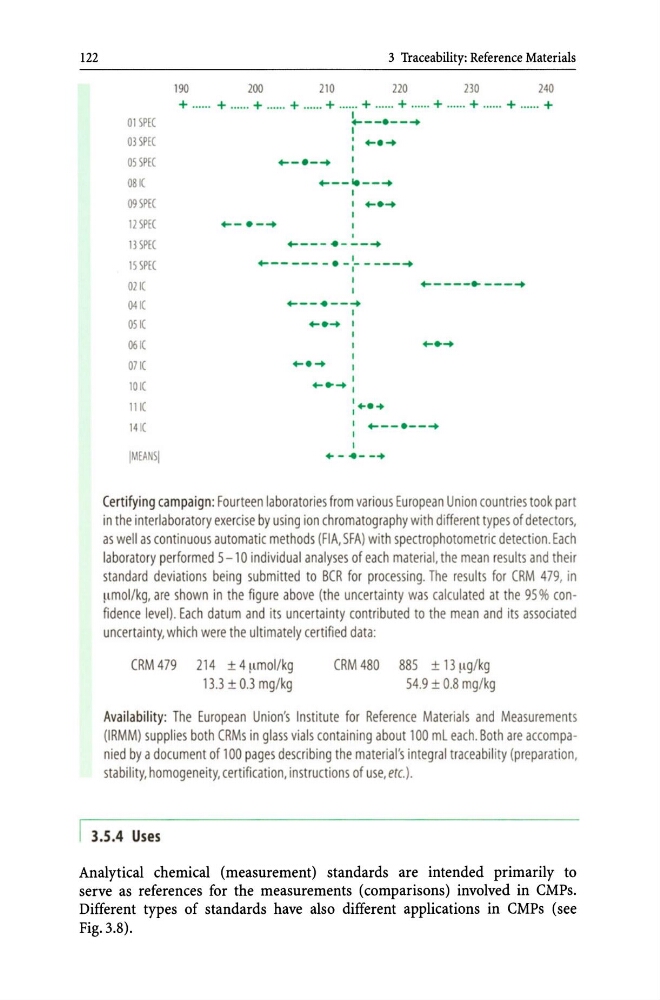
Certifying campaign: Fourteen laboratories from various European Union countries took part
in the interlaboratory exercise by using ion chromatography with different types of detectors,
as well as continuous automatic methods (FIA, SFA) with spectrophotometric detection. Each
laboratory performed 5 -10 individual ana lyses of each material, the mean results and their
standard deviations being submitted to BCR for processing. The results for CRM 479, in
~lmol/kg, are shown in the figure above (the uncertainty was calculated at the 95% confidence level). Each datum and its uncertainty contributed to the mean and its associated
uncertainty, which were the ultimately certified data:
CRM 479 214 ± 4 ~lmol/kg
CRM 480 885 ± 13 ~lg/kg
13.3 ± OJ mg/kg
54.9 ± 0.8 mg/kg
Availability: The European Union's Institute for Reference Materials and Measurements
(IRMM) supplies both CRMs in glass vials containing about 100 mL each. Both are accompanied by a document of 100 pages describing the material's integral traceabil ity (preparation,
stability, homogeneity, certification, instructions of use, ere).
3.5.4 Uses
Analytical chemical (measurement) standards are intended primarily to
serve as references for the measurements (comparisons) involved in CMPs.
Different types of standards have also different applications in CMPs (see
Fig. 3.8).
01 SPEC
03 SPEC
OS SPEC
081(
09 SPEC
12 SPEC
13 SPEC
15 SPEC
021C
04IC
OS IC
06IC
07lC
10 I(
111(
14iC
IM£ANSI
3 Traceability: Reference Materials
190
200
210
220
230
240
+ ...... + ...... + ...... + ...... + ...... + ...... + ...... + ...... + ...... + ...... +
... -.-~
I
... --.--~
I
: .... ~
... _._~
1
1
... --.--~ 1
1 .... ~
,
... --- . - --~
... -- --- -. -: - - ---~
1
... --. -- ~ 1
.... ~ 1
.... ~
1
... ·~ I
1+ ...
1
.... ~
1 ... __ • __ ~
1
1
+ - .. -- ..
Certifying campaign: Fourteen laboratories from various European Union countries took part
in the interlaboratory exercise by using ion chromatography with different types of detectors,
as well as continuous automatic methods (FIA, SFA) with spectrophotometric detection. Each
laboratory performed 5 -10 individual ana lyses of each material, the mean results and their
standard deviations being submitted to BCR for processing. The results for CRM 479, in
~lmol/kg, are shown in the figure above (the uncertainty was calculated at the 95% confidence level). Each datum and its uncertainty contributed to the mean and its associated
uncertainty, which were the ultimately certified data:
CRM 479 214 ± 4 ~lmol/kg
CRM 480 885 ± 13 ~lg/kg
13.3 ± OJ mg/kg
54.9 ± 0.8 mg/kg
Availability: The European Union's Institute for Reference Materials and Measurements
(IRMM) supplies both CRMs in glass vials containing about 100 mL each. Both are accompanied by a document of 100 pages describing the material's integral traceabil ity (preparation,
stability, homogeneity, certification, instructions of use, ere).
3.5.4 Uses
Analytical chemical (measurement) standards are intended primarily to
serve as references for the measurements (comparisons) involved in CMPs.
Different types of standards have also different applications in CMPs (see
Fig. 3.8).