

3.4 Types of Standards and their Traceability
109
standard, is kept by a national body in each country and is periodically checked against the
Paris kilogram. The mass of the Spanish prototype is 0.999999890 kg, with a combined uncertainty of 2.3 ~lg. First-class transfer weights are periodically checked against the national
standard and used by competent public or private bodies engaged on assuring the quality of
mass measurements. On another step in the ranking below are second-class transfer weights,
which are periodically checked against first-class weights and used to calibrate balances (of
wide use in the physical and chemical fields).
The traceability of the amount of mass in a weight used for calibration is established via
the serial comparisons inherent in the above ranking. In addition to establishing the amount
of mass, one should determine the combined uncertainty of the checking operations as a
whole. Calibrating a balance without consideration of the uncertainty involved is rather a
frequent mistake in practice.
Base standards coincide with the seven 51 base units for measuring time
(second), length (meter), electric current (ampere), thermodynamic temperature
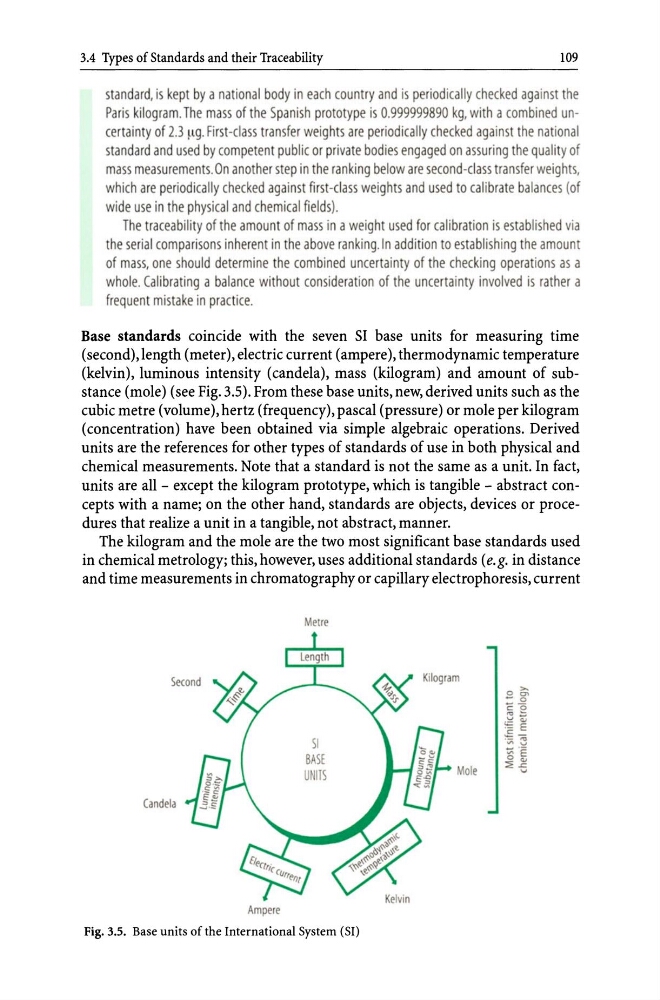
(kelvin), luminous intensity (candela), mass (kilogram) and amount of substance (mole) (see Fig. 3.5). From these base units, new, derived units such as the
cubic metre (volume), hertz (frequency), pascal (pressure) or mole per kilogram
(concentration) have been obtained via simple algebraic operations. Derived
units are the references for other types of standards of use in both physical and
chemical measurements. Note that a standard is not the same as a unit. In fact,
units are all- except the kilogram prototype, which is tangible - abstract concepts with a name; on the other hand, standards are objects, devices or procedures that realize a unit in a tangible, not abstract, manner.
The kilogram and the mole are the two most significant base standards used
in chemical metrology; this, however, uses additional standards (e. g. in distance
and time measurements in chromatography or capillary electrophoresis, current
Metre
Mole
Candela
Ampere
Fig. 3.5. Base units of the International System (SI)
109
standard, is kept by a national body in each country and is periodically checked against the
Paris kilogram. The mass of the Spanish prototype is 0.999999890 kg, with a combined uncertainty of 2.3 ~lg. First-class transfer weights are periodically checked against the national
standard and used by competent public or private bodies engaged on assuring the quality of
mass measurements. On another step in the ranking below are second-class transfer weights,
which are periodically checked against first-class weights and used to calibrate balances (of
wide use in the physical and chemical fields).
The traceability of the amount of mass in a weight used for calibration is established via
the serial comparisons inherent in the above ranking. In addition to establishing the amount
of mass, one should determine the combined uncertainty of the checking operations as a
whole. Calibrating a balance without consideration of the uncertainty involved is rather a
frequent mistake in practice.
Base standards coincide with the seven 51 base units for measuring time
(second), length (meter), electric current (ampere), thermodynamic temperature
(kelvin), luminous intensity (candela), mass (kilogram) and amount of substance (mole) (see Fig. 3.5). From these base units, new, derived units such as the
cubic metre (volume), hertz (frequency), pascal (pressure) or mole per kilogram
(concentration) have been obtained via simple algebraic operations. Derived
units are the references for other types of standards of use in both physical and
chemical measurements. Note that a standard is not the same as a unit. In fact,
units are all- except the kilogram prototype, which is tangible - abstract concepts with a name; on the other hand, standards are objects, devices or procedures that realize a unit in a tangible, not abstract, manner.
The kilogram and the mole are the two most significant base standards used
in chemical metrology; this, however, uses additional standards (e. g. in distance
and time measurements in chromatography or capillary electrophoresis, current
Metre
Mole
Candela
Ampere
Fig. 3.5. Base units of the International System (SI)