

90
2 Analytical Properties
Accuracy
• ie, the value held as true and the result of operating under near-excellence conditions, will be given by
X' = 3.45 ± 0.02 }lglkg
• One can refer to accuracy since an appropriate reference, X', is available.
• It is accuracy of a method since one intends to obtain the mean X of 6 results and,
specifically, to quantify the bias (n < 30).
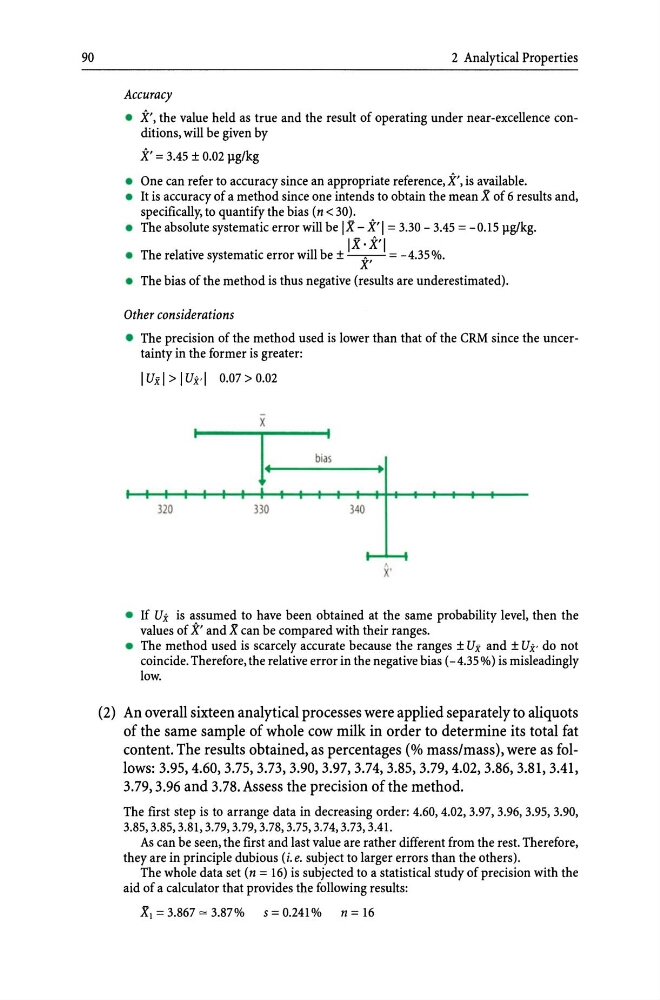
• The absolute systematic error will be IX - X'I = 3.30 - 3.45 = -0.15 }lglkg.
IX·X'I
• The relative systematic error will be ± - , - = -4.35%.
X'
• The bias of the method is thus negative (results are underestimated).
Other considerations
• The precision of the method used is lower than that of the CRM since the uncertainty in the former is greater:
I Ug I > lUx' I 0.07> 0.02
x
1
bias
4
320
330
340
h
X'
• If Ux is assumed to have been obtained at the same probability level, then the
values of X' and X can be compared with their ranges.
• The method used is scarcely accurate because the ranges ± Ug and ± Ux' do not
coincide. Therefore, the relative error in the negative bias (- 4.35 %) is misleadingly
low.
(2) An overall sixteen analytical processes were applied separately to aliquots
of the same sample of whole cow milk in order to determine its total fat
content. The results obtained, as percentages (% mass/mass), were as follows: 3.95,4.60,3.75,3.73,3.90,3.97,3.74,3.85,3.79, 4.02, 3.86, 3.81, 3.41,
3.79,3.96 and 3.78. Assess the precision of the method.
The first step is to arrange data in decreasing order: 4.60,4.02,3.97, 3.96, 3.95, 3.90,
3.85,3.85, 3.81, 3.79,3.79, 3.78, 3.75, 3.74, 3.73, 3.4l.
As can be seen, the first and last value are rather different from the rest. Therefore,
they are in principle dubious (i. e. subject to larger errors than the others).
The whole data set (n = 16) is subjected to a statistical study of precision with the
aid of a calculator that provides the following results:
Xl = 3.867 = 3.87% s = 0.241 % n = 16
2 Analytical Properties
Accuracy
• ie, the value held as true and the result of operating under near-excellence conditions, will be given by
X' = 3.45 ± 0.02 }lglkg
• One can refer to accuracy since an appropriate reference, X', is available.
• It is accuracy of a method since one intends to obtain the mean X of 6 results and,
specifically, to quantify the bias (n < 30).
• The absolute systematic error will be IX - X'I = 3.30 - 3.45 = -0.15 }lglkg.
IX·X'I
• The relative systematic error will be ± - , - = -4.35%.
X'
• The bias of the method is thus negative (results are underestimated).
Other considerations
• The precision of the method used is lower than that of the CRM since the uncertainty in the former is greater:
I Ug I > lUx' I 0.07> 0.02
x
1
bias
4
320
330
340
h
X'
• If Ux is assumed to have been obtained at the same probability level, then the
values of X' and X can be compared with their ranges.
• The method used is scarcely accurate because the ranges ± Ug and ± Ux' do not
coincide. Therefore, the relative error in the negative bias (- 4.35 %) is misleadingly
low.
(2) An overall sixteen analytical processes were applied separately to aliquots
of the same sample of whole cow milk in order to determine its total fat
content. The results obtained, as percentages (% mass/mass), were as follows: 3.95,4.60,3.75,3.73,3.90,3.97,3.74,3.85,3.79, 4.02, 3.86, 3.81, 3.41,
3.79,3.96 and 3.78. Assess the precision of the method.
The first step is to arrange data in decreasing order: 4.60,4.02,3.97, 3.96, 3.95, 3.90,
3.85,3.85, 3.81, 3.79,3.79, 3.78, 3.75, 3.74, 3.73, 3.4l.
As can be seen, the first and last value are rather different from the rest. Therefore,
they are in principle dubious (i. e. subject to larger errors than the others).
The whole data set (n = 16) is subjected to a statistical study of precision with the
aid of a calculator that provides the following results:
Xl = 3.867 = 3.87% s = 0.241 % n = 16