

Seminars: Numerical Problems
89
I Seminars: Numerical Problems
Group 1
• Learning objective
• To introduce the basic statistical concepts required to characterize
accuracy, precision and uncertainty.
(1) Samples of a certified reference material (CRM) were used to assess the
accuracy and precision of a method for the determination of a pesticide.
Six individual applications of the method provided the following results:
3.21,3.30,3.35,3.28,3.40 and 3.25 }lg/kg. The CRM was certified to contain an amount of pesticide of 3.45 ± 0.02 }lg/kg. Calculate and discuss the
parameters that define accuracy, precision and uncertainty.
Precision
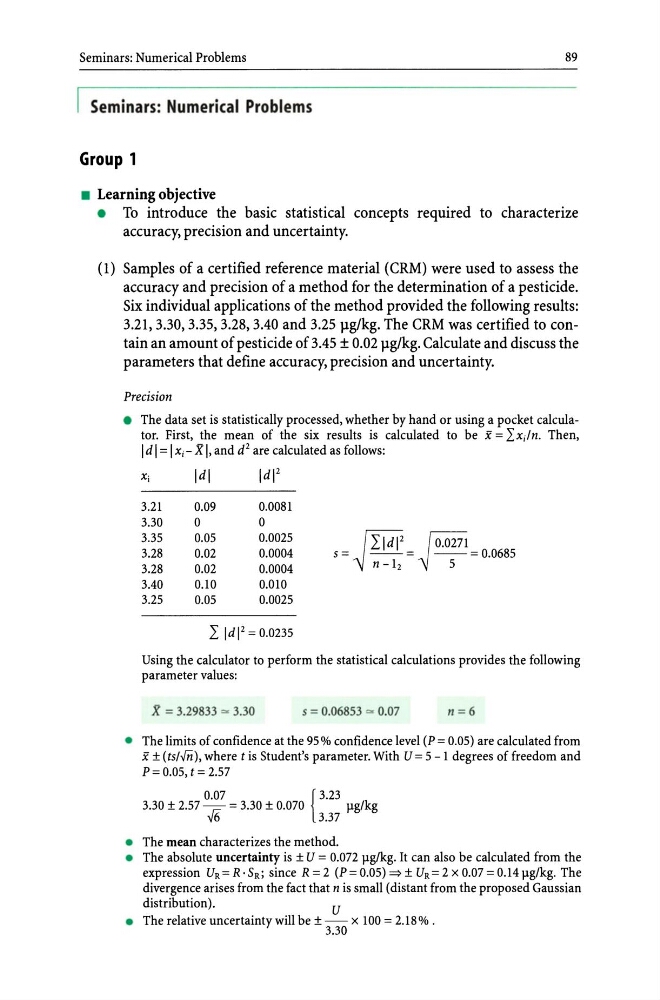
• The data set is statistically processed, whether by hand or using a pocket calculator. First, the mean of the six results is calculated to be x = LXi/n. Then,
1 d 1 = 1 Xi - X I, and d 2 are calculated as follows:
Xi
Idl
Idl 2
3.21
0.09
0.0081
3.30
0
0
3.35
0.05
0.0025
s = ~ lldl
2
= ~ 0.0271 = 0.0685
3.28
0.02
0.0004
3.28
0.02
0.0004
n -1 2
5
3.40
0.10
0.010
3.25
0.05
0.0025
L Idl 2 = 0.0235
Using the calculator to perform the statistical calculations provides the following
parameter values:
x = 3.29833 "" 3.30
s = 0.06853 =- 0.07
n=6
• The limits of confidence at the 95% confidence level (P = 0.05) are calculated from
x ± (ts/rn), where t is Student's parameter. With U = 5 - 1 degrees of freedom and
P = 0.05, t = 2.57
0.07
{3.23
3.30 ± 2.57 --;:;:- = 3.30 ± 0.070
}lg/kg
v6
3.37
• The mean characterizes the method.
• The absolute uncertainty is ± U = 0.072 }lglkg. It can also be calculated from the
expression UR = R . SR; since R = 2 (P = 0.05) ~ ± UR = 2 x 0.07 = 0.14 }lglkg. The
divergence arises from the fact that n is small (distant from the proposed Gaussian
distribution).
U
• The relative uncertainty will be ± -
x 100 = 2.18 % .
3.30
89
I Seminars: Numerical Problems
Group 1
• Learning objective
• To introduce the basic statistical concepts required to characterize
accuracy, precision and uncertainty.
(1) Samples of a certified reference material (CRM) were used to assess the
accuracy and precision of a method for the determination of a pesticide.
Six individual applications of the method provided the following results:
3.21,3.30,3.35,3.28,3.40 and 3.25 }lg/kg. The CRM was certified to contain an amount of pesticide of 3.45 ± 0.02 }lg/kg. Calculate and discuss the
parameters that define accuracy, precision and uncertainty.
Precision
• The data set is statistically processed, whether by hand or using a pocket calculator. First, the mean of the six results is calculated to be x = LXi/n. Then,
1 d 1 = 1 Xi - X I, and d 2 are calculated as follows:
Xi
Idl
Idl 2
3.21
0.09
0.0081
3.30
0
0
3.35
0.05
0.0025
s = ~ lldl
2
= ~ 0.0271 = 0.0685
3.28
0.02
0.0004
3.28
0.02
0.0004
n -1 2
5
3.40
0.10
0.010
3.25
0.05
0.0025
L Idl 2 = 0.0235
Using the calculator to perform the statistical calculations provides the following
parameter values:
x = 3.29833 "" 3.30
s = 0.06853 =- 0.07
n=6
• The limits of confidence at the 95% confidence level (P = 0.05) are calculated from
x ± (ts/rn), where t is Student's parameter. With U = 5 - 1 degrees of freedom and
P = 0.05, t = 2.57
0.07
{3.23
3.30 ± 2.57 --;:;:- = 3.30 ± 0.070
}lg/kg
v6
3.37
• The mean characterizes the method.
• The absolute uncertainty is ± U = 0.072 }lglkg. It can also be calculated from the
expression UR = R . SR; since R = 2 (P = 0.05) ~ ± UR = 2 x 0.07 = 0.14 }lglkg. The
divergence arises from the fact that n is small (distant from the proposed Gaussian
distribution).
U
• The relative uncertainty will be ± -
x 100 = 2.18 % .
3.30