

86
2 Analytical Properties
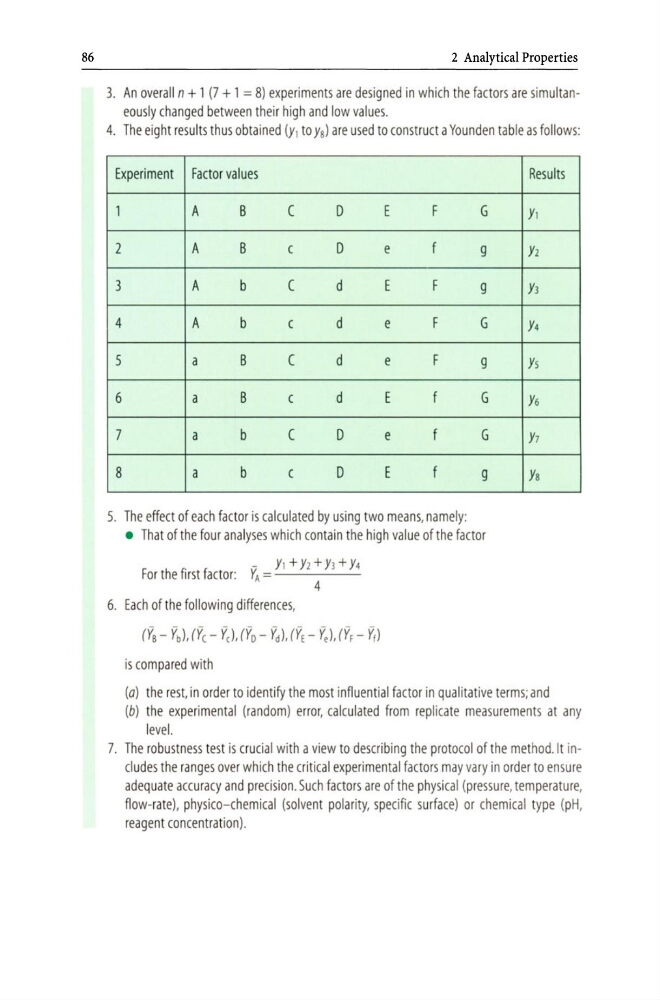
3. An overall n + 1 (7 + 1 = 8) experiments are designed in which the factors are simultaneously changed between their high and low values.
4. The eight results thus obtained (Y I to Ya) are used to construct a Younden table as follows:
Experiment Factor values
1
A
B
C
D
E
F
G
2
A
B
c
D
e
f
9
3
A
b
C
d
E
F
g
4
A
b
c
d
e
F
G
5
a
B
C
d
e
F
g
6
a
B
c
d
E
f
G
7
a
b
C
D
e
f
G
8
a
b
c
D
E
f
9
5. The effect of each factor is calculated by using two means, namely:
• That of the four analyses which contain the high value of the factor
- YI + Y2 + Y l + Y4
For the first factor: YA = - - - - -
4
6. Each of the following differences,
rY B - Yb l. ry c - Y ,), ry o - Y d ), rYE - Y e ), rYF - Y f)
is compared with
Results
YI
Y2
Yl
Y4
Ys
Y6
Y7
Y s
(a) the rest, in order to identify the most innuential factor in qualitative terms; and
(b) the experimental (random) error, calculated from replicate measurements at any
level.
7. The robustness test is crucial with a view to describing the protocol of the method. It includes the ranges over wh ich the critical experimental factors may vary in order to ensure
adequate accuracy and precision. Such factors are of the physical (pressu re, temperature,
now-rate), physico- chemical (solvent polarity, speci fic surface) or chemical type (pH,
reagent concentration ).
2 Analytical Properties
3. An overall n + 1 (7 + 1 = 8) experiments are designed in which the factors are simultaneously changed between their high and low values.
4. The eight results thus obtained (Y I to Ya) are used to construct a Younden table as follows:
Experiment Factor values
1
A
B
C
D
E
F
G
2
A
B
c
D
e
f
9
3
A
b
C
d
E
F
g
4
A
b
c
d
e
F
G
5
a
B
C
d
e
F
g
6
a
B
c
d
E
f
G
7
a
b
C
D
e
f
G
8
a
b
c
D
E
f
9
5. The effect of each factor is calculated by using two means, namely:
• That of the four analyses which contain the high value of the factor
- YI + Y2 + Y l + Y4
For the first factor: YA = - - - - -
4
6. Each of the following differences,
rY B - Yb l. ry c - Y ,), ry o - Y d ), rYE - Y e ), rYF - Y f)
is compared with
Results
YI
Y2
Yl
Y4
Ys
Y6
Y7
Y s
(a) the rest, in order to identify the most innuential factor in qualitative terms; and
(b) the experimental (random) error, calculated from replicate measurements at any
level.
7. The robustness test is crucial with a view to describing the protocol of the method. It includes the ranges over wh ich the critical experimental factors may vary in order to ensure
adequate accuracy and precision. Such factors are of the physical (pressu re, temperature,
now-rate), physico- chemical (solvent polarity, speci fic surface) or chemical type (pH,
reagent concentration ).