

290
A. Berkessel
2.3
Enantiomerically Pure α- and β-Amino Acids
from the Dynamic Kinetic Resolution of Azlactones
and the Kinetic Resolution of Oxazinones
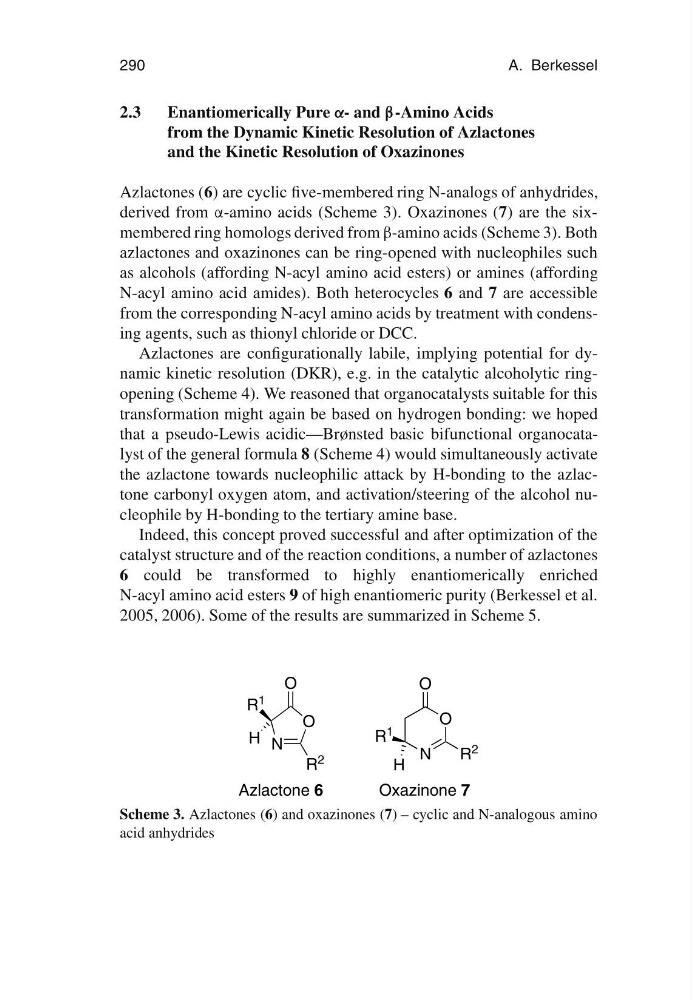
Azlactones (6) are cyclic five-membered ring N-analogs of anhydrides,
derived from α-amino acids (Scheme 3). Oxazinones (7) are the sixmembered ring homologs derived from β-amino acids (Scheme 3). Both
azlactones and oxazinones can be ring-opened with nucleophiles such
as alcohols (affording N-acyl amino acid esters) or amines (affording
N-acyl amino acid amides). Both heterocycles 6 and 7 are accessible
from the corresponding N-acyl amino acids by treatment with condensing agents, such as thionyl chloride or DCC.
Azlactones are configurationally labile, implying potential for dynamic kinetic resolution (DKR), e.g. in the catalytic alcoholytic ringopening (Scheme 4). We reasoned that organocatalysts suitable for this
transformation might again be based on hydrogen bonding: we hoped
that a pseudo-Lewis acidic—Brønsted basic bifunctional organocatalyst of the general formula 8 (Scheme 4) would simultaneously activate
the azlactone towards nucleophilic attack by H-bonding to the azlactone carbonyl oxygen atom, and activation/steering of the alcohol nucleophile by H-bonding to the tertiary amine base.
Indeed, this concept proved successful and after optimization of the
catalyst structure and of the reaction conditions, a number of azlactones
6 could be transformed to highly enantiomerically enriched
N-acyl amino acid esters 9 of high enantiomeric purity (Berkessel et al.
2005, 2006). Some of the results are summarized in Scheme 5.
Scheme 3. Azlactones (6) and oxazinones (7) – cyclic and N-analogous amino
acid anhydrides