

270
S. Breitenlechner, P. Selig, T. Bach
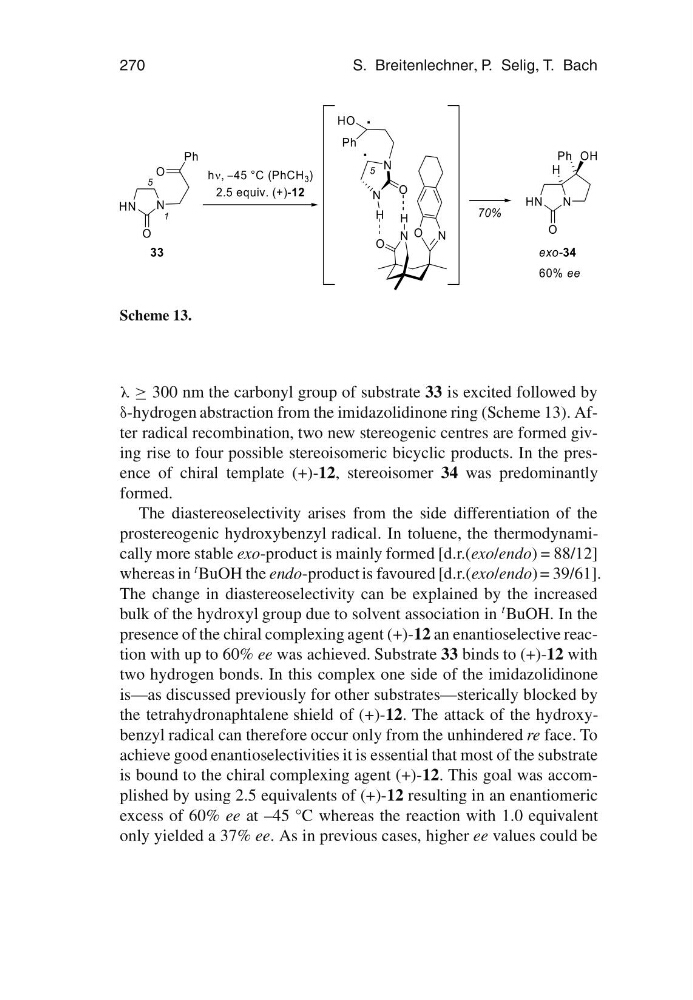
Scheme 13.
λ ≥ 300 nm the carbonyl group of substrate 33 is excited followed by
δ-hydrogen abstraction from the imidazolidinone ring (Scheme 13). After radical recombination, two new stereogenic centres are formed giving rise to four possible stereoisomeric bicyclic products. In the presence of chiral template (+)-12, stereoisomer 34 was predominantly
formed.
The diastereoselectivity arises from the side differentiation of the
prostereogenic hydroxybenzyl radical. In toluene, the thermodynamically more stable exo-product is mainly formed [d.r.(exo/endo) = 88/12]
whereas in
t BuOH the endo-product is favoured [d.r.(exo/endo) = 39/61].
The change in diastereoselectivity can be explained by the increased
bulk of the hydroxyl group due to solvent association in
t BuOH. In the
presence of the chiral complexing agent (+)-12 an enantioselective reaction with up to 60% ee was achieved. Substrate 33 binds to (+)-12 with
two hydrogen bonds. In this complex one side of the imidazolidinone
is—as discussed previously for other substrates—sterically blocked by
the tetrahydronaphtalene shield of (+)-12. The attack of the hydroxybenzyl radical can therefore occur only from the unhindered re face. To
achieve good enantioselectivities it is essential that most of the substrate
is bound to the chiral complexing agent (+)-12. This goal was accomplished by using 2.5 equivalents of (+)-12 resulting in an enantiomeric
excess of 60% ee at –45 °C whereas the reaction with 1.0 equivalent
only yielded a 37% ee. As in previous cases, higher ee values could be